

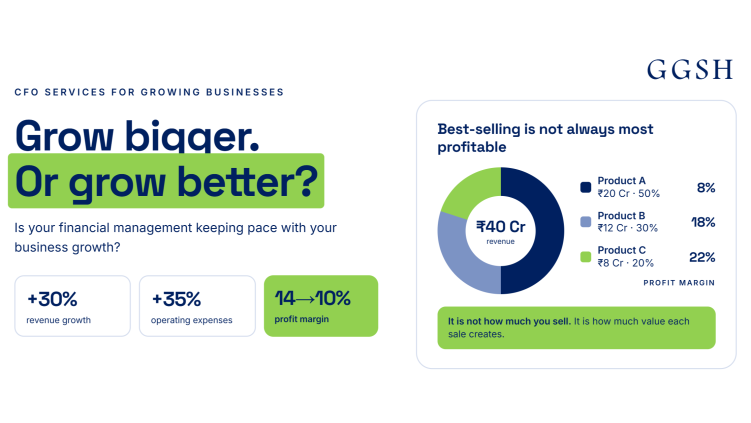
More revenue. More customers. More employees. More opportunities. But is your “Financial Management” keeping pace with your business growth?
Imagine a business that started with an annual turnover of ₹10 crore. Three years later, it has grown to ₹50 crore. Sales are strong, the team has expanded, new markets are opening up and business seems to be doing well.
Yet, the promoter has a few unanswered questions.
- Why is the bank balance constantly under pressure despite increasing sales?
- Which products or business segments are actually generating the best margins?
- Can the business afford another expansion?
- How much working capital will be required over the next six months?
- Are rising expenses eating into profitability?
These are not accounting questions alone. They are business decisions with financial consequences.
Here is the catch: "Growing a business" and "managing its finances" are two very different challenges.As organisations move from ₹5 crore to ₹50 crore, ₹100 crore or even ₹250 crore in revenue, financial decisions become increasingly complex. What once worked through spreadsheets, periodic reviews and the promoter’s understanding of the business may no longer be sufficient.
This is where a CFO services become relevant!
1. Your Sales Are Growing. But Is Your Business Actually Making More Money?
Revenue is a visible measure of growth. Profitability and cash flow reveal whether that growth is sustainable.
Consider this example:
A company records a 30% increase in annual revenue, growing from ₹40 crore to ₹52 crore. At first glance, this looks like excellent progress.
But during the same period:
- Operating expenses increase by 35%.
- Customer payment cycles extend from 45 to 75 days.
- Inventory holding increases significantly.
- Profit margins decline from 14% to 10%.
The business is selling more, but its financial efficiency is weakening.
A 30% increase in revenue does not necessarily mean a 30% improvement in business performance.
A CFO helps management look beyond topline growth and understand the numbers behind it. This includes analysing profitability, monitoring costs, evaluating working capital and identifying areas that require corrective action.Because ultimately, the objective is not just to grow bigger. It is to grow better!
2. The Bank Balance Looks Healthy. But How Much of It Is Actually Available?
One of the most common misconceptions in business is that profitability and cash availability mean the same thing.
They don’t.
A company may report ₹5 crore in annual profits and still struggle to meet its immediate payment obligations.
How?
- Customers have not paid their outstanding invoices.
- Inventory is occupying significant working capital.
- Supplier payments are due.
- Salaries, taxes, interest and other obligations are approaching.
- Expansion activities are consuming cash faster than expected.
This creates a situation where the business is profitable on paper but financially stretched in practice.
Profit is an accounting measure. Cash flow is a survival measure.
CFO services bring greater discipline to cash-flow management through forecasting, receivables monitoring, payables planning and working-capital analysis.For instance, identifying a potential ₹2 crore cash-flow gap three months in advance gives management time to plan collections, negotiate payment terms or arrange suitable funding.
Identifying the same gap when salaries are due is a very different story.
3. What If Your Best-Selling Product Is Not Your Most Profitable One?
A business may have multiple products, services, customers, locations or business verticals. But are all of them contributing equally to profitability?
Consider a company with three major product categories:

Product A generates the highest revenue. However, Product C delivers a significantly higher profit margin.
Without product-level profitability analysis, management may continue allocating most of its resources to the highest-selling category while overlooking better opportunities.
CFO-led financial analysis helps businesses understand:
- Product-wise and customer-wise profitability.
- Cost structures and contribution margins.
- Pricing effectiveness.
- Unprofitable business segments.
- Opportunities to improve operational efficiency.
The question is not just how much you sell. It is how much value each sale creates.
4. Expansion Is Exciting. But Have You Calculated What It Will Cost?
A new factory, additional branch, larger warehouse, new product line or entry into another market can be exciting milestones.
But every expansion comes with financial commitments.
Before taking the leap, management should understand:
- What is the total investment required?
- How much funding should come from internal accruals and external borrowing?
- What revenue is required to break even?
- How long will it take to recover the investment?
- What happens if projected sales are delayed by six months?
- Can existing operations sustain the additional financial burden?
A financial projection can help management evaluate different scenarios before committing capital.
For example, a proposed ₹10 crore expansion may appear attractive based on projected revenue. But what if actual utilisation reaches only 60% in the first year?
Scenario analysis helps management understand the financial implications of both favourable and unfavourable outcomes.
Growth decisions should be driven by opportunity, but backed by financial preparedness.
5. Your Accounts Team Is Doing Its Job. But Who Is Connecting the Numbers to Business Decisions?
As businesses expand, their finance and accounts functions naturally grow.
There may be accountants handling transactions, executives managing compliance, finance managers overseeing reporting and external professionals supporting taxation and audits.
Yet, an important gap can remain.
Who is looking at the overall financial picture?
Who is connecting revenue trends with margins, cash flow, business risks and future investment requirements?
Who is presenting management with the financial implications of important decisions?
This is where the CFO function becomes valuable.
While accounting focuses largely on recording and reporting financial transactions, CFO-level leadership uses that information to guide business performance and future planning.
An effective CFO function can bring together:
- Management Information System (MIS) reporting.
- Financial planning and budgeting.
- Cash-flow forecasting.
- Working-capital management.
- Financial performance analysis.
- Cost optimisation.
- Business projections and scenario planning.
- Strategic financial decision support.
The idea is not to replace the existing finance team. It is to strengthen the function by adding financial interpretation, planning and leadership.6. Do You Really Need a Full-Time CFO to Think Like One?
Not necessarily.
Hiring a full-time CFO may not always be commercially practical, even for businesses with substantial revenue. The requirement depends on the organisation’s scale, operational complexity, financial structure and strategic priorities.
Businesses can explore different engagement models:
Full-time CFO: A dedicated senior finance leader responsible for the organisation’s overall financial strategy and function.
Part-time CFO: Senior financial leadership for a defined number of days or hours, based on business requirements.
Virtual CFO: Ongoing CFO-level financial oversight and advisory support delivered through a structured remote engagement.
Outsourced CFO: An external arrangement through which an organisation accesses defined CFO capabilities without building the entire function internally.
The right model depends on the level of involvement required, the existing finance team’s capabilities and the complexity of business operations.
What matters is not necessarily having a CFO on the payroll. It is having the right financial leadership when important decisions need to be made.
7. What Should You Look for Before Engaging a CFO Services Partner?
CFO services should go beyond preparing reports and presenting spreadsheets.
A useful engagement should help management understand what the numbers mean and what actions may be required.
Before choosing a partner, consider the following:
1. Business understanding: Does the provider understand your industry, business model, revenue streams and operational challenges?
2. Financial visibility: Will you receive timely MIS reports, cash-flow projections and meaningful performance insights?
3. Decision support: Can the engagement help evaluate expansion, investments, borrowing, pricing and profitability?
4. Defined deliverables: Are reporting frequency, responsibilities, review meetings and expected outcomes clearly established?
5. Integration with existing teams: Can the CFO partner work effectively with your internal accounts and finance teams, auditors and other professionals?
Ultimately, the value of CFO services should be measured by the quality of financial visibility and decision-making they bring to the organisation.
Conclusion: The Next Stage of Growth Needs a Different Financial Perspective
A business that grows from ₹5 crore to ₹50 crore cannot always continue managing its finances the way it did at ₹5 crore.
More transactions mean more complexity. More employees mean higher financial commitments. More customers mean greater working-capital requirements. More opportunities mean more decisions involving capital and risk.
At every stage of growth, financial management must evolve alongside the business.Accurate accounting tells you where your business stands. Financial planning helps you understand where it could go. Strategic financial leadership helps you evaluate the journey ahead.
For business owners and management teams, this is an important distinction to consider while planning the next phase of growth.
To understand how structured CFO solutions can fit into your organisation, explore GGSH’s CFO Solutions or schedule a free diagnostic call.
Frequently Asked Questions
1. What are CFO services for growing businesses?
CFO services provide financial leadership and advisory support in areas such as budgeting, cash-flow forecasting, MIS reporting, profitability analysis, working-capital management and strategic financial planning.
2. At what stage should a business consider CFO services?
When business growth brings greater financial complexity, management may benefit from CFO services. This could include businesses experiencing increasing turnover, expanding operations, rising working-capital requirements or more complex investment decisions.
3. Does a business need a full-time CFO?
Not necessarily. Depending on its scale, complexity and financial requirements, a business can explore full-time, part-time, virtual or outsourced CFO arrangements.
4. What is the difference between an accountant and a CFO?
An accountant primarily focuses on recording, reconciling and reporting financial transactions. A CFO uses financial information to guide business planning, evaluate performance, manage financial risks and support strategic decisions.
5. How do CFO services improve cash-flow management?
CFO services help businesses forecast cash inflows and outflows, monitor receivables and payables, identify potential funding gaps and plan working-capital requirements.
6. Can CFO services help with business expansion?
Yes. CFO support can help evaluate investment requirements, projected returns, break-even points, funding options and different financial scenarios before an expansion decision is made.