

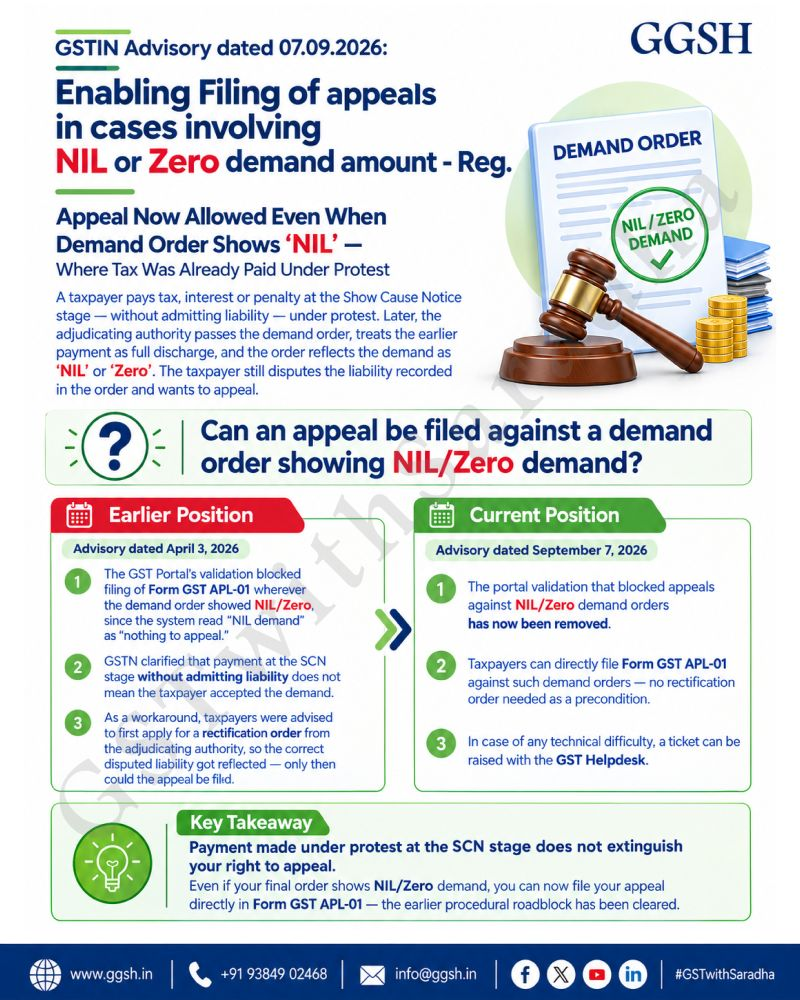
You paid the tax under protest.
Perhaps to stop the interest clock or avoid further exposure.
Then the adjudication order arrives — and the demand shown on the portal is NIL or Zero.
But what if you still disagree with the liability determined in that order?
Can you appeal?
Until recently, a technical validation on the GST Portal could make that question surprisingly difficult in practice.
The Problem: Payment Before the Order
A peculiar situation could arise when a taxpayer made payment at the SCN stage, without admitting the underlying liability.
When the adjudication order was subsequently issued, the amount already paid could result in the order reflecting NIL or Zero outstanding demand.
However, the taxpayer could still have a genuine dispute regarding the findings in the order — such as the determination of tax liability, eligibility of an input tax credit, classification, or other issues.
The problem was that the GST Portal’s validation could prevent the taxpayer from filing FORM GST APL-01, because the system saw a NIL/Zero demand.
In other words:
No outstanding demand did not necessarily mean there was nothing to challenge.
What GSTN Has Now Changed
GSTN, through Advisory No. 671 dated 7 September 2026, has addressed this specific portal-level difficulty.
GSTN has removed the earlier validation that restricted appeals where the demand amount was reflected as “NIL” or “Zero”, in cases where a liability dispute exists and payment had been made before issuance of the demand order.
Taxpayers facing such cases are now enabled to file an appeal in FORM GST APL-01 directly. A rectification order is no longer required as a precondition merely to overcome this portal validation.
This is an important distinction between the amount outstanding and the substantive dispute contained in the order.
Why This Matters
A GST order can have consequences beyond the amount currently appearing as payable on the portal.
A taxpayer may disagree with the legal or factual findings recorded in the order even where the monetary demand has already been discharged.
Therefore, the existence of an appealable grievance cannot necessarily be determined simply by looking at whether the portal shows an outstanding balance.
GSTN’s latest change addresses the technical filing barrier and allows the taxpayer to access the appellate mechanism in these specified NIL/Zero-demand situations.
But There Is One Critical Point: Limitation
Removing the portal validation does not automatically extend the statutory time limit for filing an appeal.
Under Section 107(1) of the CGST Act, an appeal to the Appellate Authority is ordinarily required to be filed within three months from the date on which the order is communicated. Section 107(4) permits the Appellate Authority, subject to the statutory conditions, to allow a further period of one month where sufficient cause is established.
Therefore, taxpayers should not interpret the GSTN portal change as a fresh limitation period.
Portal accessibility and statutory limitation are two different issues.
What Should Taxpayers Check?
If you have received an order showing NIL or Zero demand but continue to dispute the findings, review:
- The date on which the order was communicated
- The adjudication order and the specific findings being challenged
- The payment made before issuance of the order
- Whether the payment was made without admitting liability, wherever applicable
- Records of any earlier attempt to file the appeal
- Any GST Portal error or validation that prevented filing
- The applicable limitation period under Section 107
- Documents and grounds required for filing FORM GST APL-01
If a technical difficulty continues while filing, GSTN has advised taxpayers to raise a ticket with the GST Helpdesk.
The Larger Principle
NIL demand is not necessarily the same as NIL dispute.
A taxpayer may have already paid an amount, while still maintaining that the underlying liability determined by the department is incorrect.
The GSTN’s September 2026 change is therefore significant from a portal and procedural perspective: the absence of an outstanding demand should no longer, in the specified circumstances, prevent the taxpayer from electronically filing an appeal.
But the next step remains crucial:
Check the limitation. Preserve the evidence. File the appeal on time.
Reference
GSTN Advisory No. 671 dated 7 September 2026
“Enabling Filing of Appeals in Cases Involving NIL or Zero Demand Amount”
Read with the earlier GSTN advisory dated 3 April 2026 concerning difficulties in filing appeals where adjudication orders reflected NIL demand due to prior voluntary payment.
This article is for general information and should not be treated as legal or tax advice. The applicability of the appellate remedy and limitation period should be examined based on the specific order and facts of each case.
