Indian Exporters RELIEF Scheme due to IRAN WAR and GEOPOLITICAL challenges Realisation Nexus: A Legal Analysis of ECGC Claims & the GST REFUNDS

TO SET THE CONTEXT

1.What are ECGC Claims?

ECGC claims refer to the amounts payable by the Export Credit Guarantee Corporation of India (ECGC) to exporters when they suffer a loss due to non-payment or default by overseas buyers, or due to political risks in the importing country. In short, ECGC claims are insurance payouts to exporters for losses arising from buyer default or political risks in international trade.

2.Purpose of ECGC Claims

  • Protect exporters against export credit risk
  • Encourage exports by reducing uncertainty in international trade
  • Provide financial security in case of default or disruption

3.Recent developments: What is actually happening on the ground?

  • War-related disruptions in West Asia (including Iran region) have:
    • Increased freight costs
    • Increased insurance / war-risk premiums
    • Caused shipment delays, rerouting, and contract uncertainty
  • Government response:
    • ₹497 crore RELIEF scheme launched
    • ECGC made nodal agency for claim verification and settlement
  • Exporters are now facing:
    • Payment delays / contract cancellations
    • Higher probability of defaults
    • Logistics disruptions affecting delivery timelines

These are classic triggers for ECGC claims (political + commercial risk).

4.The Problem No One Is Talking About – The Critical ECGC-GST Intersection

If an exporter’s buyer in a West Asia country or any other part of the world fails to pay due to war/political disruption, and the exporter receives settlement from ECGC instead. Does that satisfy the “realisation of sale proceeds” condition under GST law?

I. The Geopolitical Context: What the RELIEF Scheme Actually Is

The Government of India on March 19, 2026 unveiled the RELIEF (Resilience & Logistics Intervention for Export Facilitation) Scheme with a financial outlay of ₹497 crore under the Export Promotion Mission (EPM), aimed at addressing “extraordinary freight escalation, heightened insurance premia and war-related export risks” faced by Indian exporters due to the West Asia conflict.

The crisis has been triggered by escalating security concerns around the Strait of Hormuz, forcing vessel diversions, longer sailing routes, congestion at transshipment hubs, and emergency conflict-linked surcharges. Commerce Secretary confirmed that “exporters to the Middle East are facing challenges” and “exports haven’t reached destinations, future exports getting impacted,” with a “sense of worry” among exporters exposed to the region.

The scheme is structured into three components:

Component I (₹56 crore): For exporters already insured by ECGC with shipments between February 14 and March 15, 2026 – government tops up war and political risk losses beyond ordinary ECGC cover, keeping premiums at pre-disruption levels.

Component II (₹159 crore): For upcoming exports from March 16 to June 15, 2026 – enhanced coverage up to 95% for fresh shipments to UAE, Saudi Arabia, Kuwait, Qatar, Oman, Bahrain, Iraq, Iran, Israel, and Yemen.

Component III (₹282 crore): For non-ECGC-insured MSME exporters – reimbursement of up to 50% of additional freight and insurance costs for shipments to the same countries. ECGC Ltd. will maintain a dashboard-based monitoring system to enable real-time tracking of claims and fund utilisation.

II. The GST Question: Realisation of Export Proceeds as a Condition for Refund

This is where the geopolitical risk directly intersects with GST law. The question is stark:

If an exporter’s buyer in a West Asia country fails to pay due to war/political disruption, and the exporter receives settlement from ECGC instead – does that satisfy the “realisation of sale proceeds” condition under GST law?

The answer requires dissecting the legal architecture at three levels: the IGST Act, the CGST Rules, and the FEMA/RBI framework.

III. The GST Statutory Framework: Realisation Condition

A. Section 16(3) of the IGST Act, 2017 – The Parent Provision

As per proviso to Section 16(3) of the IGST Act:

“Provided that the registered person making zero rated supply of goods shall, in case of nonrealisation of sale proceeds, be liable to deposit the refund so received under this sub-section along with the applicable interest under section 50 of the Central Goods and Services Tax Act within thirty days after the expiry of the time limit prescribed under the Foreign Exchange Management Act, 1999 (42 of 1999.) for receipt of foreign exchange remittances, in such manner as may be prescribed.”

Consequently, with effect from 1st October 2023, as notified through Notification No. 27/2023-Central Tax, realisation of export proceeds in case of export of goods has become a statutory necessity for exporter to retain the refund of utilised ITC or refund of IGST paid upon export.

This is a critical inflection point when non-realisation within the FEMA-prescribed period triggers mandatory refund reversal. There is no longer any credible ultra-vires argument against this condition.

B. Rule 96B of the CGST Rules, 2017 – The Recovery Mechanism

Rule 96B(1) mandates: where any refund of unutilised ITC on account of export of goods or of IGST paid on export of goods has been paid to an applicant but the sale proceeds in respect of such exported goods have not been realised, in full or in part, in India within the period allowed under FEMA, 1999, including any extension of such period, the exporter shall deposit the refund amount (to the extent of non-realisation) along with applicable interest within thirty days of the expiry of the said period, failing which the amount shall be recovered under Section 73, 74, or 74A of the Act (as applicable for recovery of erroneous refund).

Provided, where RBI writes off the requirement of realisation of sale proceeds on merits, the refund paid to the applicant shall not be recovered.

Rule 96B(2) provides a restoration mechanism: where sale proceeds are subsequently realised after recovery under sub-rule (1), and the exporter produces evidence of such realisation within three months from the date of realisation, the recovered amount shall be refunded by the proper officer – provided the proceeds have been realised within the extended period as permitted by RBI.

The GST architecture is therefore:

EventTimelineGST Consequence
Export madeDay 0Zero-rated, refund claimed
FEMA realisation deadline15 months from date of export (currently)Must realise by this date
Non-realisationPost 15 monthsDeposit refund + interest within 30 days
Failure to depositDay 31 onwardsRecovery under S.73/74/74A
Subsequent realisationWithin 3 months of actual receiptApply for re-credit

D. An interesting comparison : Rule 96A vs 96B

Rule 96A (governing export under LUT/Bond) uses the expression “foreign exchange” or “Indian Rupees wherever permitted by RBI” as the mode of realisation, thereby explicitly acknowledging INR receipt as a valid realisation mode where RBI so permits.

Rule 96B (the recovery provision), however, uses the broader expression “sale proceeds“, without the explicit qualifier of foreign exchange or INR. The provision simply mandates receipt of sale proceeds within the period allowed under FEMA.

This distinction is legally significant. Rule 96B’s use of “sale proceeds” is wider and more neutral in its language on currency modality – the emphasis is on the receipt of proceeds, not necessarily on the currency of receipt, subject to what FEMA permits. This opens a textual argument that INR receipt through RBI-permitted mechanisms (such as the Special Rupee Vostro Account mechanism discussed below) could constitute valid “sale proceeds” realisation under Rule 96B. This is a position strengthened by the RBI’s own liberalisation framework.

IV. Comparison with other Export Incentives
A.Drawback Rules

Rule 18(5) of Customs & Central Excise Duties Drawback Rules, 2017 stipulates that drawback shall NOT be recovered where non-realization has been compensated by ECGC and RBI has written off the requirement of realization on merits, supported by a certificate from the concerned Foreign Mission of India. While the aforementioned proviso to Rule 96B(1) above covers the scenario of RBI write off, an explicit mentioning about ECGC compensation is unfound in the GST rules unlike drawback rules.

B.Foreign Trade Policy – FTP, 2023

2.54 Non-Realisation of Export Proceeds

(a) If an exporter fails to realize export proceeds within time specified by RBI, he shall, without prejudice to any liability or penalty under any law in force, be liable to return all benefits / incentives availed against such exports and action in accordance with provisions of FT (D&R) Act, Rules and Orders made thereunder and the FTP.

(b) In case an Exporter is unable to realize the export proceeds for reasons beyond his control (force-majeure), he may approach RBI for writing off the unrealized amount as laid down in Para 2.72 of Handbook of Procedures. (c) The payment realized through insurance cover, would be eligible for benefits under FTP as per Procedures laid down in Para 2.71 of Handbook of Procedures.

C.Handbook of Procedures (HBP)

Para 2.71 which specifically determines the “Admissibility of benefits on payment through insurance cover” states in that “(I) Payment through ECGC cover would count for benefits under FTP” The said para also deals about the case of insurance claims other than ECGC.

Further Para 2.72 of HBP also states that: RBI write-off on export proceeds realization Realization of export proceeds shall not be insisted under FTP, if the RBI or any “Authorised Bank” (authorised by RBI for this purpose) writes off the requirement of realization of export proceeds on merits and the exporter produces a certificate from the concerned Foreign Mission of India about the fact of non-recovery of export proceeds from the buyer. However, this would not be applicable in self – write off cases.

D.Inference:

Thus, a comprehensive reading makes it amply clear that Export incentives are undisturbed due to Compensation of short realisation of sale proceeds from ECGC. However, the same is subject to RBI Write off approval and certification from concerned Foreign Mission. This position for Drawback/RoDTEP/ RoSCTL is also clarified recently through Para 3 of CBIC Circular No. 20/2026-Customs dated 10th April 2026.

V. The FEMA/RBI Framework: What is the “Period Allowed”?

The Governing Regulation (Currently Applicable)

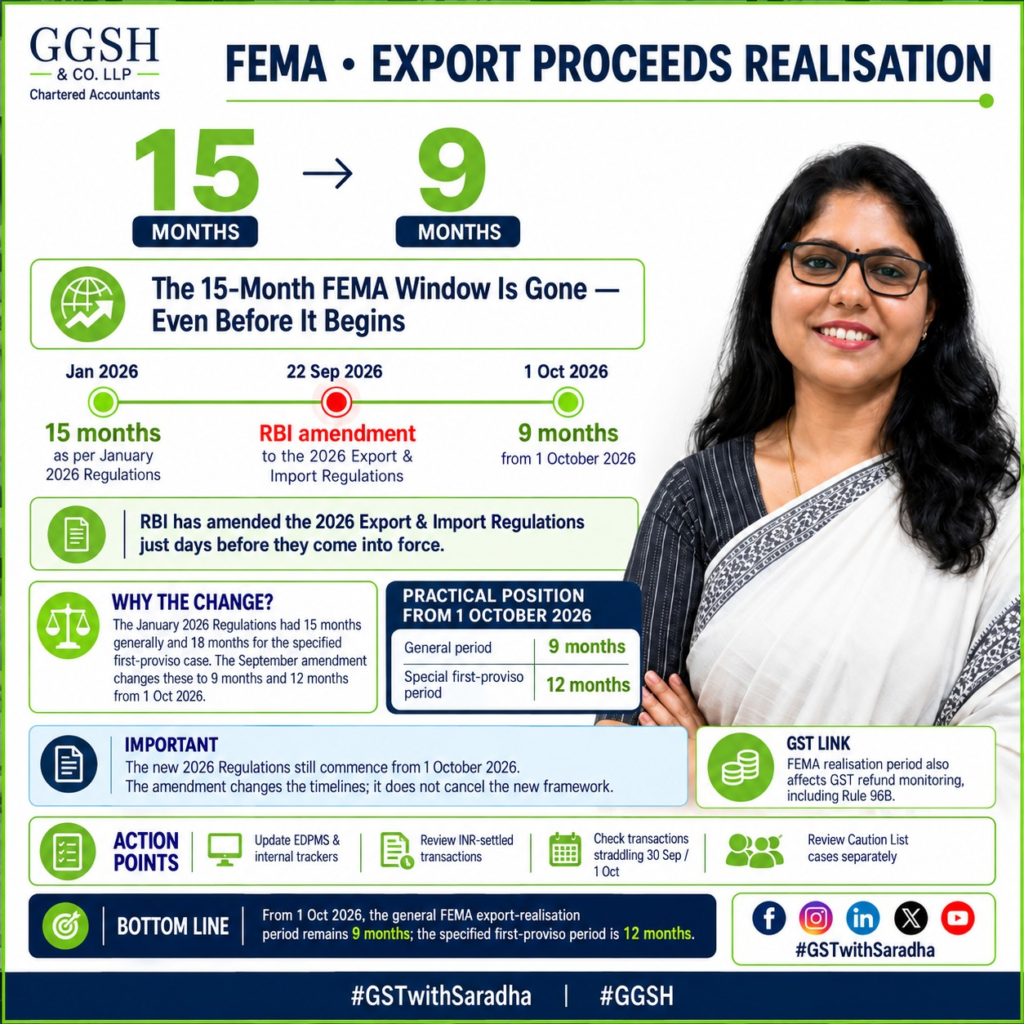
RBI, vide Notification No. FEMA 23(R)/(7)/2025-RB dated November 13, 2025, amended the Foreign Exchange Management (Export of Goods & Services) Regulations, 2015 under Sections 7, 8 and 47(2) of FEMA. Regulation 9 now stands revised from nine months to fifteen months for realisation and repatriation of export proceeds.

This revised 15-month period applies to all exporter categories – including units in SEZs, Status Holder exporters, EOUs, EHTPs, STPs, and BTPs – ensuring uniformity across all export categories.

The 2026 Regulatory Overhaul – Forward-Looking Framework

The RBI notified the Foreign Exchange Management (Export and Import of Goods and Services) Regulations, 2026 on January 13, 2026 (Notification FEMA 23(R)/2026-RB), followed by the Directions on Export and Import on January 16, 2026. The 2026 Update comes into force on October 1, 2026, and upon implementation, the 2015 Regulations, both Master Directions, and existing circulars stand superseded. Nevertheless, the 15-month realisation timeline has been retained in the New Regulations.

Additionally, the 2026 Regulations provide that an additional three months is available for exports invoiced or settled in Indian Rupees – making the effective realisation window 18 months for INR-denominated exports. The new framework also includes set-off between parties as a valid realisation method, aligned with jurisprudence under Income Tax and Indirect Taxes.

Important note: Until October 1, 2026, the existing 2015 Regulations as amended by FEMA 23(R)/(7)/2025-RB continue to govern. The 2026 framework is notified but not yet operative. AD Banks will have the authority to grant extensions beyond the 15-month period, subject to their internal policies. If export proceeds remain unrealised for more than 1 year past the due date, the RBI restricts future shipments to advance payments or irrevocable letters of credit only.

VI. The Critical ECGC-GST Intersection: The Problem No One Is Talking About

This is the core legal issue that every exporter covered under the RELIEF scheme must understand.

The RBI’s Own Position: ECGC Claims ≠ Export Realisation in Foreign Exchange

The RBI’s Master Direction – Export of Goods and Services – explicitly states the following:

“C.24 Write off in cases of payment of claims by ECGC and private insurance companies regulated by Insurance Regulatory and Development Authority (IRDA)

(i) AD Category – I banks shall, on an application received from the exporter supported by documentary evidence from the ECGC and private insurance companies regulated by IRDA confirming that the claim in respect of the outstanding bills has been settled by them, write off the relative export bills in EDPMS.

(ii) Such write-off will not be restricted to the limit of 10 per cent indicated above.

(iii) Surrender of incentives, if any, in such cases will be as provided in the Foreign Trade Policy.

(iv) The claims settled in rupees by ECGC and private insurance companies regulated by IRDA should not be construed as export realization in foreign exchange.”

The ECGC Write-Off Process and Its GST Implication

When ECGC settles a claim, banks can write off the unrealised export receivables under FEMA without any limit. Eg. if ECGC settles 70% of the export bill value, then 30% shall be written off by the exporter. Exporters can avail export incentives for claims settled by insurance companies.

AD Category-I banks can write off export bills without any limit in case of payment of claims by ECGC and private insurance companies regulated by IRDA. But the claims settled in rupees by insurance companies should not be construed as export realisation in foreign exchange.

The GST Consequence of ECGC Write-Off

Under Rule 96B, the question is whether an ECGC settlement followed by an AD bank write-off constitutes “realisation within the period allowed under FEMA.” The answer, while partially protective, is nuanced:

Positive protection: Under Rule 96B(1), where export proceeds are not realised within the FEMA period but the RBI writes off the requirement of realisation on merits, the refund paid to the applicant shall not be recovered. Write-offs approved by AD Category-I banks under RBI’s delegated authority constitute a valid write-off under this rule. This means exporters are protected from refund recovery if their export bills are formally written off by their AD bank following proper evaluation and in line with RBI’s directions.

Critical caveat: The protection only flows from a formal AD bank write-off. Thus, it does NOT arise automatically from ECGC claim settlement. There are therefore two distinct scenarios:

VII. Scenario Analysis for West Asia-Affected Exporters

Scenario 1: Exporter covered under ECGC, ECGC pays the claim

  • ECGC pays in Indian Rupees
  • Under RBI law, this is NOT treated as export realisation in foreign exchange
  • The FEMA clock continues to run on the unrealised foreign exchange proceeds
  • The exporter must separately seek AD bank write-off of the unrealised export bill
  • GST implication: Unless the AD bank formally writes off the bill before the 15-month FEMA deadline (or an extended period is granted), Rule 96B recovery is triggered and refund must be deposited with interest within 30 days of deadline expiry
  • On such deposit, the export incentive (drawback, RoDTEP) is protected per FTP provisions if the write-off route is taken

Scenario 2: Exporter receives partial payment from buyer + partial ECGC settlement

  • The FEMA realisation clock is satisfied only to the extent of actual foreign exchange received from the buyer
  • The ECGC-settled portion, received in INR, does not count toward FEMA realisation
  • Rule 96B recovery applies proportionately to the non-realised forex portion
  • The exporter must deposit the refund proportionate to the unrealised amount within 30 days of FEMA deadline

Scenario 3: No payment received, buyer country blocked (Iran, Yemen, etc.)

  • Complete non-realisation scenario
  • FEMA has a specific carve-out: exporters cannot write off proceeds in cases where the overseas buyer has already deposited the export proceeds in local currency but the amount is not allowed to be repatriated by that country’s central banking authorities (externalization problem countries).
  • This creates a particularly difficult situation for Iran-linked exports where even ECGC settlement may not fully resolve the FEMA and GST compliance position
  • Such cases may require specific RBI Regional Office approval for write-off

Scenario 4: ECGC settlement + subsequent recovery from buyer

In cases where ECGC initially settles the claims of exporters and export proceeds are subsequently received from the buyer/buyer’s country, the share of exporters in the amount so received is disbursed through the AD bank which handled the shipping documents, after receipt of a certificate issued by ECGC. The certificate shall indicate the GR/PP form number, name of exporter, AD details, date of negotiation, bill number, invoice value, and amount actually received.

In this scenario, if subsequent recovery occurs within RBI’s extended period, Rule 96B(2) re-credit becomes available, and the GST refund can be re-availed.

VIII. The INR Realisation Question

This section addresses what is perhaps the most practically significant question for West Asia exporters – particularly those trading with Iran, UAE, and other countries under India’s evolving rupee trade framework.

One important aspect of the RELIEF scheme is that many of the affected countries (particularly Iran) have been settling trade in INR under RBI’s special arrangements. This raises a separate question: does INR settlement count as “realisation” for GST purposes?

Under Rule 96B, the provision specifies that sale proceeds should be received within the period allowed under FEMA, 1999, but the manner of receipt is not specified in Rule 96B itself. The proviso to Section 16(3) uses the phrase “foreign exchange remittances”, which suggests forex realisation. However, a broader reading may accommodate INR realisation where RBI has specifically permitted INR settlement.

The RBI Framework: INR Settlement as a Permitted Mode

The foundation of INR-based export realisation rests on RBI A.P. (DIR Series) Circular No. 10 dated 11th July 2022 read with Regulation 7(1) of the Foreign Exchange Management (Deposit) Regulations, 2016. The RBI, through this circular, put in place an additional arrangement for invoicing, payment, and settlement of exports and imports in INR. For settlement of trade transactions with any country, AD banks in India may open Special Rupee Vostro Accounts (SRVAs) of correspondent banks of the partner trading country. Indian exporters undertaking exports of goods and services through this mechanism shall be paid the export proceeds in INR from the balances in the designated Special Vostro Account of the correspondent bank of the partner country.

This framework is operative for both goods and services and was further reinforced by FTP 2023, Para 2.52(d), which explicitly permits invoicing, payment, and settlement of exports and imports in INR subject to compliance with RBI’s circular of 11th July 2022.

CBIC Circular 202/14/2023-GST dated 27th October 2023 – The GST Clarification

CBIC Circular No. 202/14/2023-GST, issued pursuant to the recommendations of the 52nd GST Council Meeting, brought this settled RBI position formally into the GST framework. The CBIC clarified that when Indian exporters are paid the export proceeds in INR from the Special Rupee Vostro Accounts of correspondent banks of the partner trading country, opened by AD banks, the same shall be considered to fulfil the conditions of sub-clause (iv) of clause (6) of Section 2 of the IGST Act, 2017, subject to the conditions/restrictions mentioned in FTP 2023 and extant RBI Circulars.

While this circular specifically addresses the export of services definition under Section 2(6)(iv) of the IGST Act, it is clarificatory in nature and the substantive permission flows from the RBI’s own framework, which applies equally to goods and services. The GST law position must be read in harmony with the RBI’s liberalisation policy: INR receipt through the SRVA mechanism, being RBI-permitted, constitutes valid realisation of export proceeds for GST purposes, both for goods and services.

This position is also consistent with the language of Rule 96B, which requires realisation of “sale proceeds” within the FEMA-allowed period, without mandating a specific currency, thereby accommodating INR receipt through RBI-permitted routes as valid realisation.

The Iran-Specific Dimension: A Separate and Older Bilateral Channel

The specific question of whether INR-settled proceeds under RBI’s special bilateral arrangements (e.g., India-Iran rupee trade framework) qualify as “realisation” for Rule 96B purposes is a genuinely unsettled area where no CBIC circular or judicial ruling has yet provided authoritative guidance as of the date of this analysis.

Here is where the Iran situation becomes legally distinct and more complex. Iran is not among the 22 countries included in the 2022 SRVA framework. The reason is structural: Iran has accumulated significant INR surpluses in its accounts with UCO Bank over the years, and the mutual balance has made it easy for RBI to keep Iran outside the ambit of the formal SRVA facility.

The India-Iran INR trade mechanism is far older, predating the 2022 framework by a decade. In 2012, after the US imposed sanctions on Iran, UCO Bank started a rupee trade mechanism through which 45% of oil imports of Indian oil companies were settled in rupee denomination. Under the mechanism, Iranian banks opened Indian Rupee accounts with UCO Bank. Payments towards imports of crude oil were paid by Indian oil companies to these accounts, and payments towards exports of goods from India to Iran were paid from these accounts.

Under this mechanism, Indian importers deposited payments in rupee in the Vostro account of Iranian banks maintained with UCO Bank for imports including crude oil. The account was also used to make payments to Indian exporters for sending goods to Iran and the payments were settled on a daily basis.

The critical GST and FEMA implications for Iran-specific exporters are therefore:

First, the Iran INR mechanism operates through a pre-existing bilateral arrangement with UCO Bank and not through the standard 2022 SRVA framework. The regulatory basis is distinct and the formal linkage to RBI Circular No. 10 of July 2022 does not automatically apply.

Second, Iran presents an externalization problem: even where Iranian banks hold rupee balances with UCO Bank sufficient to pay Indian exporters, the broader context of US sanctions means that the payment infrastructure itself is fragile and subject to disruption when geopolitical tensions escalate, as they have now with the US-Iran-Israel conflict.

Third, from a FEMA write-off standpoint, where an Iranian buyer has deposited proceeds in local currency (Rial or through the UCO Bank rupee mechanism) but the funds cannot be repatriated due to sanctions or banking channel disruptions, the exporter faces the externalization bar. Exporters cannot self-write off, requires RBI Regional Office approval, and the GST refund recovery threat remains live.

Exporters with Iran exposure must therefore treat their position as a special category requiring dedicated regulatory engagement with both their AD bank and, wherever necessary, directly with RBI’s Foreign Exchange Department, rather than assuming the standard SRVA realisation route applies to them.

Bottomline: INR receipt for export is permissible as per the RBI liberalisation policy, but export to those countries like Iran which are not in the 22 countries enlisted, should remain more cautious in the specific procedural compliances.

IX. Practical Precautions: What Exporters Must Do Now

Given the above legal landscape, exporters covered by the RELIEF scheme should take the following steps in a time-bound manner:

1. Map Your Export Bill Dates to the FEMA Clock

Identify all export shipments to West Asia (UAE, Saudi Arabia, Qatar, Oman, Kuwait, Bahrain, Iraq, Iran, Israel, Yemen) from January 2025 onwards. These are the shipments currently within the live 15-month FEMA realisation window as of April 2026. For each shipping bill, calculate the precise FEMA deadline and the 30-day GST deposit window under Rule 96B. Map this proactively and Do not wait for a GST notice.

2. Initiate Formal AD Bank Communication – Do Not Rely on ECGC Settlement Alone

The moment you receive ECGC claim settlement, formally approach your AD Category-I bank with:

  • ECGC settlement certificate (which indicates GR/PP form, invoice value, amount received)
  • Supporting evidence of the geopolitical event causing non-realisation
  • Application for formal write-off under FEMA of the unrealised export bill This write-off, once granted by the AD bank, protects you under Rule 96B(1) from GST refund recovery.

3. Proactively Apply for RBI/AD Bank Time Extension Before Deadline

If there is any prospect of eventual recovery (e.g., buyer is not insolvent but payment is delayed due to war disruption), do not rush to write-off. Instead:

  • Seek an extension of the realisation period from your AD bank citing war disruption
  • Maintain documentary evidence of all buyer communications, payment attempts, and ECGC correspondence
  • This preserves the Rule 96B(2) pathway for re-credit if proceeds are subsequently received

4. Procedures separately for Drawback/RoDTEP/ RoSCTL

Compensation of short realisation of sale proceeds from ECGC, RBI Write off and certification from concerned Foreign Mission are one set of procedural compliance to be completed. However, the due discharge and satisfaction of this requirement could be required to be separately established procedurally to safeguard GST refund under Rule 96B, apart from protection of export incentive schemes like Duty Drawback / RoDTEP / RoSCTL.

Note: This position for Drawback/RoDTEP/ RoSCTL is also clarified through Para 3 of CBIC Circular No. 20/2026-Customs dated 10th April 2026.

5. Maintain a Parallel EDPMS Compliance Trail

Banks are required to report the write-off of unrealised export proceeds (self-write-off or otherwise) through EDPMS to RBI. Ensure your AD bank updates EDPMS correctly and promptly, since a mismatch between EDPMS status and GST refund records is a common trigger for scrutiny.

6. Do Not Treat ECGC Settlement as a Substitute for e-BRC

The e-BRC (Electronic Bank Realisation Certificate) remains the primary documentary evidence of export realisation for GST refund purposes. ECGC settlement in INR will not generate an e-BRC in the conventional sense. Maintain a clean paper trail distinguishing between the two.

7. Watch the FEMA 2026 Transition

The 2026 Regulations come into force on October 1, 2026 and will supersede existing circulars. If your extended realisation period runs into post-October 2026, be aware that the legal framework governing your compliance will shift. The 2026 framework authorises AD Banks to grant extensions for both export and import timelines without requiring RBI approval – a significant liberalisation that can benefit exporters in distress scenarios.Given the above legal landscape, exporters covered by the RELIEF scheme should take the following steps in a time-bound manner:

X.The open Legal Questions and Risk Positions

IssueCurrent Legal PositionRisk Level
ECGC INR claim as GST realisationNOT treated as realisation per RBI/FEMAHIGH RISK if no AD write-off obtained
AD bank write-off protection under Rule 96BProtects from refund recoveryModerate — requires formal process
INR through SRVA (2022 framework countries)Valid realisation — RBI permitted, FTP 2023 confirmedNO RISK where SRVA is operational
INR through Iran bilateral UCO Bank channelSeparate pre-2022 arrangement; externalization complicationsHIGH RISK — requires dedicated RBI engagement
Post-ECGC settlement recovery from buyerTriggers Rule 96B(2) re-credit pathwayFavourable if documented within 3 months
Self-write-off without AD bank approvalNOT protected under Rule 96BVERY HIGH RISK
Externalization problem countriesCannot write off; RBI Regional Office approval neededVERY HIGH RISK
Set-off as realisation (post Oct 2026)Expressly recognised in 2026 RegulationsFavourable under incoming framework

XI. Conclusion

The RELIEF scheme addresses the commercial and logistical disruption caused by the West Asia conflict admirably. But it creates, simultaneously, a GST Refund challenge for exporters who assume that ECGC claim settlement ends their regulatory obligations.

The legal position is unambiguous on one point: ECGC claim receipt in INR is NOT export realisation in foreign exchange for FEMA or GST purposes. The 15-month FEMA clock continues to run regardless of ECGC settlement, and Rule 96B recovery is triggered the moment that clock expires without forex realisation or a formal AD bank write-off on record.

Exporters, particularly MSMEs who may not have the compliance bandwidth to track this intersection and hence need immediate proactive advisory on the following hierarchy of actions:

  1. Obtain formal AD bank write-off where recovery from buyer is impossible → protects existing GST refund under Rule 96B(1)
  2. Seek AD bank time extension where recovery may come later → preserves Rule 96B(2) re-credit path
  3. Do not conflate ECGC settlement with realisation – these are two legally distinct events under Indian law
  4. Track FEMA deadlines independently of the RELIEF scheme timelines – the RELIEF scheme runs to June 2026; the FEMA clock may run to 15 months post-export, which for some shipments means realisation deadlines extending into early 2027

The interplay of the RELIEF scheme, ECGC insurance mechanics, FEMA realisation rules, and Rule 96B of the CGST Rules creates a multi-layered compliance obligation that no exporter can afford to navigate without precision. A geopolitical disruption should not become a GST default, that could cost a litigation with penal consequences in the future.

Key Citations: Section 16(3) IGST Act, 2017 (as notified by Notification No. 27/2023-Central Tax, effective 01.10.2023) | Rule 96B, CGST Rules, 2017 (inserted vide Notification No. 16/2020-CT dated 23.03.2020; amended w.e.f. 01.11.2024) | Rule 96A, CGST Rules, 2017 | FEMA 23(R)/(7)/2025-RB dated 13.11.2025 (Regulation 9 – 15-month realisation period) | FEMA 23(R)/2026-RB dated 13.01.2026 (New Regulations, operative from 01.10.2026) | RBI A.P. (DIR Series) Circular No. 10 dated 11.07.2022 (Special Rupee Vostro Account framework) | FTP 2023, Para 2.52(d) | CBIC Circular No. 202/14/2023-GST dated 27.10.2023 | RELIEF Scheme under Export Promotion Mission, Ministry of Commerce, March 19, 2026 | CBIC Circular No. 20/2026-Customs dated 10th April 2026.

For any clarifications or conversations or feedback, please feel free to reach us @ saradha@ggsh.in or info@ggsh.in

Year-End Compliance Checklist for Businesses in India

A practical guide across Books of Accounts, GST, and Income Tax

As the financial year draws to a close, businesses enter a critical phase of validation, reconciliation, and compliance readiness. Year-end is not just about closing numbers—it’s about ensuring accuracy, completeness, and alignment across financial, GST, and income tax records.

To simplify this process, we’ve broken down the year-end compliance into three key areas:

  • Books of Accounts
  • GST Compliance (“Dasavathaaram” approach)
  • Income Tax Compliance

This checklist is designed to help businesses stay structured, reduce last-minute risks, and approach closure with confidence.

1. Books of Accounts Checklist

The foundation of all compliance begins with accurate books. A well-reviewed set of accounts ensures smoother audits, filings, and decision-making.

Key areas to focus on:

1. Cash & Bank Validation

  • Perform bank and cash balance verification
  • Ensure proper reconciliation with bank statements

2. Investments & Loans

  • Obtain updated statements
  • Ensure correct accounting treatment in books

3. Inventory & Stock

  • Conduct physical stock count as on 31st March
  • Perform closing stock valuation

4. Fixed Assets

  • Review additions, deletions, and disposals
  • Ensure correct valuation and depreciation

5. Revenue Integrity

  • Identify, match, and link all income streams
  • Ensure proper disclosure in books

6. Expense Completeness

  • Verify expenses with:
    • Bank reconciliation
    • IMS vs Books
    • Vendor balances

7. Expense Apportionment

  • Allocate expenses across financial years appropriately
  • Validate ledger classifications

8. Receivables Review

  • Identify doubtful or non-recoverable balances
  • Write off where necessary

Outcome:
A clean, reconciled, and audit-ready set of financial statements.

2. GST Compliance Checklist – “Dasavathaaram”

GST year-end is multi-dimensional. Think of it as covering ten critical compliance “avatars” that ensure readiness for the upcoming financial year.

A. Strategic & Reconciliation Checks

  • Review aggregate turnover for FY 2025–26
    • Determine applicability for:
      • Registration thresholds
      • Composition scheme
      • QRMP
      • E-invoicing
  • Ensure HSN/SAC code compliance
  • File LUT (Form GST RFD-11) before 31st March 2026
    • Applicable for zero-rated supplies in FY 2026–27
  • Perform 7-way reconciliation for outward supplies
  • Review ITC reversals as per:
    • Rule 37, 37A, 42, 43
    • Blocked credits

B. Compliance & Transition Readiness

  • Ensure all GST-related job/work compliances are completed
  • Verify invoice series reset for new financial year
    • Align with changes effective from 1st April 2026
  • GTA Compliance
    • File Annexure V or VI based on RCM/FCM option
  • Specified Premises
    • File Annexure VII where applicable
  • Update GST registration details:
    • Bank account
    • Aadhaar authentication
    • Authorized signatory

Outcome:
A GST-compliant business that is both backward reconciled and forward-ready.

3. Income Tax Compliance Checklist

Income tax closure is not just about computation—it’s about aligning financial data, tax positions, and regulatory expectations.

A. Reconciliation & Financial Integrity

  • Reconcile turnover across:
    • GST returns
    • Books of accounts
    • Income tax filings
  • Maintain proper books of accounts and documentation
  • Perform GST vs Income Tax turnover reconciliation

B. Compliance & Evaluation Areas

  • Evaluate cash transaction limits and compliance
  • Review applicability of presumptive taxation
  • Perform TDS/TCS reconciliation and verification
  • Validate related party transactions and documentation

C. Asset, Liability & Reporting Checks

  • Verify depreciation and fixed asset register
  • Ensure loan and deposit compliance
  • Review statutory due dates and audit readiness

D. Advanced Tax & Risk Areas

  • Assess advance tax liability and payment accuracy
  • Review penalty exposure and structure
  • Ensure compliance with MSME payments
    • Especially Section 43B(h) timelines

Outcome:
An income tax position that is accurate, defensible, and audit-ready.

Closing Note

Year-end compliance doesn’t have to be chaotic. With a structured approach across Books, GST, and Income Tax, businesses can move from reactive corrections to proactive control.

The key is simple:

  • Reconcile early
  • Review thoroughly
  • Document properly
  • Prepare ahead

A well-executed year-end not only ensures compliance—it sets the tone for a stronger, more efficient financial year ahead

🇺🇸 US Supreme Court Strikes Down Trump Tariffs: A Landmark Ruling for Global Trade & Tax Policy

In a decisive 6–3 verdict, the Supreme Court of the United States has struck down sweeping tariffs imposed under the Trump administration—marking a significant constitutional and economic moment.

At the heart of the case:

👉 Whether the President could impose broad tariffs under the International Emergency Economic Powers Act (IEEPA)

The Court’s answer was clear:

No.

⚖️ What the Court Held

The Supreme Court of the United States rejected the government’s argument that IEEPA allows the President to regulate tariffs under emergency powers.

It observed:

  • The interpretation would lead to an “unbounded expansion” of executive authority
  • The term “regulate” does not equate to imposing tariffs at will
  • Such powers would fundamentally alter the constitutional balance

🏛️ Core Constitutional Principle

The ruling strongly reaffirms:

👉 Tariff powers lie with the legislature, not the executive

As emphasized by the Court:

  • The United States Congress alone holds tariff authority
  • Any delegation must be:
    • Explicit
    • Limited
    • Clearly defined

💡 Key takeaway:

“Extraordinary fiscal powers require clear congressional authorization.”

🌍 Why This Matters Globally

This is not just a US domestic ruling—it has global ripple effects:

🔹 Trade Stability

  • Reduces unpredictability in tariff regimes
  • Reinforces rule-based international trade

🔹 Legal Certainty

  • Limits unilateral executive action
  • Strengthens institutional checks and balances

🔹 Policy Signal

  • Taxation and tariffs are not administrative tools
  • They are constitutionally governed powers

🇮🇳 Impact on Indian Exporters

For Indian exporters, this ruling brings a wave of relief:

  • Earlier, US tariffs had gone as high as 50%, later reduced to ~18%
  • This judgment undermines the legal basis of such emergency tariffs

Key Beneficiaries:

  • Textiles 👕
  • Engineering goods ⚙️
  • Food products 🍤
  • Chemicals 🧪

👉 Result:
Improved pricing certainty + better export planning

🧠 What Tax Professionals Should Note

This ruling sets a powerful global precedent:

✔️ Taxation = Legislative Function

  • Cannot be expanded through broad executive interpretation

✔️ Delegation Must Be Precise

  • Vague statutory language is not enough

✔️ Judicial Oversight Matters

  • Courts will intervene where constitutional limits are crossed

🔍 The Bigger Message

Across jurisdictions, one principle stands reinforced:

Tax and tariff powers are constitutional in nature—not executive conveniences.

💬 Final Thought

In an era of shifting geopolitics and economic nationalism, this ruling is a reminder:👉 Institutions matter. Boundaries matter. Law matters.

First GSTAT Order (Feb 2026): What the Sterling & Wilson Case Reveals About Future GST Litigation

“Every new institution speaks through its first order.”

On 11th February 2026, the Goods and Services Tax Appellate Tribunal (GSTAT), Principal Bench, Delhi delivered its first-ever second appeal decision in:

M/s Sterling & Wilson Pvt. Ltd. vs Commissioner, Odisha CT GST & Ors.

At first glance, the issue may seem routine—a GSTR-1 vs GSTR-3B mismatch for FY 2018–19.

But that is precisely why this order matters.

Case Background: A Common Issue, A Crucial Clarification

The dispute involved:

  • Mismatch between GSTR-1 and GSTR-3B
  • Proceedings initiated under Section 74 (fraud/suppression)

However:

  • At the appellate stage, fraud allegations were not sustained

Key Ruling by GSTAT

The Goods and Services Tax Appellate Tribunal made a critical clarification:

👉 If fraud or suppression is not established, the case must be re-determined under Section 73

And importantly:

👉 The matter must go back to the Proper Officer for fresh adjudication

Why This Matters

1. Clear Separation Between Section 73 & 74

  • Section 74 → Requires intent (fraud/suppression)
  • Section 73 → Applies to non-fraud cases

👉 The ruling reinforces that Section 74 cannot be invoked mechanically.

2. Appellate Forums Have Defined Limits

The Tribunal emphasized:

👉 Appellate authorities cannot step into the shoes of adjudicating officers to re-quantify tax demands

Instead:

  • They must remand the matter for proper determination

3. Recognition of Early GST Challenges

A notable aspect of the order is its practical approach:

  • Acknowledgement of:
    • Initial GST implementation issues
    • Portal limitations
    • Manual filings
    • COVID-19 disruptions

👉 The Tribunal allowed the taxpayer:

  • 30 days to reconcile and amend records

Key Takeaways for Businesses & Professionals

✔️ Section 74 Cannot Be Used by Default

  • Fraud must be:
    • Clearly alleged
    • Properly established

✔️ Mismatch ≠ Suppression

  • Differences between returns do not automatically imply intent to evade

✔️ Right Forum, Right Process Matters

  • Adjudication → Appeal → Tribunal
  • Each stage has a defined role

✔️ Remand Is Not a Setback

  • It provides:
    • Opportunity to correct errors
    • Chance for proper reconciliation

What This First GSTAT Order Signals

This decision sets the tone for how GSTAT may function going forward:

🔹 Fact + Law Driven Approach

  • Not just legal interpretation, but factual examination

🔹 Balanced View on Compliance Gaps

  • Distinguishing genuine errors from deliberate non-compliance

🔹 Structured Adjudication

  • Preference for proper re-determination over penalties

Impact on GST Litigation Strategy

For taxpayers and professionals, this order is an early indicator:

👉 Litigation strategy must focus on:

  • Correct classification (Section 73 vs 74)
  • Strong factual documentation
  • Proper sequencing of appeals

Conclusion

The first order of the Goods and Services Tax Appellate Tribunal is not just about a GSTR mismatch.

It is about:

👉 Discipline in invoking provisions
👉 Respect for procedural hierarchy
👉 Fair treatment of genuine compliance gaps

Final Thought 💬

In GST litigation, the real question is not just:

“Is there a mismatch?”

But:

“Does it justify intent?”

Union Budget 2026: Indirect Tax (GST) Key Takeaways & What It Means for Businesses

The Union Budget 2026 signals a clear and consistent direction for India’s indirect tax ecosystem—moving towards simplification, digitisation, and trust-based governance.

Rather than introducing disruptive changes, the focus is on strengthening systems, improving compliance experience, and reducing friction for businesses.

Policy Direction: Simplification with Trust

At its core, the Budget emphasizes:

  • Simplifying GST processes
  • Digitising tax administration
  • Building a trust-based compliance framework

This reflects a shift from control-driven regulation to facilitation-driven governance.

Core Focus: Rationalising GST Compliance

The government aims to:

  • Reduce compliance burden
  • Eliminate redundant procedures
  • Improve ease of doing business

With 350+ reforms already implemented, the direction is clear:

👉 Continuous process clean-up rather than one-time overhaul.

Technology as the Backbone of GST

A major highlight is the increasing role of technology.

🔍 AI-Enabled GST Ecosystem

  • Use of Artificial Intelligence for:
    • Risk assessment
    • Fraud detection
    • Data analytics

👉 This enables smarter scrutiny with fewer manual interventions.

⚙️ System-Driven Compliance

  • Faster processing of returns and refunds
  • Reduced dependency on officers
  • More predictable outcomes

👉 The system is evolving into a self-regulating framework.

Economic Perspective: GST as a Structural Pillar

GST continues to play a crucial role in:

  • Enhancing tax buoyancy
  • Driving formalisation of the economy
  • Supporting fiscal discipline

👉 It remains a key component of India’s long-term economic strategy.

MSME Impact: Reduced Friction, Greater Trust

For MSMEs, the changes are particularly significant:

✔️ Lower Compliance Burden

  • Simplified processes
  • Reduced procedural hurdles

✔️ Trust-Based Governance

  • Less intrusive scrutiny
  • Focus on voluntary compliance

✔️ Reduced Litigation

  • Clearer systems
  • Fewer interpretational disputes

👉 This creates a more business-friendly tax environment.

Execution Signal: Continuous Reform Mindset

The mention of 350+ reforms indicates:

  • Ongoing refinement of GST systems
  • Incremental improvements across processes
  • Focus on long-term stability over short-term changes

The Big Shift: Enforcement → System-Led Governance

Perhaps the most important takeaway:

👉 GST is transitioning from:

  • Enforcement-led model
    (manual checks, officer dependency)

👉 To:

  • System-led model
    (automation, AI-driven validation, transparency)

What This Means for Businesses

🔹 Be System-Ready

  • Ensure accurate and consistent data reporting

🔹 Strengthen Internal Controls

  • Align accounting, GST returns, and documentation

🔹 Embrace Digital Compliance

  • Adapt to automation and AI-based scrutiny

🔹 Focus on Accuracy Over Adjustments

  • System-driven checks reduce scope for post-facto corrections

Conclusion

The Union Budget 2026 does not introduce radical GST changes—but it reinforces a clear, long-term vision:

  • Simpler processes
  • Stronger systems
  • Predictable compliance

Bottom Line

👉 GST in India is steadily evolving into a technology-driven, trust-based tax regime

👉 The future lies in clean data, timely compliance, and system alignment

Final Thought 💬

The question for businesses is no longer:

“What are the rules?”

But:

“Are our systems aligned with how GST now works?”

GSTR-9 & GSTR-9C Changes for FY 2024–25: Key Updates, New Tables & Compliance Insights

If you thought GSTR-9 and GSTR-9C were just routine annual compliance forms, FY 2024–25 brings a subtle but significant shift.

While there are no dramatic overhauls on the surface, several new tables, additional disclosures, and tighter reconciliation requirements have been introduced. These changes are enough to make GST annual return filing more detailed and sensitive for businesses and tax professionals.

Why GSTR-9 & 9C Changes Matter in FY 2024–25

The latest updates aim to:

  • Improve accuracy of GST reporting
  • Strengthen data reconciliation across returns
  • Enhance transparency in disclosures
  • Reduce inconsistencies between filings

For businesses, this means a greater focus on data validation and explanation-based reporting.

Key Changes in GSTR-9 & GSTR-9C

1. New Tables & Additional Disclosures

FY 2024–25 introduces expanded reporting requirements, requiring:

  • More granular disclosure of transactions
  • Better classification of supplies and credits
  • Clear reporting of adjustments

👉 Even small errors in classification can now lead to reconciliation mismatches.

2. ITC Reversal & Reclaim Reporting

One of the most critical areas this year is:

  • Input Tax Credit (ITC) reversals and reclaims

Businesses must ensure:

  • Proper tracking of reversed ITC
  • Accurate reporting of reclaimed ITC
  • Alignment with books and GST returns

👉 Misreporting here can trigger notices or scrutiny.

3. Auto-Populated Data – Not Always Final

The behavior of auto-populated values in GSTR-9 has evolved:

  • Data flows from GSTR-1 and GSTR-3B
  • However, it may not always be complete or accurate

👉 Taxpayers must:

  • Verify all auto-filled data
  • Make necessary corrections through proper disclosures

4. Importance of Reconciliation Explanations

In GSTR-9C, reconciliation is no longer just about numbers.

  • Explanations for differences are now critical
  • Authorities are focusing more on reasoning and justification

👉 Proper documentation and clear narration can make a significant difference during scrutiny.

5. Separate Late Fee for GSTR-9C

A notable compliance change:

  • Late fees for GSTR-9C are now treated separately

This increases the importance of:

  • Timely filing of both GSTR-9 and GSTR-9C
  • Avoiding unnecessary penalties

Impact on Businesses & Tax Professionals

These changes directly affect:

  • Companies filing annual GST returns
  • Chartered accountants and GST consultants
  • CFOs and finance teams

Key Implications:

  • Increased compliance responsibility
  • Greater need for reconciliation accuracy
  • Higher scrutiny from tax authorities
  • Risk of penalties for incorrect reporting

Best Practices for FY 2024–25 GST Annual Filing

To stay compliant and avoid last-minute stress:

✔️ Start Early

  • Begin reconciliation well before the due date

✔️ Review ITC Carefully

  • Track reversals and reclaims throughout the year

✔️ Validate Auto-Populated Data

  • Do not rely blindly on system-generated numbers

✔️ Document Explanations

  • Maintain clear records for reconciliation differences

✔️ Seek Professional Guidance

  • Complex scenarios require expert review

Why a Practical Approach Matters

GST annual return filing is no longer just a formality — it’s a detailed compliance exercise.

A structured, practical approach helps:

  • Avoid errors and mismatches
  • Reduce litigation risks
  • Ensure smooth audits and assessments

Conclusion

The updates in GSTR-9 and GSTR-9C for FY 2024–25 may appear subtle, but they significantly increase the importance of accuracy, reconciliation, and explanation-based reporting.

Businesses must shift from a last-minute filing mindset to a well-planned compliance strategy.

Final Thoughts 💬

GST annual returns are no longer “just another form” — they are a comprehensive reflection of your entire year’s compliance.Are you prepared for the new level of scrutiny in GSTR-9 & 9C filing?

Section 74A Under GST: New Time Limits, Monetary Powers & Impact on Tax Litigation

A major transformation has been introduced in the GST assessment and litigation framework with the insertion of Section 74A, applicable from FY 2024-25 onwards.

This new provision replaces the earlier Sections 73 and 74 of the CGST Act and introduces a uniform approach to tax assessments, significantly impacting GST litigation in India.

What is Section 74A in GST?

Section 74A is a newly introduced provision under GST that:

  • Replaces Section 73 (non-fraud cases) and Section 74 (fraud cases)
  • Introduces uniform time limits for issuing notices and passing orders
  • Simplifies the GST assessment process

This marks a shift toward a more streamlined and consistent tax litigation framework.

Key Change: Uniform Time Limit for All Cases

Earlier, GST law differentiated between:

  • Fraud cases (longer time limits)
  • Non-fraud cases (shorter time limits)

With Section 74A:

👉 A single, uniform time limit now applies to both categories.

Impact:

  • Reduces complexity in interpretation
  • Brings clarity for taxpayers and tax officers
  • Minimizes disputes on limitation

CBIC Circular on Monetary Limits for Officers

The Central Board of Indirect Taxes and Customs (CBIC) has issued a circular prescribing monetary limits for tax officers under Section 74A.

What the Circular Covers:

  • Specifies jurisdictional limits for issuing:
    • Show Cause Notices (SCN)
    • Adjudication orders
  • Assigns the “Proper Officer” under:
    • Section 74A
    • Section 75(2)
    • Section 122

Applicability of Monetary Limits

  • These limits currently apply to Central GST officers
  • State Governments may:
    • Adopt the same limits
    • Issue separate circulars for State GST officers

Legal Consequence: Orders Beyond Power Are Void

One of the most critical aspects of this update is:

⚠️ Any notice or order issued beyond the prescribed monetary limit is without jurisdiction and legally void

This is a crucial safeguard for taxpayers.

Judicial Backing from High Courts

Various High Courts of India have consistently held that:

  • Orders passed beyond the authority of officers are invalid
  • Jurisdictional errors cannot be cured later
  • Such proceedings are liable to be set aside

This principle applies under both:

  • Existing GST law
  • Earlier indirect tax regimes

What Businesses & Tax Consultants Must Do

With Section 74A in force, it is essential for:

Businesses:

  • Review SCNs and orders carefully
  • Check whether the issuing officer has proper authority
  • Track monetary limits applicable

Tax Consultants:

  • Identify jurisdictional errors early
  • Raise objections where powers are exceeded
  • Advise clients on legal remedies

👉 Awareness is key to protecting your legal rights

Practical Example

If a lower-ranking officer issues:

  • A high-value SCN beyond their monetary limit, or
  • Passes an order exceeding their jurisdiction

➡️ Such action can be challenged as void ab initio (invalid from the beginning).

Why Section 74A Matters

This reform aims to:

  • Bring consistency in GST assessments
  • Reduce litigation complexity
  • Ensure proper allocation of authority
  • Strengthen legal certainty in tax administration

Conclusion

The introduction of Section 74A under GST is a significant step toward a more structured and transparent tax litigation system.

However, with new powers come new responsibilities — both for tax authorities and taxpayers.

Understanding monetary limits and jurisdictional boundaries is now essential to ensure compliance and safeguard legal rights.

Final Thoughts 💬

In GST litigation, knowledge is power.Are you reviewing whether your notices and orders are issued by the right authority within prescribed limits?

GST Registration Auto-Approval from November 2025: Faster Approvals for Startups & MSMEs

A major transformation is coming to the GST registration process in India. In a move toward automation and ease of doing business, the government is set to introduce an auto-approval mechanism for GST registration starting 1st November 2025.

This reform is expected to benefit nearly 96% of new GST applicants, especially startups, MSMEs, and small businesses, by significantly reducing approval timelines.

What is GST Registration Auto-Approval?

Under the new system, eligible applicants will receive automatic GST registration approval without manual intervention, provided they meet certain risk-based criteria.

This initiative, supported by the Goods and Services Tax Network (GSTN), aims to create a faster, technology-driven GST compliance system.

Key Highlights of the New GST Auto-Approval System

📅 Effective Date

  • 1st November 2025

⚡ Faster Approval Timeline

  • GST registration approval within 3 working days

🎯 Eligibility Criteria

  • Declared monthly output tax liability up to ₹2.5 lakh
  • Applicant qualifies under analytics-based risk filters

📊 Coverage

  • Expected to benefit around 96% of applicants

How GST Registration Will Change

1. Reduced Manual Intervention

  • Minimal officer interaction
  • Faster processing with system-driven validation

2. Risk-Based Verification

  • Applications assessed using data analytics and risk profiling
  • Only high-risk cases flagged for manual scrutiny

3. Improved Ease of Doing Business

  • Quicker onboarding for new businesses
  • Reduced compliance burden for small taxpayers

Benefits for Startups, MSMEs & Growing Businesses

This reform is a game-changer for:

  • Startups launching new ventures
  • MSMEs seeking quick market entry
  • Businesses expanding operations across states

Key Advantages:

  • Faster business setup
  • Reduced delays in GST registration
  • Lower compliance friction
  • Improved operational efficiency

Preparation Checklist for Businesses

To fully benefit from the auto-approval GST registration system, businesses should prepare in advance:

✅ 1. Ensure Data Accuracy

  • PAN details
  • Business address
  • HSN/SAC codes
  • Bank account information

✅ 2. Digitize Documents

  • Keep all statutory documents ready in digital format
  • Ensure clarity and consistency in submissions

✅ 3. Strengthen Internal Processes

  • Train teams on the new GST registration workflow
  • Implement validation checks before submission

✅ 4. Align with Compliance Requirements

  • Maintain proper records
  • Avoid discrepancies in filed data

Challenges to Watch Out For

While automation simplifies the process, businesses must be cautious about:

  • Incorrect or mismatched data leading to rejection
  • Risk profiling flags triggering manual verification
  • Delays due to incomplete documentation

👉 Automation works best only when data is accurate and consistent

Why This Reform Matters

The move toward GST registration auto-approval reflects the government’s broader goal of:

  • Enhancing digital governance in taxation
  • Reducing human intervention and subjectivity
  • Promoting ease of doing business in India
  • Encouraging formalization of the economy

Conclusion

The introduction of auto-approved GST registration from November 2025 is a significant milestone in India’s GST journey. By combining automation with compliance, the system is set to deliver faster, more efficient, and more reliable registration processes.

However, the responsibility now shifts to businesses to ensure data accuracy and readiness.

Final Thoughts 💬

Automation is here to make GST compliance faster, not harder — but only if you’re prepared.Is your business ready for the new automated GST registration system?

GSTR-3B Hard Locking from July 2025: Key Changes, Impact & Compliance Strategy

A major shift is coming in the GST return filing system in India. With the implementation of GSTR-1A, the government is moving toward hard locking of GSTR-3B, making tax compliance more structured and error-sensitive.

As per the latest advisory issued by the Goods and Services Tax Network (GSTN) dated 7th June 2025, this change will significantly impact how businesses report and correct their GST liabilities.

What is GSTR-3B Hard Locking?

Starting from July 2025 tax period (returns filed in August 2025):

  • Tax liability auto-populated from GSTR-1 into GSTR-3B will become non-editable
  • Taxpayers will not be able to manually modify liability in GSTR-3B

This marks a transition toward a more system-driven GST compliance framework.

Role of GSTR-1A in the New System

With GSTR-1A now effectively in place, it becomes the only window for making corrections before filing GSTR-3B.

Key Function of GSTR-1A:

  • Amend errors in outward supplies reported in GSTR-1
  • Correct tax liability before it flows into GSTR-3B
  • Ensure accuracy before final return filing

👉 Once GSTR-3B is filed, no edits can be made to the auto-populated tax liability

Key Changes in GST Return Filing Process

1. Auto-Population Becomes Final

  • Data from GSTR-1 → flows into GSTR-3B
  • No manual override allowed

2. Mandatory Use of GSTR-1A for Corrections

  • Errors must be corrected before filing GSTR-3B
  • Post-filing corrections will become more complex

3. Increased Importance of Data Accuracy

  • Even minor mistakes can lead to:
    • Incorrect tax payments
    • Compliance issues
    • Reconciliation challenges

Impact on Businesses and Tax Professionals

This update will significantly affect:

  • Businesses filing monthly GST returns
  • Accountants and GST practitioners
  • CFOs managing compliance and reporting
  • Organizations with high transaction volumes

Key Implications:

  • Greater reliance on accurate GSTR-1 filing
  • Reduced flexibility in GSTR-3B
  • Need for stronger internal review systems

Compliance Challenges to Watch Out For

With GSTR-3B hard locking, businesses may face:

  • Difficulty in correcting errors after filing
  • Increased reconciliation between books and returns
  • Risk of interest and penalties due to incorrect reporting

Best Practices to Stay Compliant

To adapt to this new system, businesses should implement:

1. Strong Internal Controls

  • Multi-level review of GST data before filing
  • Validation of invoices and tax amounts

2. Timely Reconciliation

  • Match GSTR-1 with:
    • Books of accounts
    • E-invoices
    • ERP data

3. Early Error Detection

  • Identify discrepancies before filing GSTR-1A
  • Avoid last-minute corrections

4. Regular GST Portal Monitoring

  • Track auto-populated data in GSTR-3B
  • Ensure alignment with filed returns

Why This Change Matters

The move toward hard locking of GSTR-3B reflects the government’s intention to:

  • Improve data consistency across GST returns
  • Reduce manual intervention and errors
  • Strengthen the GST compliance ecosystem

It is also a step toward greater automation and transparency in tax reporting.

Conclusion

The introduction of GSTR-3B hard locking from July 2025 is a significant development in India’s GST framework. While it enhances accuracy and system control, it also places greater responsibility on taxpayers to ensure error-free reporting at the initial stage.

Businesses must now shift from a correction-based approach to a prevention-based compliance strategy.

Final Thought 💬

Are you prepared for a non-editable GSTR-3B system?Now is the time to strengthen your processes and ensure accurate GST return filing from day one.

CBIC GST Circular No. 249/2025: DIN Not Required for GST Notices on Portal – Legal Implications & Analysis

The recent GST Circular No. 249 dated 9th June 2025 issued by the Central Board of Indirect Taxes and Customs (CBIC) has sparked widespread discussion across tax and legal communities.

The headline takeaway making rounds across media platforms is:

“DIN is not required for GST notices issued on the GST portal with RFN.”

While this clarification appears to streamline digital communication under GST, it raises important legal and procedural questions regarding validity, authentication, and compliance with statutory provisions.

Background: GSTN Advisory and Evolution of Digital Notices

This circular builds upon the earlier advisory issued by the Goods and Services Tax Network (GSTN) dated 26th September 2024, which encouraged increased reliance on portal-based communication for GST notices, orders, and reminders.

The broader objective has been to:

  • Shift toward paperless GST compliance
  • Ensure faster communication with taxpayers
  • Improve administrative efficiency

Key Update: DIN Not Required for Portal-Based GST Notices

The CBIC circular clarifies that:

  • Document Identification Number (DIN) is not mandatory for notices issued through the GST portal
  • Instead, Reference Number (RFN) can be used for authentication

This marks a shift in how official GST communications are validated.

Legal Framework: Section 169 & Rule 26 of CGST Act

To understand the implications, it is crucial to examine:

Section 169 – Mode of Service of Notice

Under the CGST Act, Section 169 provides multiple modes for serving notices, including:

  • Direct delivery
  • Registered post
  • Email communication
  • Uploading on the GST portal

However, courts have increasingly scrutinized exclusive reliance on portal uploads.

Rule 26 – Authentication of Documents

Rule 26 mandates that notices and orders must be:

  • Signed using Digital Signature Certificate (DSC)
  • E-signed as per the Information Technology Act, 2000
  • Or verified through any other notified mode of authentication

This brings us to a critical legal question:

Can RFN-based authentication replace DSC or legally notified modes?

Judicial Perspective: Madras High Court’s Stand

The Madras High Court has, in recent rulings, consistently examined the validity of GST notices served through the portal:

Key Cases:

  • TVL Dee Dee Creators (02.06.2025)
  • M/s Poomika Infra Developers (09.04.2025) – Batch of writ petitions
  • M/s Axiom Gen Nxt India Private Limited (22.04.2025) – Larger batch

Key Observations:

  • Authorities must ensure proper service of notice
  • Mere portal upload may not always suffice
  • Taxpayers should not be prejudiced due to procedural lapses

These rulings indicate that procedural compliance remains critical, even in a digital framework.

Critical Issues & Open Questions

The circular raises several important legal and practical concerns:

1. RFN vs DSC Authentication

  • Can a system-generated RFN be equated with a digitally signed document?
  • Does it meet the legal standards prescribed under Rule 26?

2. Absence of Explicit Notification

  • Rule 26 allows “other modes” only if notified by the Board
  • Has RFN been formally notified as a valid authentication method?

3. Validity of Notices Without DIN

  • DIN ensures traceability and accountability
  • Will removing DIN weaken procedural safeguards?

4. Retrospective Validation

  • Can future amendments validate past notices retrospectively?
  • What happens to already disputed cases?

A Reverse Legal Flow?

An interesting observation in this evolving framework is the perceived sequence:

GSTN Advisory → CBIC Circular → Rules Amendment → Act Amendment → Constitutional Review

This raises questions about whether procedural changes are being regularized after implementation, rather than being legislatively grounded from the outset.

Practical Impact on Taxpayers

For businesses and professionals, this development means:

  • Increased reliance on GST portal communications
  • Need for regular monitoring of GST portal notices
  • Potential legal grounds to challenge improperly authenticated notices

Importantly, taxpayers may still explore:

  • Writ remedies before High Courts
  • Seeking remand of cases where procedural lapses occurred

Conclusion: Clarity or Continued Litigation?

While the intent behind CBIC Circular No. 249/2025 is to streamline GST communication and address operational gaps, it also opens the door to new legal debates around authentication and validity.

Until there is clear legislative backing or judicial clarity, the issue of DIN vs RFN vs DSC authentication is likely to remain a contested space in GST litigation in India.

Final Thoughts 💬

Is this circular a step toward efficient digital governance, or does it risk procedural dilution in GST law?

Taxpayers, professionals, and legal experts will closely watch how courts interpret these changes in the coming months.