GSTAT Appeal Deadline: Who Gets the 31 July 2026 Extension?

The extension of the deadline for filing appeals and applications before the GST Appellate Tribunal (GSTAT) has been widely welcomed by taxpayers and professionals.

But there is an important question that deserves closer attention:

Does the 31 July 2026 deadline apply to every GST order?

The answer is No.

The benefit of the extended deadline depends on when the order was communicated to the taxpayer and, in the case of departmental appeals, when the order was passed.

Understanding this distinction is critical to avoid incorrectly assuming that every GSTAT appeal can be filed by 31 July 2026.

The Extension — In Simple Terms

The Government, on the recommendations of the GST Council, has extended the time for filing certain appeals/applications before the GST Appellate Tribunal up to 31 July 2026.

The extension operates differently for:

A. Taxpayer appeals — Section 112(1)

B. Departmental appeals — Section 112(3)

The starting point for calculating the limitation period is also different.

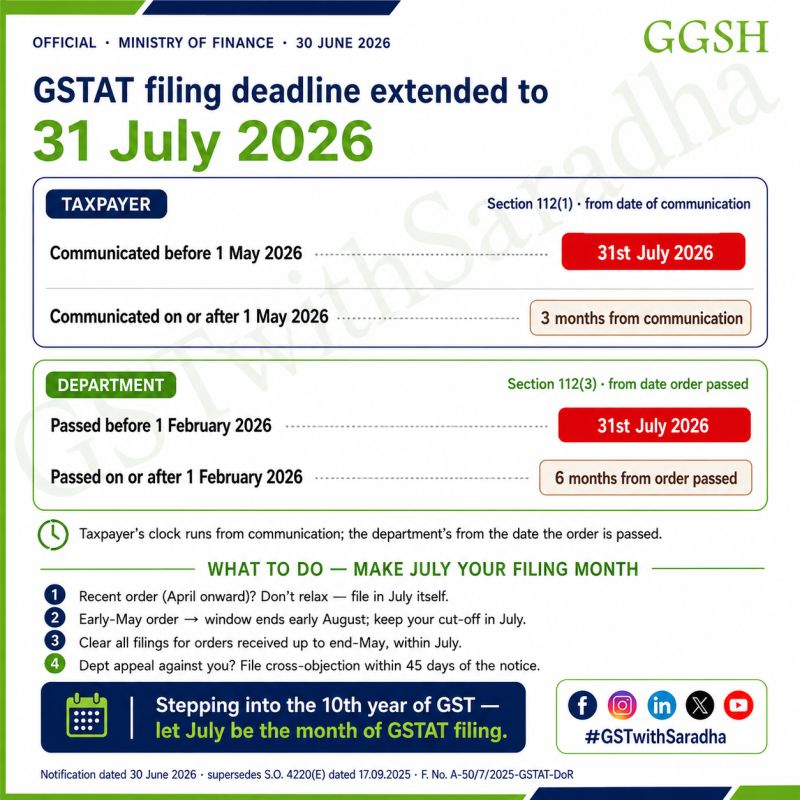
A. For the Taxpayer — Section 112(1)

For a taxpayer, the relevant period is generally reckoned from the date of communication of the order.

Order communicated before 1 May 2026

Where the order was communicated before 1 May 2026, the extended deadline is:

31 July 2026

Order communicated on or after 1 May 2026

Where the order was communicated on or after 1 May 2026, the normal limitation period applies.

That means the taxpayer generally has:

3 months from the date of communication of the order.

Therefore, the 31 July 2026 extension should not be interpreted as a universal deadline for all taxpayer appeals.

B. For the Department — Section 112(3)

The calculation is different for departmental appeals.

Here, the relevant date is the date on which the order is passed, rather than the date on which the order is communicated to the taxpayer.

Order passed before 1 February 2026

Where the order was passed before 1 February 2026, the extended deadline is:

31 July 2026

Order passed on or after 1 February 2026

For orders passed on or after 1 February 2026, the normal limitation period applies:

6 months from the date on which the order was passed.

This difference between the taxpayer’s limitation period and the Department’s limitation period is important when analysing GSTAT proceedings.

Why the Date of Communication Matters

One of the most important points for taxpayers is this:

The extension is linked to the date of communication of the order — not merely the date on which the order was passed.

Consider a simple example.

Suppose an order was passed in April 2026 but communicated to the taxpayer only in May 2026.

The relevant date for the taxpayer’s appeal is the date of communication, not the date on which the order was passed.

Therefore, taxpayers should examine the communication date carefully before assuming that the 31 July deadline applies.

Don’t Wait Until the Last Day

Even where the 31 July 2026 deadline is available, waiting until the final day may create unnecessary risks.

A GSTAT appeal may involve several practical steps, including:

  • Reviewing the impugned order
  • Identifying grounds of appeal
  • Preparing the appeal papers
  • Arranging supporting documents
  • Obtaining certified copies wherever required
  • Calculating and arranging the applicable pre-deposit
  • Completing the e-filing requirements
  • Addressing technical or portal-related issues

A delay at any one of these stages can create last-minute complications.

Therefore, the safer approach is to treat July 2026 as the filing month, rather than treating 31 July as the date on which preparation should begin.

What About an Order Communicated in May 2026?

This is where careful calculation becomes particularly important.

For example, if an order is communicated during the first week of May 2026, the normal three-month limitation period may extend into the first week of August.

However, that does not mean taxpayers should automatically wait until the outermost date.

From a practical risk-management perspective, completing the filing within July can provide a useful buffer against:

Drafting delays.
Document gaps.
Pre-deposit issues.
Certified-copy requirements.
Portal problems.

The safest deadline is often the one you do not have to test.

What If the Department Files an Appeal?

Taxpayers should also remember that GSTAT proceedings are not limited to appeals filed by the taxpayer.

If the Department files an appeal against an order affecting the taxpayer, the taxpayer may need to consider filing a cross-objection within the prescribed 45-day period, where applicable.

This is a separate timeline and can easily be overlooked.

Therefore, taxpayers should monitor GSTAT-related communications carefully rather than assuming that the 31 July 2026 extension covers every procedural requirement.

A Practical GSTAT Checklist

Before relying on the extended deadline, taxpayers should verify:

1. When was the order passed?

2. When was the order communicated?

3. Is the appeal being filed by the taxpayer or by the Department?

4. Which limitation provision applies?

5. Does the 31 July 2026 extension actually apply to the particular order?

6. Has the pre-deposit requirement been calculated and arranged?

7. Are the appeal documents and supporting records ready?

8. Has sufficient time been kept for portal-related issues?

9. If the Department has filed an appeal, has the cross-objection timeline been monitored?

These checks can prevent a seemingly simple deadline from becoming a procedural dispute.

The Larger Picture

As GST moves into its tenth year, the GSTAT framework is becoming increasingly important for resolving disputes arising under the GST regime.

The extension to 31 July 2026 provides relief in eligible cases.

But an extension of time does not eliminate the need for careful limitation analysis.

The key takeaway is simple:

31 July 2026 is not automatically the deadline for every GSTAT appeal.

For taxpayers, the date of communication of the order is critical.

For departmental appeals, the date on which the order was passed becomes relevant.

Understanding these two different timelines is essential before deciding whether the extended deadline applies.

Don’t just mark 31 July on your calendar.
First determine whether 31 July is actually your deadline.

In GST litigation, knowing the limitation period is as important as knowing the merits of the case.
31 July 2026: GST Month Turns “GSTAT Month”

The Government has pushed the GST Appellate Tribunal filing deadline to 31 July 2026. Here is what the notification really means and why July must still be your filing month.

I) A reprieve at the eleventh hour

For weeks, a single date hung over every GST litigator’s desk: 30 June 2026 — the outer deadline for filing backlog appeals before the Goods and Services Tax Appellate Tribunal (GSTAT). With the Tribunal only recently operational and a mountain of pending second appeals still waiting to be filed, the pressure on taxpayers and professionals alike was immense.

An unknown notification xxx?? “S.O. __(E).” dated 30th June 2026 issued by the Ministry of Finance in supersession of Notification S.O. 4220(E) dated 17 September 2025, and on the recommendations of the GST Council, the Government extended the last date for filing appeals and applications before the GSTAT to 31 July 2026.

Well, None seems to be bothered about the unnamed Notification without any reference, when both sides are happy about the extension!

But before you exhale, read the fine print.

II) What the notification actually says

The extension operates along two limbs — one for the taxpayer and one for the department — and each is tied to a different reference date.

Appellant Reference date Before the cut-off On or after the cut-off
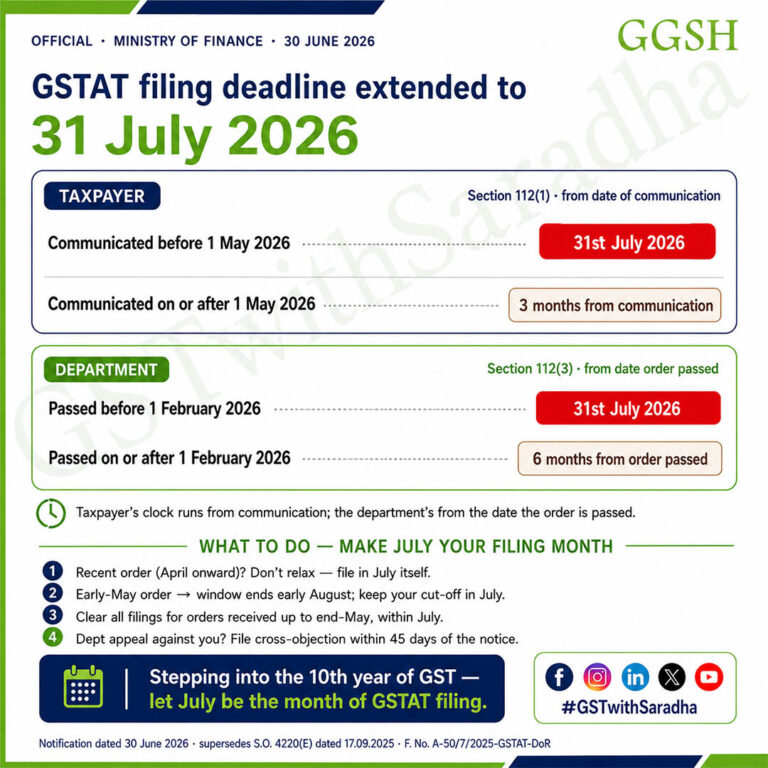
Taxpayer — Section 112(1) Date the order is communicated Communicated before 1 May 2026 → file by 31 July 2026 Communicated on/after 1 May 2026 → 3 months from communication
Department — Section 112(3) Date the order is passed Passed before 1 Feb 2026 → file by 31 July 2026 Passed on/after 1 Feb 2026 → 6 months from the date passed

In plain terms: the 31 July date is a special window for older matters. Newer matters simply continue under the ordinary statutory limitation.

III) The nuance not to miss under Sec 112: “communicated,” vs “passed”

Here is the single most important point, and the one most likely to trip up the unwary. For the taxpayer, the extension is keyed to the date of communication of the order — not the date the order was signed or passed.

This distinction matters enormously. An Order-in-Appeal passed in April 2026 but communicated to you in April — that is, before 1 May – still enjoys the 31 July benefit. But if that very same order reaches you on or after 1 May 2026, you fall outside the extension and are back on the standard three-month clock.

So the rule is simple, but unforgiving: always count from the date the order was communicated to you, and verify that date before you assume you have until July.

IV) So who actually benefits?

The 31 July 2026 date is available only where the order was communicated to the taxpayer before 1 May 2026. For every order communicated on or after 1 May, there is no extra time — the normal three months runs from communication, exactly as before.

If your order is recent i.e. on or after 1st May 2026, extension has not relevance at all.

V) Why July must still be your filing month

Even where the extension does apply, treating 31 July as a comfortable finish line is a mistake. Take an order communicated in the first week of May 2026. Three months carries you only to the first week of August, yet you should still aim to file within July, never the closing days. The reason is practical, not merely cautious. A GSTAT appeal is not a one-click affair: you must compute the pre-deposit precisely (the admitted amount in full, plus ten percent of the disputed tax), arrange certified copies, draft and compile your grounds, pay the court fee through the correct channel, and navigate an e-filing portal that is still settling in. Any short payment or missing document gets the appeal returned as defective, with only a limited window to cure it. Leave it to the last week, and a small slip becomes a lost appeal.

The disciplined response is straightforward — make July your filing month:

  1. Identify the date of communication of every pending order; that, not the date passed, is your trigger.
  2. For orders communicated before 1 May 2026, file by 31 July — ideally well before.
  3. For orders communicated on or after 1 May, count three months from communication, and still aim to file in July wherever it falls due.
  4. Compute the pre-deposit, arrange certified copies, draft, compile, and pay court fees early, not on the deadline.
  5. Clear all filings for orders received up to the end of May within the month of July, and remove the last-minute scramble entirely.

The PIB Press Release dated 30th June 2026also highlights the importance of timely filing:

“The Government has extended the due date in view of the recent representations from various stakeholders, highlighting technical difficulties due to rush to file appeals on the GSTAT portal. It is to be noted that in the last 15 days alone, 30,000 appeals were filed, with daily volumes peaking at5,500 appeals.

Taxpayers are advised to plan their appeal filings well in advance and not wait until the deadline.”

VI) The condonation safety net and its hard limit

What if you genuinely miss the date? Section 112(6) permits the Tribunal to admit an appeal within a further three months, on sufficient cause being shown. In effect, the window can stretch a little beyond the deadline.

But do not build your plan around it. Condonation is discretionary, a relief you must earn by demonstrating sufficient cause and not a second deadline to which you are entitled. And crucially, the Tribunal, being a creature of statute, has no power to condone delay beyond that statutory window. Past the outer limit, the door is bolted. Treat the deadline as a wall, not a guideline.

VII) Don’t forget: the Department can appeal too

One final point that businesses consistently overlook. A favourable first-appeal order is not the end of the road. The department has its own right to carry the matter to the Tribunal. If it does, and you are served notice, your window to file a cross-objection is just forty-five days under Section 112(5) — far shorter than the time to file an appeal. Stay alert for any such notice, register on the GSTAT portal so that communications reach you directly, and act quickly if it lands.

Step into year 10 with your filings done

As we step into the 10th year of GST with hope, trust, and loyalty to the law, the smartest response to this extension is not relief, but resolve. Read the date of communication carefully. Don’t assume the extension covers you. And whether it does or not, let July be the month of GSTAT filing.

The deadline moved. Your discipline shouldn’t.

Author’s note: This article is based on the notification dated 30 June 2026, issued in supersession of Notification S.O. 4220(E) dated 17 September 2025, on the recommendations of the GST Council. Readers are advised to seek professional advice on the facts of their own case before acting.

GSTR-4 Annual Return: A Simple Compliance Requirement That Should Not Be Delayed

For businesses registered under the Composition Scheme, GST compliance may appear relatively simple compared with regular taxpayers.

But simplicity does not mean that compliance deadlines can be ignored.

One important annual compliance requirement for eligible composition taxpayers is the filing of GSTR-4, the annual return applicable to composition taxpayers, subject to the provisions and applicability for the relevant financial year.

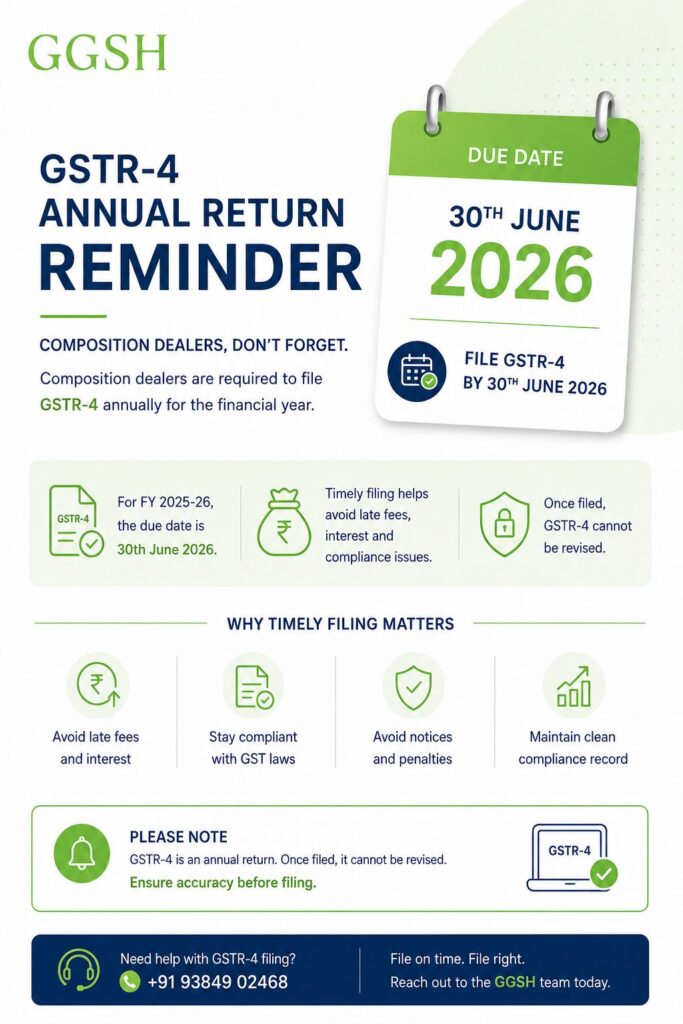
For FY 2025-26, the due date highlighted for filing GSTR-4 is:

30 June 2026

With the deadline approaching, composition dealers should ensure that their records are reviewed and the return is filed within the prescribed time.

Why Is Timely Filing Important?

Timely filing of GSTR-4 is not merely about meeting a statutory deadline.

It also helps a taxpayer maintain a consistent GST compliance record and avoid unnecessary complications arising from delayed filing.

A timely and accurate filing can help:

  • Avoid applicable late fees and other consequences of delayed compliance
  • Maintain compliance with GST requirements
  • Reduce the possibility of future notices arising from filing-related issues
  • Keep GST records up to date
  • Maintain a cleaner overall compliance history

For a small business, an annual return may appear to be a routine task.

However, a missed deadline can turn a simple compliance exercise into an avoidable problem.

Accuracy Matters Because GSTR-4 Cannot Simply Be Revised

One important aspect that composition taxpayers should keep in mind is that GSTR-4, once filed, cannot be revised.

This makes the verification stage particularly important.

Before submitting the return, taxpayers should carefully review the relevant details and ensure that the information being reported is accurate and properly supported by their records.

A rushed filing simply to meet the deadline can create its own set of complications.

Therefore, the process should ideally be:

Review → Reconcile → Verify → File

rather than:

Deadline arrives → File immediately

What Should Composition Dealers Review?

Before filing GSTR-4, taxpayers should consider reviewing the relevant books and GST records for the financial year.

Particular attention should be given to:

  • Outward supplies
  • Inward supplies
  • Purchases and expenses
  • Tax liability
  • Payments already made
  • Details reported in relevant GST returns
  • Any differences between books and GST records
  • Supporting invoices and documents

The exact reporting requirements should be checked based on the taxpayer’s circumstances and the applicable GST provisions for the relevant year.

Don’t Wait Until the Last Few Days

Deadlines often create unnecessary pressure when compliance work is postponed.

Reviewing the data early gives taxpayers an opportunity to identify discrepancies, obtain missing information and resolve issues before the return is submitted.

This becomes even more important because the return cannot simply be revised after filing.

A few minutes of additional verification today can potentially prevent hours of correction and clarification later.

A Small Compliance Task With a Bigger Impact

GST compliance is often built around several small recurring responsibilities.

GSTR-4 may be just one annual filing, but completing it accurately and on time contributes to maintaining a disciplined compliance process.

For composition dealers, the key message is simple:

Don’t wait for the deadline to arrive.

Review your records.

Verify the figures.

Check the applicable requirements.

And file GSTR-4 within the prescribed due date.

Due Date: 30 June 2026

A small compliance task today can help prevent bigger complications tomorrow.

Need assistance with your GSTR-4 compliance?
+91 93849 02468

GSTAT Appeals: Why Waiting Until the Deadline Could Be a Costly Mistake

“There’s still time. I’ll file it next week.”

For taxpayers with a pending GST appeal, this may sound like a harmless decision.

But when thousands of appeals are expected to reach the GST Appellate Tribunal within a short period, waiting until the final weeks could create unnecessary procedural and logistical challenges.

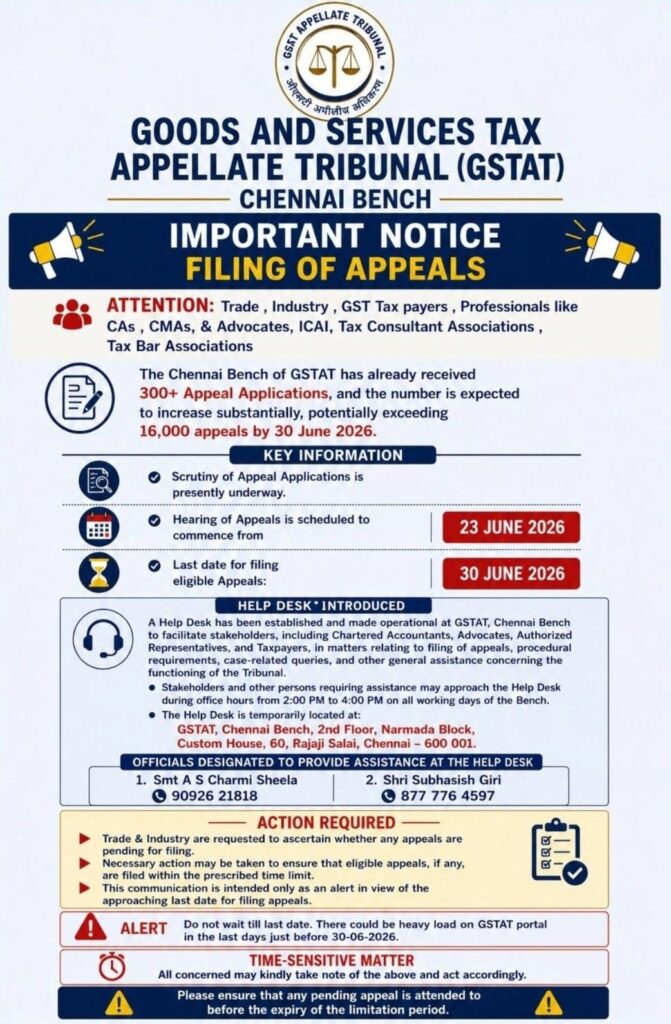
The situation at the Chennai Bench of GSTAT highlights why taxpayers and professionals should start preparing well in advance.

300+ Appeals Already Received

The Chennai Bench of the GST Appellate Tribunal has reportedly already received 300+ appeal applications and estimates that the number could rise significantly, potentially crossing 16,000 appeals before 30 June 2026.

If the expected volume materialises, the final weeks before the deadline could witness a substantial increase in filings.

For taxpayers, this means one thing:

The closer the deadline gets, the greater the filing pressure is likely to become.

Why Should Taxpayers Act Early?

A GSTAT appeal is not simply a matter of uploading a form before the deadline.

Depending on the case, preparation may involve:

  • Reviewing the adjudication or appellate order
  • Identifying appropriate grounds of appeal
  • Preparing the statement of facts
  • Drafting and reviewing grounds of appeal
  • Collecting supporting documents
  • Obtaining certified copies where required
  • Calculating the applicable pre-deposit
  • Arranging the necessary payment
  • Completing the e-filing process
  • Addressing any technical or procedural issues

Each of these steps takes time.

Waiting until the final days can turn a manageable filing exercise into a last-minute scramble.

The Tribunal Has Also Set Up a Helpdesk

Recognising the practical challenges faced by stakeholders, the Tribunal has also operationalised a Helpdesk to assist with filing-related queries and procedural requirements.

This is a useful facility for taxpayers and authorised representatives who may encounter difficulties during the filing process.

However, the availability of a Helpdesk should not be viewed as a reason to postpone filing.

If a taxpayer encounters an issue close to the deadline, there may be limited time available to resolve it.

The Right to Appeal Must Be Exercised Within Time

An appeal is not merely a procedural formality.

For a taxpayer who disagrees with an order, the statutory right to challenge that order can be extremely important.

But that right has to be exercised within the applicable limitation period.

A taxpayer may have strong grounds on merits, but failing to take timely procedural steps can create a separate and potentially serious limitation issue.

Therefore, the question should not simply be:

“How many days are left?”

The better question is:

“Is my appeal completely ready to be filed?”

A Simple Pre-Filing Check

If you have a pending GSTAT appeal, consider checking the following immediately:

✓ Is the order eligible for appeal?

✓ What is the applicable limitation period?

✓ Has the limitation deadline been correctly calculated?

✓ Are the grounds of appeal ready?

✓ Are all supporting documents available?

✓ Has the applicable pre-deposit been arranged?

✓ Are certified copies or other required documents ready?

✓ Has the e-filing process been initiated?

✓ Are there any outstanding procedural or portal-related issues?

If the answer to any of these questions is “No”, waiting another week may not be the safest approach.

Don’t Let the Deadline Become the Starting Point

A deadline should be the final checkpoint, not the point at which preparation begins.

With a significant number of appeals expected to be filed before the applicable deadline, taxpayers and professionals would be better served by completing their filings as early as reasonably possible.

Early preparation provides room to identify errors, obtain missing documents, address payment or pre-deposit issues and resolve technical difficulties.

Most importantly, it reduces the pressure of trying to complete everything at the last moment.

The Takeaway

The projected increase in GSTAT filings is a reminder that time available on paper is not necessarily the same as time available in practice.

The right to appeal is valuable only when it is exercised within the prescribed time and through the required procedure.

So, if you have been telling yourself:

“There’s still time. I’ll file it next week.”

This may be the right time to stop postponing it.

Check the limitation.
Prepare the appeal.
Complete the documentation.
Arrange the pre-deposit.
File well before the deadline.

Because 30 June 2026 is not just another date on the calendar for many taxpayers — it could be the last opportunity to exercise their right of appeal.

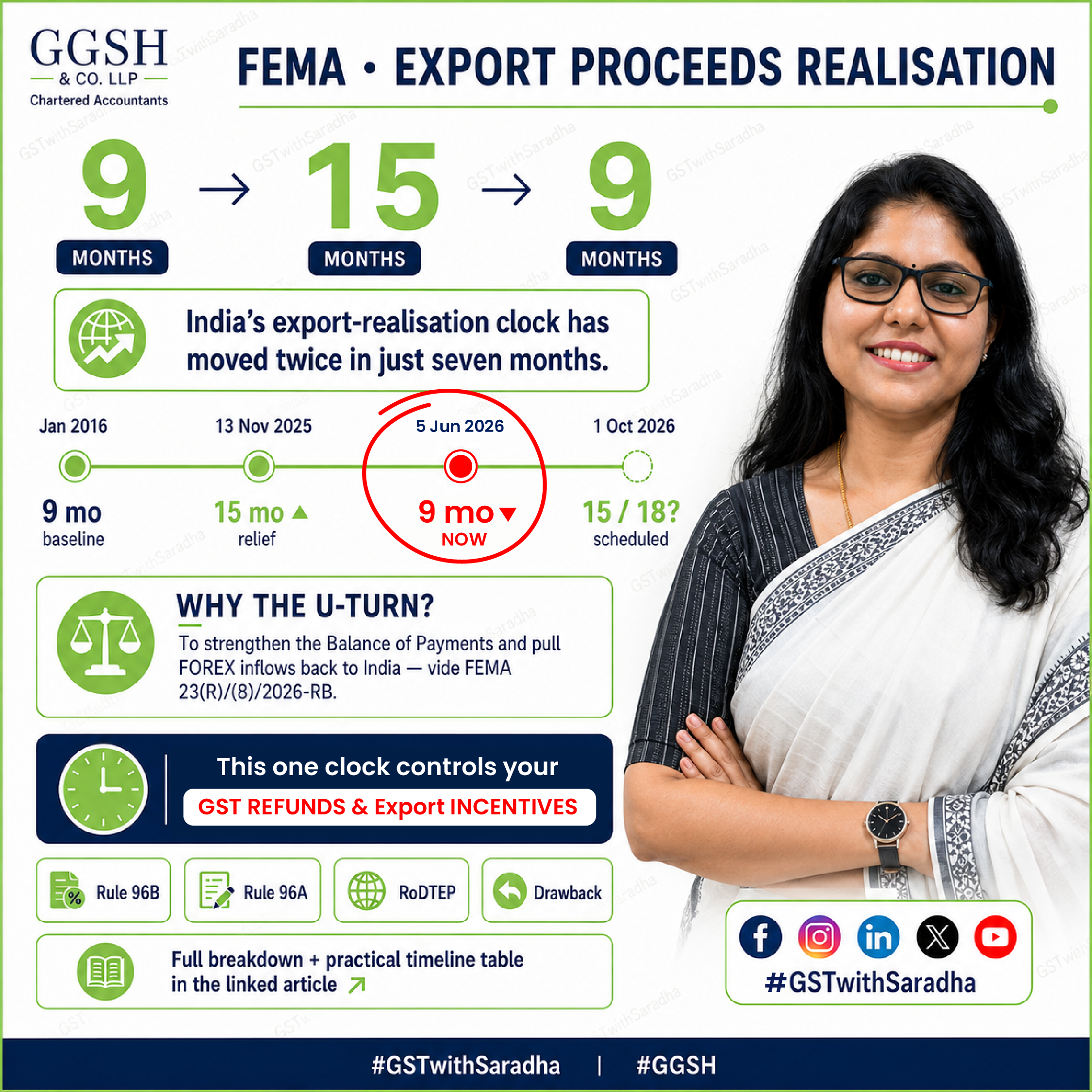
Nine-Month Clock: One FEMA Regulation AMENDED Twice in Seven Months and it STRINGENTLY Controls Your GST Refunds and every other Export Incentive

A deadline in FEMA Regulation 9 — the one that decides whether your export dollars, your GST refund, and your incentive scrips all survive the year.

Why this is a P&L question, before it is a FEMA question

For an exporter, GST refunds and export incentives like Duty Drawback, RoDTEP, RoSCTL and the rest, are not “other income” parked at the bottom of the statement. They are a core determinant of whether a shipment is actually profitable. And, properly understood, most of them are not “incentives” at all: they are the refund of Indian taxes and duties already borne by the exporter, returned on the bedrock principle that a country should export goods and services — not its taxes. Zero-rating and Refund of Accumulated credits exist precisely so that domestic levies do not travel abroad embedded in the price.

Yet in today’s environment softening global demand, geopolitical uncertainty, and the West Asia conflict inflating freight, insurance and lead times, no exporter can realistically defend margins or manage cash flow unless those refunds and incentives actually arrive, and arrive on time.

Here is the thread that ties it together: almost every one of these benefits hangs on one stringent condition — timely realisation of export proceeds, in line with the RBI’s FEMA guidelines. And when that single FEMA timeline keeps oscillating from nine months to fifteen, then nine again — the real difficulty is no longer just the realisation of foreign exchange. It is realising, in time, which timeline even applies — a burden that lands squarely on the business and its CFO.

This article gets into the depth of that moving deadline with the precise notifications, dates and provisions, and then ties it back to your refunds and incentives through a practical, example-led quick-referencer you can actually use.

A CFO’s November, and a June that undid it

Picture the finance head of a mid-sized engineering exporter, late November 2025. For nine years she has lived with a hard rule: bring the export money home within nine months, or you are technically in breach of FEMA. Long-credit buyers in slow markets made that a perennial squeeze.

Then, on 13 November 2025, relief arrives. The RBI extends the clock to fifteen months. She does the sensible thing — re-papers a few contracts, loosens the treasury model, tells her GST consultant the recovery risk on refunds has eased, and exhales.

In between all these, there came another notification on 13th Jan 2026 with all new liberalised Export Regulations, which created a big expectation for her that the new fifteen months timeline could become permanent from 1st Oct 2026.

And now suddently, Six months later, on the evening of 5 June 2026, the clock snaps back to nine months. Same provision. Opposite direction. Everything she relaxed now has to be re-tightened.

That whiplash is the story of Regulation 9 of the Foreign Exchange Management (Export of Goods & Services) Regulations, 2015, and it is far more than an exchange-control footnote. This one number is quietly wired into your GST refunds, your duty drawback, and your RoDTEP scrips. When it moves, all of them move with it. Here is how the clock got here, why the RBI keeps resetting it, and what you actually do about it.

What Regulation 9 really is

:How long do you have to realise and repatriate the full value of your exports before you are offside?”

The principal regulation — Notification No. FEMA 23(R)/2015-RB dated January 12, 2016 (G.S.R. 19(E)) set the baseline:

  • Reg 9(1) — the general rule: nine months from the date of export.
  • Reg 9(1), proviso (a) — goods to an RBI-approved overseas warehouse: fifteen months.
  • Reg 9(2)(a) — SEZ units, Status Holders, EOUs, EHTPs, STPs, BTPs: nine months.

But here is the hook that makes it IMPORTANT: Every other statutes don’t write their own deadline — they borrow this one. GST’s refund rule, the customs drawback recovery rule, and several incentive schemes all say, in effect, “within the period allowed under FEMA, including any extension.” So Regulation 9 is not one clock. It is the master clock. Move it, and a whole chain of consequences shifts on the same hinge.

The PENDULUM: a decade of the clock swinging

For most of its life the number sat at nine. Then it started to swing — gently at first, then violently. The full trail, reconciled against RBI’s own statutory footnote and the June 2026 papers:

#InstrumentDateWhat it did to the clockThe “why” behind it
0FEMA 23(R)/2015-RB (G.S.R. 19(E))12-Jan-2016Baseline: 9 months (15 for warehouse; 9 for SEZ/EOU).Replaced FEMA 23/2000-RB; the long-standing norm.
1G.S.R. 635(E)23-Jun-2017Clock untouched (deleted a declaration-retention rule).Housekeeping.
2FEMA 23(R)/(2)/2019-RB03-Dec-2019Clock untouched.Operational.
3FEMA 23(R)/(3)/2020-RB31-Mar-2020Clock figure untouched — but inserted the magic words “or within such period as may be specified by the Reserve Bank … from time to time.”Built the lever that lets RBI swing the clock at will.
—A.P. (DIR Series) Circular No. 2701-Apr-2020Temporary 9 → 15 months for exports up to 31-Jul-2020.COVID lifeline, by circular; lapsed by its own terms.
4FEMA 23(R)/(4)/2021-RB08-Jan-2021Clock untouched (leased-aircraft re-export).Sectoral.
5FEMA 23(R)/(5)/2021-RB08-Sep-2021Clock untouched (LIBOR → benchmark in Reg 15).Rate-benchmark transition.
6FEMA 23(R)/(6)/2025-RB24-Jun-2025Clock untouched (tugs, dredgers, offshore vessels).Marine/offshore sector.
7FEMA 23(R)/(7)/2025-RB (“Second Amendment, 2025”)13-Nov-20259 → 15 months (Reg 9(1) and 9(2)(a)); advance-shipment window 1 → 3 years (Reg 15).Relief amid US tariffs and shipping disruption.
—FEMA 23(R)/2026-RB (Export & Import Regs, 2026)13-Jan-2026; eff. 01-Oct-2026Supersedes 2015 Regs. Carries 15 months (18 for INR); warehouse from date of sale; set-off recognised as realisation.The big consolidation — not in force yet.
8FEMA 23(R)/(8)/2026-RB (“First Amendment, 2026”)05-Jun-202615 → 9 months (Reg 9(1) and 9(2)(a)). Warehouse (15 months) and Reg 15 (3 years) left alone.Balance-of-payments / capital-inflow push.

Read the right-hand column top to bottom and the plot reveals itself: the clock is RBI’s valve. Loosen it when exporters need breathing room; tighten it when India needs its dollars home. The 2020 insertion in amendment (3) reads as “or within such period as may be specified”. This is what made the valve turn-able in the first place.

So the net journey of the headline number: 9 (2016) → a COVID detour to 15 → 15 (Nov 2025) → back to 9 (Jun 2026) — while a brand-new regime (15, or 18 for rupee invoicing) waits in the wings for 1 October 2026.

The WHODUNIT: Why the clock snapped back on 5 June 2026

If the November extension was relief, the June reversal looked, at first glance, like a contradiction, especially with the liberal 2026 Regulations (fifteen/eighteen months) due in barely four months. So why?

The answer is in the Governor’s Statement of 5 June 2026, delivered with the bi-monthly monetary policy (the MPC held the repo rate at 5.25%). The reversion wasn’t a trade-compliance tweak at all. It was the fifth of five measures announced that day expressly to attract foreign capital. Alongside it came an expanded Fully Accessible Route for 15/30/40-year G-secs (with FPI limits eased), wider NRI/OCI/PROI access to listed equity without SEBI registration, a concessional forex-swap facility for PSU external commercial borrowings (to 30 September 2026), and full hedging-cost support for fresh 3–5 year FCNR(B) deposits (to 30 September 2026).

The common thread, in the RBI’s own words, is that these steps are expected to “strengthen our balance of payments.” The backdrop made the motive plain: net foreign-portfolio outflows of US$13.7 billion between 1 April and 2 June 2026 (mostly equity), a depreciating drift across emerging-market currencies, crude near US$110 a barrel, and a still-unresolved West Asia conflict — even as reserves stayed comfortable at US$682.3 billion (about eleven months of imports).

By shortening the realisation window, RBI intends to pull export receipts home sooner, improving the dollar inflows quickly. It is precisely the lever RBI reached for in the 2013 taper-tantrum, when it compressed the SEZ realisation period to speed up flows.

Note: This is not the RBI defending a rupee level. The Governor reiterated that the exchange-rate policy is unchanged and targets no specific level or band. The central bank acts only to curb excessive volatility and prevent disorderly markets. So, this is a balance-of-payments / inflow-timing measure, not a currency peg.

The OCTOBER puzzle — and why it isn’t really a paradox

Here’s the apparent riddle a sharp reader will spot. Today’s in-force law (the 2015 Regs, as amended) says nine months. The not-yet-commenced 2026 Regulations say fifteen / eighteen months from 1 October 2026. Two opposite numbers, four months apart. Now what is the fate of new 2026 Regulation, which is already notified to be effective from 1st October 2026?

Look at the design and the tension dissolves. The two foreign-currency facilities in the June package — the forex swap and the FCNR(B) hedging support — were given an explicit 30 September 2026 end-date. That is exactly one day before the 2026 Regulations switch on. The reasonable sensible reading: the nine-month reversion is a bridge — a roughly four-month sprint to maximise near-term inflows, after which the liberalised 2026 framework resumes by simply superseding the old one.

Honestly, Two caveats to note here:

  1. No sunset clause. Unlike the swap and deposit facilities, the (8)/2026 notification put no end-date on the nine-month period. It is an open-ended substitution that legally just ends when the 2015 Regulations are superseded.
  2. The bridge holds only if 1 October holds. The fifteen/eighteen-month restoration depends on the 2026 Regulations commencing on schedule. As of now, there is no sign of deferral, which means the nine months tightening is only from 5th June to 30th Sep 2026. But if external-sector stress persists, RBI could push that date or carry the nine-month discipline into the new regime. That is the single thing to watch.

PRACTICAL examples for quick reference:

Same goods, seven shipping dates, seven deadlines: the clock in practice

Theory is one thing; the calendar is another. Here is the rule made concrete. Imagine the same consignment, identical goods with identical value, but shipped on different dates. Watch how it picks up wildly different deadlines depending purely on which phase of the clock it lands in. Pay special attention to items 3 and 4 (one week apart), and to items 6 and 7 (the warehouse clock that never moved — but whose starting point shifts on 1 October 2026).

S. No.Illustrative date of exportRegime in force on that date (governing instrument)Applicable realisation periodRealisation cut-off date (deadline)What it means in practice
110-Sep-2025 (before the Nov-2025 extension)Original 9-month rule, 2015 Regs as then in force9 months10-Jun-2026The old normal — proceeds had to be home by 10-Jun-2026.
220-Jan-2026 (in the 15-month window)FEMA 23(R)/(7)/2025-RB (9 → 15 months)15 months20-Apr-2027Shipped while 15 months applied — the longer clock survives the June reversal (prospective change).
301-Jun-2026 (still in the 15-month window — four days before the reversal)FEMA 23(R)/(7)/2025-RB (15 months)15 months01-Sep-2027Just made it under the wire. A full 15 months to realise.
408-Jun-2026 (three days after the reversal)FEMA 23(R)/(8)/2026-RB (15 → 9 months)9 months08-Mar-2027A near-identical shipment a week later — yet due nearly six months earlier than item 3.
505-Nov-2026 (under the new regime, assuming on-schedule commencement)FEMA 23(R)/2026-RB (15 months; 18 if INR-invoiced/settled)15 months (18 if INR)05-Feb-2028 (or 05-May-2028 if INR)The liberalised regime returns — and rewards rupee invoicing with three extra months.
6Goods sent to an overseas warehouse, shipped 01-Jul-2026 (2015 proviso still in force)FEMA 23(R)/2015-RB, Reg 9(1) proviso (a)15 months from date of shipment01-Oct-2027Warehouse exports were never part of the 9-month reversal — still 15 months even in the June–Sep nine-month phase. Clock runs from shipment.
7Goods sent to an overseas warehouse; sold from the warehouse on 10-Jan-2027 (2026 regime)FEMA 23(R)/2026-RB, warehouse rule15 months from date of sale10-Apr-2028Same 15-month length as item 6 — but from 1 Oct 2026 the starting point shifts from shipment to date of sale, which can fall long after the goods left India.

Notes for the table:

(a) The one-week cliff-edge (items 3 and 4). A shipment on 1 June 2026 carries a 15-month clock (due Sep 2027); an almost identical shipment on 8 June 2026 carries only nine months (due Mar 2027). The later shipment is due roughly six months earlier, because the longer clock had already attached to the earlier one. This is exactly the kind of counter-intuitive trap that triggers real-world recovery notices, so date-stamp and bucket every shipment around the 5 June 2026 line.

(b) “Date of export” defined. For goods it is the date of shipment; for software/services in non-physical form it is the date of invoice (Explanation to Reg 9 / the 2026 Regulations).

(c) Deadlines are a floor, not a ceiling. An AD bank or the RBI may extend the period for sufficient and reasonable cause — a documented, timely extension request is your safety net.

(d) The in-flight rule (item 2 and item 3). An export made while fifteen months applied keeps fifteen months even though the rule later reverted — keep dated proof of the period in force at shipment.

(e) Two regimes and a shifting starting point (items 6 and 7). Items 1–4 and 6 sit under the 2015 Regs; items 5 and 7 sit under the superseding 2026 Regs. The warehouse 15-month proviso stayed at fifteen months throughout the 9 → 15 → 9 whipsaw of the general clock — but the basis of counting changes on 1 October 2026: from date of shipment (2015 proviso) to date of sale from the warehouse (2026 regime). Same duration, materially different start date and for consignment/fulfilment models where goods sit abroad for months before sale, the 2026 basis is far more generous in practice.

(f) The bridge to the next section. Under GST’s Rule 96B, the 30-day deposit alarm starts ticking the day after each cut-off above — so these are not merely FEMA dates, they are the dates your refund stops being safe.

How it affects your GST refund?

This is the part most operational teams miss, and the reason the swing back to nine months is not just an FX story, rather a cash story.

EXPORT OF GOODS:

If you export goods, Zero-rating doesn’t wait for the money: an “export of goods” is simply goods leaving India (Section 2(5), IGST Act). So you can claim a refund on shipment, either with payment of IGST (refund of the IGST paid, Section 16(3) r/w Rule 96) or without payment, under a Letter of Undertaking or bond (the LUT/bond itself furnished in Form RFD-11 under Rule 96A; the refund of accumulated ITC then claimed under Section 54 r/w Rule 89).

First, Rule 96A(1)(a) requires the goods to be physically exported within three months of the invoice (Commissioner-extendable) if you miss that, you have to pay the tax with interest, the LUT is withdrawn (recovery under Section 79) and restored only on payment (Rule 96A(3)–(4)).

Second, Rule 96B: If the proceeds aren’t realised within the FEMA period, including any extension, you must deposit back the proportionate refund with interest within 30 days of that period’s expiry — failing which it’s recovered as an erroneous refund under Section 73/74/74A with interest under Section 50. (Relief valves exist: re-credit if you realise later, and no recovery if RBI writes off the realisation on merits.) Note: Rule 18 of the Customs & Central Excise Duties Drawback Rules, 2017 claws back drawback on the very same trigger.

Now connect the dots: because Rule 96B borrows the FEMA clock by reference, the swing back to nine months shrinks your refund-safe window by six months overnight. The 30-day deposit alarm now rings sooner. Every exporter who relaxed Rule 96B monitoring to a fifteen-month horizon in the interim has just been put back on a tighter leash without changing a thing in their own operations.

EXPORT OF SERVICES:

If you export services. Here the clock is even more fundamental, it’s part of the definition. Under Section 2(6) of the IGST Act, a supply is an “export of service” only if, among five cumulative conditions, payment is received in convertible foreign exchange (or in INR wherever the RBI permits). The supply is not an export, not zero-rated without realisation. e-BRC/FIRC becomes your single most important survival document for claiming your refund (IGST-paid or accumulated-ITC).

For services exported under LUT, the GST deadline to realise lives in Rule 96A(1)(b) and since its substitution with effect from 10 July 2024 (Notification No. 12/2024-Central Tax), that deadline is expressly the later of (i) one year, or (ii) the period allowed under FEMA including any RBI extension, from the invoice date. The FEMA realisation number is, in other words, literally written into the GST rule. Watch how it moves: when FEMA stood at fifteen months, this GST clock stretched to fifteen; with FEMA back at nine months it rests on its one-year floor; and under the 2026 regime’s eighteen-month INR window it would run to eighteen. If you breach it, you have to pay the tax with interest (Section 50) within fifteen days, the LUT is withdrawn (recovery under Section 79) and restored only once you pay (Rule 96A(3)–(4)). So a service exporter actually watches two interlocked clocks (a) the FEMA/EDPMS realisation period (nine months, governing the Section 2(6) export character and exchange-control compliance) and (b) Rule 96A(1)(b) GST clock (the later of one year or FEMA). And finally, the two-year limitation for filing the refund claim itself under Section 54.

What happens to your EXPORT incentives

The pattern repeats right across the benefit stack, because they all key off the same FEMA period:

  • Duty Drawback — recovered on non-realisation within the FEMA period (Rule 18, Drawback Rules, 2017).
  • RoDTEP / RoSCTL — benefits conditioned on, and scrips liable to recovery for, non-realisation in time.
  • Advance Authorisation / EPCG — export-obligation discharge needs realisation in free foreign exchange (subject to permitted INR settlement) within FEMA timelines.
  • SEZ / EOU — predicated on timely realisation; back on the nine-month footing after (8)/2026.
  • INR-settled trade — DGFT extended FTP export benefits to rupee-settled trade via the special Vostro mechanism. Note the asymmetry: the 2026 Regulations reward INR invoicing with an extra window (18 months), but today’s Reg 9 makes no INR distinction — rupee and forex exports alike run on nine months until the 2026 regime arrives.

The takeaway in one line: a single change to one FEMA Regulation can affect all the benefits of Indian Exporters. The reversion to nine months re-enlarges exactly that danger zone.

What actually BUSINESSES SHOULD DO

Action by action:

  1. Reset the clock in your systems. Re-base EDPMS trackers, treasury models and customer-credit terms to nine months for every export made on or after 5 June 2026.
  2. Protect your in-flight shipments. For exports made during the fifteen-month window (14 Nov 2025 – 4 Jun 2026), the better view is that the fifteen-month period survives (the change runs prospectively) But the notification carries no transition clause, so preserve dated evidence of the period that applied at shipment and confirm with your AD bank before you move any existing deadline.
  3. Re-map your Rule 96B exposure. Re-run the refund-recovery calendar on a nine-month basis; revisit anything you set to fifteen months. Build the 30-day deposit alarm into your GST compliance calendar so a missed realisation never becomes a Section 73/74 recovery.
  4. For services, treat the e-BRC/FIRC as a basic document, under Section 2(6), no realisation means no export, means no refund. If you export under LUT, track the Rule 96A(1)(b) clock too — currently the later of one year or the FEMA period — and remember the LUT can be withdrawn (and then restored on payment) if you breach it. For goods under LUT, don’t lose sight of the separate Rule 96A(1)(a) three-month physical-export deadline.
  5. Don’t mix up the clocks. Warehouse exports (15 months) and advance-payment shipments (3-year shipment window, Reg 15) were not reverted. Tag these transactions separately so they aren’t swept into the nine-month reset.
  6. Watch the 1 October 2026 hand-off – Confirm whether the 2026 Regulations commence on schedule restoring fifteen/eighteen months and re-introducing set-off and the “date of sale” warehouse rule; or get deferred/amended if external-sector pressure lingers. Plan in-flight shipments, warehouse stock and any set-off arrangements around that switchover.
  7. Engage your AD bank early on extensions. AD banks (and the RBI) retain power to extend the period for sufficient cause; a proactive, documented request beats a missed deadline.

The clock will almost certainly swing again; that is now its nature. The exporters and finance teams who treat Regulation 9 as a live variable rather than a fixed fact. Businesses who connect it to their GST refunds and incentives are the ones who will never be caught on the wrong side of a thirty-day alarm.

HOW do you manage

A timeline that changes this often shouldn’t be carried alone. If it would help to have someone map your shipments to the right realisation period, rebuild your Rule 96B monitoring, align contracts and AD-bank extension requests, or pressure-test your GST refund and incentive positions against the very latest notification. That is exactly where we would be glad to help.

Reach out to us at info@ggsh.in. +91 93849 02468 for a quick, no-obligation conversation tailored to your export profile. Bring your trickiest shipment dates; we will tell you which clock is ticking, and how long you really have.

(If you found this useful, do share it with a fellow exporter, CFO or finance colleague who is still working off the old nine-month — or the interim fifteen-month — assumption.)

Sources: RBI Notifications FEMA 23(R)/2015-RB and its amendment chain through FEMA 23(R)/(8)/2026-RB dated 05-Jun-2026 (First Amendment Regulations, 2026); FEMA 23(R)/2026-RB dated 13-Jan-2026; the RBI Governor’s Statement and the Monetary Policy Statement, 2026-27 / Resolution of the MPC, both dated 05-Jun-2026 (RBI Press Releases 2026-2027/386 and 2026-2027/385); the CGST Rules (Rules 96, 96A, 96B and 89 — Rule 96A(1)(b) as substituted w.e.f. 10-Jul-2024 by Notification No. 12/2024-Central Tax); the IGST Act (ss. 2(5), 2(6), 16, 54); the CGST Act (ss. 50, 73, 74, 74A, 79); and the Customs & Central Excise Duties Drawback Rules, 2017.

GGSH Disclaimer:

This article is intended for informational purposes only and does not constitute legal, tax, FEMA or professional advice. Readers should evaluate the applicability of the discussed provisions to their specific facts and seek professional advice before acting on any matter discussed herein. GGSH & Co. LLP shall not be liable for any action taken or not taken based on this publication.

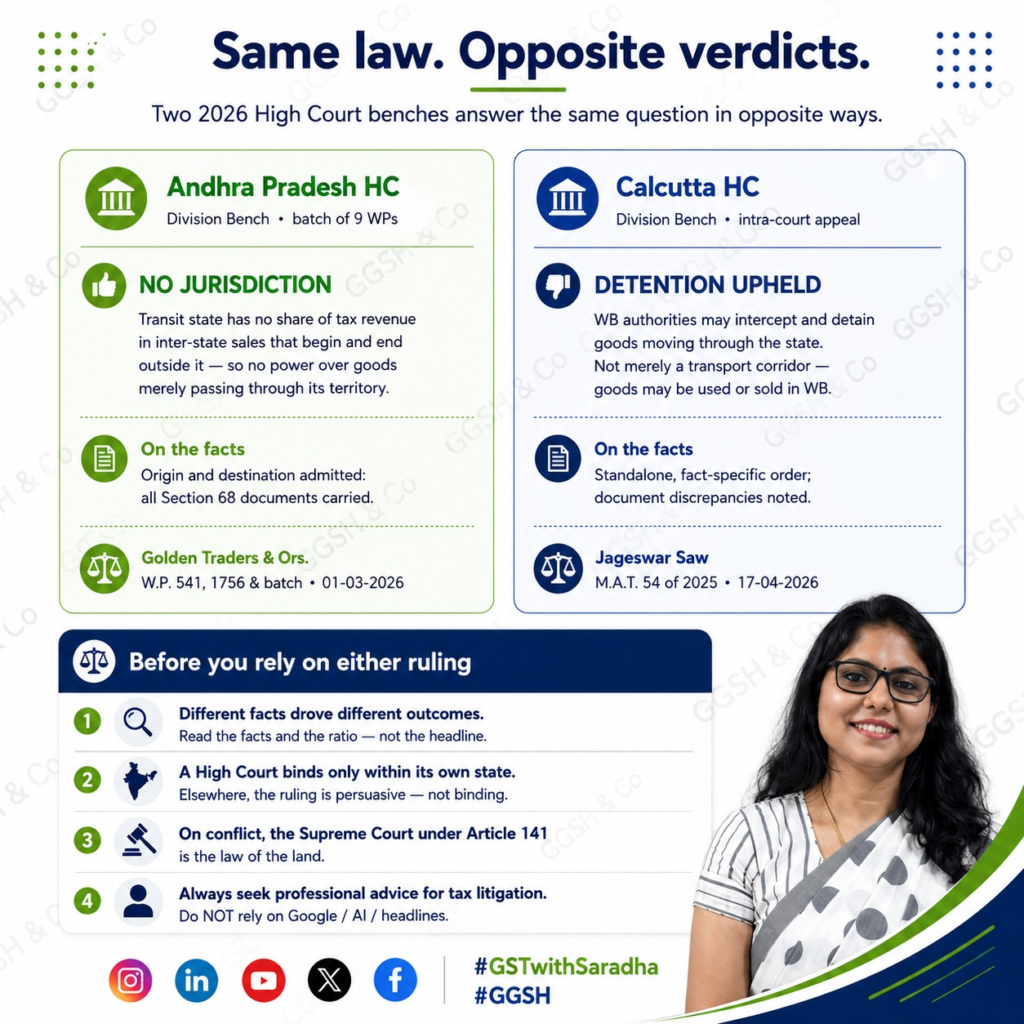
Goods Detention by Transit-state officer?? When Two High Courts Read the Same Law in Opposite Ways on the POWER of Officers to detain goods.

A practitioner’s note on the apparent conflict between the Andhra Pradesh High Court and the Calcutta High Court on the power of a transit-state officer to intercept and detain goods.

The Promise & The Present Reality

In 2017, GST was sold to industry on a single, powerful idea – the seamless movement of goods across India. One nation, one tax, no check-posts at every border. Nearly nine years on, businesses still find themselves litigating a surprisingly basic question: can goods be intercepted, detained or confiscated by any officer, anywhere in the country, simply because the vehicle happened to pass through that State?

On the ground, the answer often feels like “yes”. On the statute book and in recent case law, the position is far less settled. Two recent High Court decisions have, in fact, answered the very same question in opposite ways – and the divergence is instructive for anyone who advises on movement of goods.

The Two Rulings

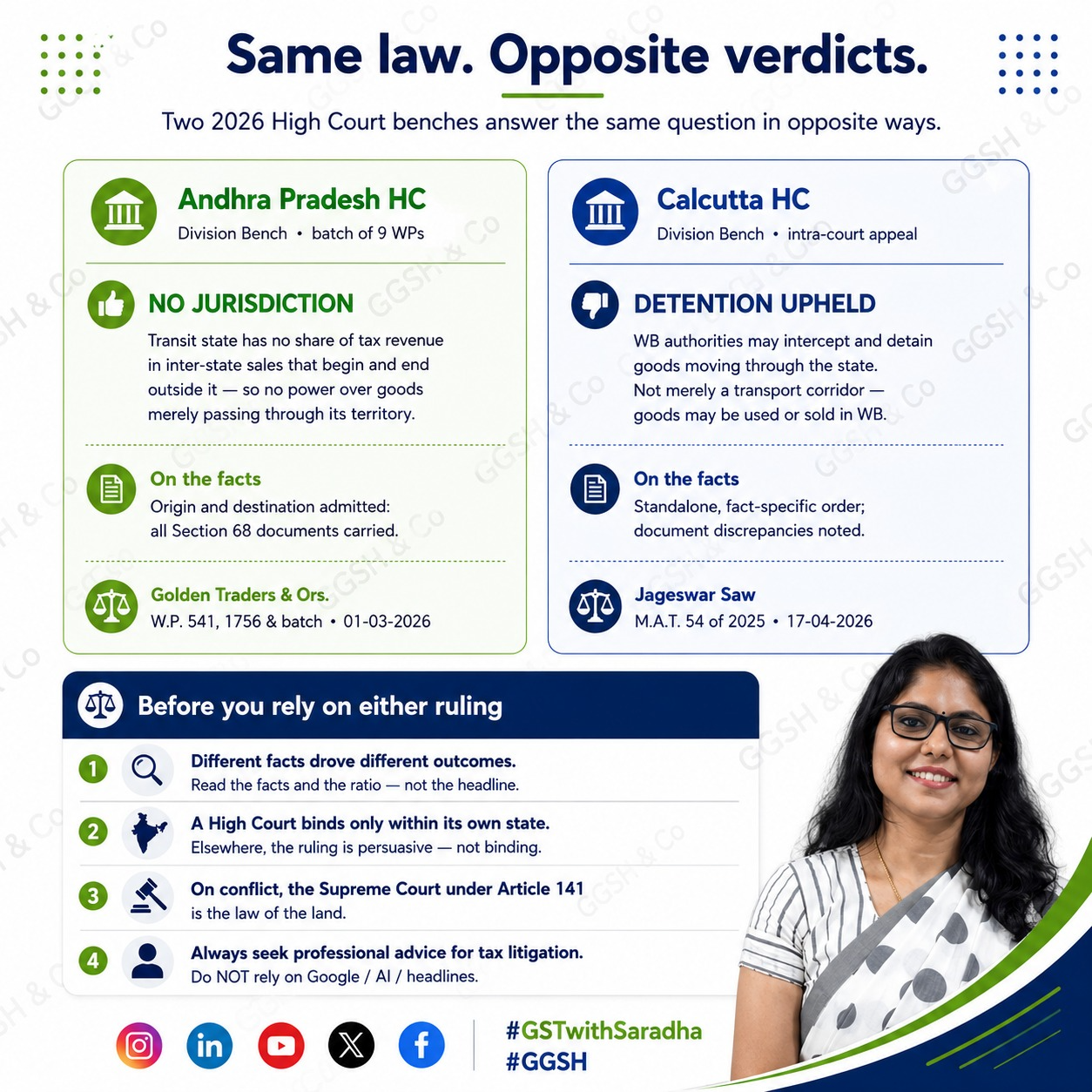
Andhra Pradesh High Court (Division Bench) – Golden Traders – W.P. Nos. 541, 1756, 3097, 3225, 3227, 3252, 3254, 3258 & 3354 of 2026, dated 01-03-2026.

The Division Bench took the view that a transit State has no share of tax revenue in an inter-State sale that originates outside the State and culminates outside the State. Since the transit State has no fiscal stake in such a transaction, it has no jurisdiction over goods that merely pass through its territory en route to another State.

Calcutta High Court — Jageswar Saw, M.A.T. 54 of 2025, dated 17-04-2026.

Hearing an appeal against an order of the Single Judge, the Division Bench took the opposite view and upheld the power of the West Bengal authorities to intercept and detain goods moving through the State.

Same GST law. Similar movement of goods. Very different judicial outcomes. So how does one reconcile them?

Why the outcomes diverged: read the FACTS, not the headline

The instinct is to treat these as two benches taking diametrically opposite views of the same legal question. A closer reading suggests the divergence is driven by a thin but decisive line of fact.

The Calcutta decision is a standalone, fact-specific order. The Court flagged a lack of clarity in the facts before it. In Para 32, the Bench observed that on the material on record, “it cannot be accepted that West Bengal was merely a transport corridor and the goods would not be used or sold in West Bengal.” The order also records discrepancies in the accompanying documents. In other words, the Court was not satisfied that West Bengal was a pure pass-through State, and it was not dealing with clean documentation.

The Andhra Pradesh decision arises in a very different posture. It is a batch order disposing of nine petitions on common facts. The judgment proceeds on concluded facts as to the origin State and the destination State (Para 4) and on an admitted position that the goods were accompanied by all the documents required under Section 68 (Para 5). On those facts, Andhra Pradesh genuinely was only a transit corridor, and the documentation was not in question.

That single distinction does a great deal of work:

  • In Andhra Pradesh, the State’s status as a mere transit corridor and the sufficiency of Section 68 documentation were settled. The Court could therefore reach the jurisdictional question cleanly.
  • In Calcutta, neither of those things was established. The transit-corridor claim was contested, and the documents were deficient. The Court never had to decide the pure jurisdictional question on undisputed facts.

So while the two orders appear to be on the same subject, the divergence is at least as much a function of facts and circumstances as of any irreconcilable view of law. That differentiation is critical before either order is cited as authority.

The precedent question: binding versus persuasive, and Article 141

Even where two High Courts do genuinely differ on a question of law, a practitioner cannot simply pick the favourable one. Two settled principles govern how these orders may be used:

A High Court judgment is binding only within its own territorial jurisdiction. The Andhra Pradesh order binds authorities and tribunals within Andhra Pradesh; the Calcutta order binds within West Bengal. Outside its home State, a High Court ruling carries persuasive value – it can be cited and relied upon as reasoning – but it is not binding precedent.

When conflicting views emerge, the Supreme Court settles the law. A reasoned judgment of the Supreme Court on the merits becomes, by virtue of Article 141 of the Constitution, the law of the land binding on all courts within the territory of India. Until and unless the issue is taken up and decided by the Supreme Court, taxpayers across different States may continue to face genuinely different positions depending on where the vehicle is stopped.

What this means for businesses and advisers

For a transporter or consignor whose goods are detained in a transit State, the practical lesson is not “the Andhra Pradesh order protects me everywhere.” It does not. The lesson is more disciplined:

  1. Establish the FACTS FIRST. Is the State of detention genuinely only a transit corridor – origin and destination both elsewhere? Are the Section 68 documents complete and consistent? The strength of any jurisdictional argument rises and falls on these facts.
  2. Match the facts before citing the case. A favourable order helps only where your facts mirror it. Andhra Pradesh helps the clean transit, complete documents fact pattern. Calcutta is a caution for the contested corridor, deficient documents fact pattern.
  3. Know your forum. Within your own State, the local High Court position governs. Elsewhere, you are arguing on persuasive value and on first principles, not on binding precedent.
  4. Watch for escalation. Given the split, this is precisely the kind of issue that may ultimately need an authoritative Supreme Court ruling under Article 141. Track the position rather than treating any single headline as final.

A Closing Caution

Headlines, search engines and AI summaries are tempting shortcuts in tax practice, and an apparent “conflict” between two High Courts makes for striking copy. But the discipline of the profession lies in reading the issue, the facts and the ratio and in recognising when a divergence is genuinely about law and when it is, on closer reading, about facts.

Before relying on either of these orders, study the full text, map it against your own fact pattern, and seek professional advice rather than drawing quick conclusions from matching case titles.

This article is intended as general information for tax professionals and does not constitute legal or professional advice. Citations should be independently verified against the certified copies of the orders, and the full text of each judgment should be read before reliance.

Indian Exporters RELIEF Scheme due to IRAN WAR and GEOPOLITICAL challenges Realisation Nexus: A Legal Analysis of ECGC Claims & the GST REFUNDS

TO SET THE CONTEXT

1.What are ECGC Claims?

ECGC claims refer to the amounts payable by the Export Credit Guarantee Corporation of India (ECGC) to exporters when they suffer a loss due to non-payment or default by overseas buyers, or due to political risks in the importing country. In short, ECGC claims are insurance payouts to exporters for losses arising from buyer default or political risks in international trade.

2.Purpose of ECGC Claims

  • Protect exporters against export credit risk
  • Encourage exports by reducing uncertainty in international trade
  • Provide financial security in case of default or disruption

3.Recent developments: What is actually happening on the ground?

  • War-related disruptions in West Asia (including Iran region) have:
    • Increased freight costs
    • Increased insurance / war-risk premiums
    • Caused shipment delays, rerouting, and contract uncertainty
  • Government response:
    • ₹497 crore RELIEF scheme launched
    • ECGC made nodal agency for claim verification and settlement
  • Exporters are now facing:
    • Payment delays / contract cancellations
    • Higher probability of defaults
    • Logistics disruptions affecting delivery timelines

These are classic triggers for ECGC claims (political + commercial risk).

4.The Problem No One Is Talking About – The Critical ECGC-GST Intersection

If an exporter’s buyer in a West Asia country or any other part of the world fails to pay due to war/political disruption, and the exporter receives settlement from ECGC instead. Does that satisfy the “realisation of sale proceeds” condition under GST law?

I. The Geopolitical Context: What the RELIEF Scheme Actually Is

The Government of India on March 19, 2026 unveiled the RELIEF (Resilience & Logistics Intervention for Export Facilitation) Scheme with a financial outlay of ₹497 crore under the Export Promotion Mission (EPM), aimed at addressing “extraordinary freight escalation, heightened insurance premia and war-related export risks” faced by Indian exporters due to the West Asia conflict.

The crisis has been triggered by escalating security concerns around the Strait of Hormuz, forcing vessel diversions, longer sailing routes, congestion at transshipment hubs, and emergency conflict-linked surcharges. Commerce Secretary confirmed that “exporters to the Middle East are facing challenges” and “exports haven’t reached destinations, future exports getting impacted,” with a “sense of worry” among exporters exposed to the region.

The scheme is structured into three components:

Component I (₹56 crore): For exporters already insured by ECGC with shipments between February 14 and March 15, 2026 – government tops up war and political risk losses beyond ordinary ECGC cover, keeping premiums at pre-disruption levels.

Component II (₹159 crore): For upcoming exports from March 16 to June 15, 2026 – enhanced coverage up to 95% for fresh shipments to UAE, Saudi Arabia, Kuwait, Qatar, Oman, Bahrain, Iraq, Iran, Israel, and Yemen.

Component III (₹282 crore): For non-ECGC-insured MSME exporters – reimbursement of up to 50% of additional freight and insurance costs for shipments to the same countries. ECGC Ltd. will maintain a dashboard-based monitoring system to enable real-time tracking of claims and fund utilisation.

II. The GST Question: Realisation of Export Proceeds as a Condition for Refund

This is where the geopolitical risk directly intersects with GST law. The question is stark:

If an exporter’s buyer in a West Asia country fails to pay due to war/political disruption, and the exporter receives settlement from ECGC instead – does that satisfy the “realisation of sale proceeds” condition under GST law?

The answer requires dissecting the legal architecture at three levels: the IGST Act, the CGST Rules, and the FEMA/RBI framework.

III. The GST Statutory Framework: Realisation Condition

A. Section 16(3) of the IGST Act, 2017 – The Parent Provision

As per proviso to Section 16(3) of the IGST Act:

“Provided that the registered person making zero rated supply of goods shall, in case of nonrealisation of sale proceeds, be liable to deposit the refund so received under this sub-section along with the applicable interest under section 50 of the Central Goods and Services Tax Act within thirty days after the expiry of the time limit prescribed under the Foreign Exchange Management Act, 1999 (42 of 1999.) for receipt of foreign exchange remittances, in such manner as may be prescribed.”

Consequently, with effect from 1st October 2023, as notified through Notification No. 27/2023-Central Tax, realisation of export proceeds in case of export of goods has become a statutory necessity for exporter to retain the refund of utilised ITC or refund of IGST paid upon export.

This is a critical inflection point when non-realisation within the FEMA-prescribed period triggers mandatory refund reversal. There is no longer any credible ultra-vires argument against this condition.

B. Rule 96B of the CGST Rules, 2017 – The Recovery Mechanism

Rule 96B(1) mandates: where any refund of unutilised ITC on account of export of goods or of IGST paid on export of goods has been paid to an applicant but the sale proceeds in respect of such exported goods have not been realised, in full or in part, in India within the period allowed under FEMA, 1999, including any extension of such period, the exporter shall deposit the refund amount (to the extent of non-realisation) along with applicable interest within thirty days of the expiry of the said period, failing which the amount shall be recovered under Section 73, 74, or 74A of the Act (as applicable for recovery of erroneous refund).

Provided, where RBI writes off the requirement of realisation of sale proceeds on merits, the refund paid to the applicant shall not be recovered.

Rule 96B(2) provides a restoration mechanism: where sale proceeds are subsequently realised after recovery under sub-rule (1), and the exporter produces evidence of such realisation within three months from the date of realisation, the recovered amount shall be refunded by the proper officer – provided the proceeds have been realised within the extended period as permitted by RBI.

The GST architecture is therefore:

EventTimelineGST Consequence
Export madeDay 0Zero-rated, refund claimed
FEMA realisation deadline15 months from date of export (currently)Must realise by this date
Non-realisationPost 15 monthsDeposit refund + interest within 30 days
Failure to depositDay 31 onwardsRecovery under S.73/74/74A
Subsequent realisationWithin 3 months of actual receiptApply for re-credit

D. An interesting comparison : Rule 96A vs 96B

Rule 96A (governing export under LUT/Bond) uses the expression “foreign exchange” or “Indian Rupees wherever permitted by RBI” as the mode of realisation, thereby explicitly acknowledging INR receipt as a valid realisation mode where RBI so permits.

Rule 96B (the recovery provision), however, uses the broader expression “sale proceeds“, without the explicit qualifier of foreign exchange or INR. The provision simply mandates receipt of sale proceeds within the period allowed under FEMA.

This distinction is legally significant. Rule 96B’s use of “sale proceeds” is wider and more neutral in its language on currency modality – the emphasis is on the receipt of proceeds, not necessarily on the currency of receipt, subject to what FEMA permits. This opens a textual argument that INR receipt through RBI-permitted mechanisms (such as the Special Rupee Vostro Account mechanism discussed below) could constitute valid “sale proceeds” realisation under Rule 96B. This is a position strengthened by the RBI’s own liberalisation framework.

IV. Comparison with other Export Incentives
A.Drawback Rules

Rule 18(5) of Customs & Central Excise Duties Drawback Rules, 2017 stipulates that drawback shall NOT be recovered where non-realization has been compensated by ECGC and RBI has written off the requirement of realization on merits, supported by a certificate from the concerned Foreign Mission of India. While the aforementioned proviso to Rule 96B(1) above covers the scenario of RBI write off, an explicit mentioning about ECGC compensation is unfound in the GST rules unlike drawback rules.

B.Foreign Trade Policy – FTP, 2023

2.54 Non-Realisation of Export Proceeds

(a) If an exporter fails to realize export proceeds within time specified by RBI, he shall, without prejudice to any liability or penalty under any law in force, be liable to return all benefits / incentives availed against such exports and action in accordance with provisions of FT (D&R) Act, Rules and Orders made thereunder and the FTP.

(b) In case an Exporter is unable to realize the export proceeds for reasons beyond his control (force-majeure), he may approach RBI for writing off the unrealized amount as laid down in Para 2.72 of Handbook of Procedures. (c) The payment realized through insurance cover, would be eligible for benefits under FTP as per Procedures laid down in Para 2.71 of Handbook of Procedures.

C.Handbook of Procedures (HBP)

Para 2.71 which specifically determines the “Admissibility of benefits on payment through insurance cover” states in that “(I) Payment through ECGC cover would count for benefits under FTP” The said para also deals about the case of insurance claims other than ECGC.

Further Para 2.72 of HBP also states that: RBI write-off on export proceeds realization Realization of export proceeds shall not be insisted under FTP, if the RBI or any “Authorised Bank” (authorised by RBI for this purpose) writes off the requirement of realization of export proceeds on merits and the exporter produces a certificate from the concerned Foreign Mission of India about the fact of non-recovery of export proceeds from the buyer. However, this would not be applicable in self – write off cases.

D.Inference:

Thus, a comprehensive reading makes it amply clear that Export incentives are undisturbed due to Compensation of short realisation of sale proceeds from ECGC. However, the same is subject to RBI Write off approval and certification from concerned Foreign Mission. This position for Drawback/RoDTEP/ RoSCTL is also clarified recently through Para 3 of CBIC Circular No. 20/2026-Customs dated 10th April 2026.

V. The FEMA/RBI Framework: What is the “Period Allowed”?

The Governing Regulation (Currently Applicable)

RBI, vide Notification No. FEMA 23(R)/(7)/2025-RB dated November 13, 2025, amended the Foreign Exchange Management (Export of Goods & Services) Regulations, 2015 under Sections 7, 8 and 47(2) of FEMA. Regulation 9 now stands revised from nine months to fifteen months for realisation and repatriation of export proceeds.

This revised 15-month period applies to all exporter categories – including units in SEZs, Status Holder exporters, EOUs, EHTPs, STPs, and BTPs – ensuring uniformity across all export categories.

The 2026 Regulatory Overhaul – Forward-Looking Framework

The RBI notified the Foreign Exchange Management (Export and Import of Goods and Services) Regulations, 2026 on January 13, 2026 (Notification FEMA 23(R)/2026-RB), followed by the Directions on Export and Import on January 16, 2026. The 2026 Update comes into force on October 1, 2026, and upon implementation, the 2015 Regulations, both Master Directions, and existing circulars stand superseded. Nevertheless, the 15-month realisation timeline has been retained in the New Regulations.

Additionally, the 2026 Regulations provide that an additional three months is available for exports invoiced or settled in Indian Rupees – making the effective realisation window 18 months for INR-denominated exports. The new framework also includes set-off between parties as a valid realisation method, aligned with jurisprudence under Income Tax and Indirect Taxes.

Important note: Until October 1, 2026, the existing 2015 Regulations as amended by FEMA 23(R)/(7)/2025-RB continue to govern. The 2026 framework is notified but not yet operative. AD Banks will have the authority to grant extensions beyond the 15-month period, subject to their internal policies. If export proceeds remain unrealised for more than 1 year past the due date, the RBI restricts future shipments to advance payments or irrevocable letters of credit only.

VI. The Critical ECGC-GST Intersection: The Problem No One Is Talking About

This is the core legal issue that every exporter covered under the RELIEF scheme must understand.

The RBI’s Own Position: ECGC Claims ≠ Export Realisation in Foreign Exchange

The RBI’s Master Direction – Export of Goods and Services – explicitly states the following:

“C.24 Write off in cases of payment of claims by ECGC and private insurance companies regulated by Insurance Regulatory and Development Authority (IRDA)

(i) AD Category – I banks shall, on an application received from the exporter supported by documentary evidence from the ECGC and private insurance companies regulated by IRDA confirming that the claim in respect of the outstanding bills has been settled by them, write off the relative export bills in EDPMS.

(ii) Such write-off will not be restricted to the limit of 10 per cent indicated above.

(iii) Surrender of incentives, if any, in such cases will be as provided in the Foreign Trade Policy.

(iv) The claims settled in rupees by ECGC and private insurance companies regulated by IRDA should not be construed as export realization in foreign exchange.”

The ECGC Write-Off Process and Its GST Implication

When ECGC settles a claim, banks can write off the unrealised export receivables under FEMA without any limit. Eg. if ECGC settles 70% of the export bill value, then 30% shall be written off by the exporter. Exporters can avail export incentives for claims settled by insurance companies.

AD Category-I banks can write off export bills without any limit in case of payment of claims by ECGC and private insurance companies regulated by IRDA. But the claims settled in rupees by insurance companies should not be construed as export realisation in foreign exchange.

The GST Consequence of ECGC Write-Off

Under Rule 96B, the question is whether an ECGC settlement followed by an AD bank write-off constitutes “realisation within the period allowed under FEMA.” The answer, while partially protective, is nuanced:

Positive protection: Under Rule 96B(1), where export proceeds are not realised within the FEMA period but the RBI writes off the requirement of realisation on merits, the refund paid to the applicant shall not be recovered. Write-offs approved by AD Category-I banks under RBI’s delegated authority constitute a valid write-off under this rule. This means exporters are protected from refund recovery if their export bills are formally written off by their AD bank following proper evaluation and in line with RBI’s directions.

Critical caveat: The protection only flows from a formal AD bank write-off. Thus, it does NOT arise automatically from ECGC claim settlement. There are therefore two distinct scenarios:

VII. Scenario Analysis for West Asia-Affected Exporters

Scenario 1: Exporter covered under ECGC, ECGC pays the claim

  • ECGC pays in Indian Rupees
  • Under RBI law, this is NOT treated as export realisation in foreign exchange
  • The FEMA clock continues to run on the unrealised foreign exchange proceeds
  • The exporter must separately seek AD bank write-off of the unrealised export bill
  • GST implication: Unless the AD bank formally writes off the bill before the 15-month FEMA deadline (or an extended period is granted), Rule 96B recovery is triggered and refund must be deposited with interest within 30 days of deadline expiry
  • On such deposit, the export incentive (drawback, RoDTEP) is protected per FTP provisions if the write-off route is taken

Scenario 2: Exporter receives partial payment from buyer + partial ECGC settlement

  • The FEMA realisation clock is satisfied only to the extent of actual foreign exchange received from the buyer
  • The ECGC-settled portion, received in INR, does not count toward FEMA realisation
  • Rule 96B recovery applies proportionately to the non-realised forex portion
  • The exporter must deposit the refund proportionate to the unrealised amount within 30 days of FEMA deadline

Scenario 3: No payment received, buyer country blocked (Iran, Yemen, etc.)

  • Complete non-realisation scenario
  • FEMA has a specific carve-out: exporters cannot write off proceeds in cases where the overseas buyer has already deposited the export proceeds in local currency but the amount is not allowed to be repatriated by that country’s central banking authorities (externalization problem countries).
  • This creates a particularly difficult situation for Iran-linked exports where even ECGC settlement may not fully resolve the FEMA and GST compliance position
  • Such cases may require specific RBI Regional Office approval for write-off

Scenario 4: ECGC settlement + subsequent recovery from buyer

In cases where ECGC initially settles the claims of exporters and export proceeds are subsequently received from the buyer/buyer’s country, the share of exporters in the amount so received is disbursed through the AD bank which handled the shipping documents, after receipt of a certificate issued by ECGC. The certificate shall indicate the GR/PP form number, name of exporter, AD details, date of negotiation, bill number, invoice value, and amount actually received.

In this scenario, if subsequent recovery occurs within RBI’s extended period, Rule 96B(2) re-credit becomes available, and the GST refund can be re-availed.

VIII. The INR Realisation Question

This section addresses what is perhaps the most practically significant question for West Asia exporters – particularly those trading with Iran, UAE, and other countries under India’s evolving rupee trade framework.

One important aspect of the RELIEF scheme is that many of the affected countries (particularly Iran) have been settling trade in INR under RBI’s special arrangements. This raises a separate question: does INR settlement count as “realisation” for GST purposes?

Under Rule 96B, the provision specifies that sale proceeds should be received within the period allowed under FEMA, 1999, but the manner of receipt is not specified in Rule 96B itself. The proviso to Section 16(3) uses the phrase “foreign exchange remittances”, which suggests forex realisation. However, a broader reading may accommodate INR realisation where RBI has specifically permitted INR settlement.

The RBI Framework: INR Settlement as a Permitted Mode

The foundation of INR-based export realisation rests on RBI A.P. (DIR Series) Circular No. 10 dated 11th July 2022 read with Regulation 7(1) of the Foreign Exchange Management (Deposit) Regulations, 2016. The RBI, through this circular, put in place an additional arrangement for invoicing, payment, and settlement of exports and imports in INR. For settlement of trade transactions with any country, AD banks in India may open Special Rupee Vostro Accounts (SRVAs) of correspondent banks of the partner trading country. Indian exporters undertaking exports of goods and services through this mechanism shall be paid the export proceeds in INR from the balances in the designated Special Vostro Account of the correspondent bank of the partner country.

This framework is operative for both goods and services and was further reinforced by FTP 2023, Para 2.52(d), which explicitly permits invoicing, payment, and settlement of exports and imports in INR subject to compliance with RBI’s circular of 11th July 2022.

CBIC Circular 202/14/2023-GST dated 27th October 2023 – The GST Clarification

CBIC Circular No. 202/14/2023-GST, issued pursuant to the recommendations of the 52nd GST Council Meeting, brought this settled RBI position formally into the GST framework. The CBIC clarified that when Indian exporters are paid the export proceeds in INR from the Special Rupee Vostro Accounts of correspondent banks of the partner trading country, opened by AD banks, the same shall be considered to fulfil the conditions of sub-clause (iv) of clause (6) of Section 2 of the IGST Act, 2017, subject to the conditions/restrictions mentioned in FTP 2023 and extant RBI Circulars.

While this circular specifically addresses the export of services definition under Section 2(6)(iv) of the IGST Act, it is clarificatory in nature and the substantive permission flows from the RBI’s own framework, which applies equally to goods and services. The GST law position must be read in harmony with the RBI’s liberalisation policy: INR receipt through the SRVA mechanism, being RBI-permitted, constitutes valid realisation of export proceeds for GST purposes, both for goods and services.

This position is also consistent with the language of Rule 96B, which requires realisation of “sale proceeds” within the FEMA-allowed period, without mandating a specific currency, thereby accommodating INR receipt through RBI-permitted routes as valid realisation.

The Iran-Specific Dimension: A Separate and Older Bilateral Channel

The specific question of whether INR-settled proceeds under RBI’s special bilateral arrangements (e.g., India-Iran rupee trade framework) qualify as “realisation” for Rule 96B purposes is a genuinely unsettled area where no CBIC circular or judicial ruling has yet provided authoritative guidance as of the date of this analysis.

Here is where the Iran situation becomes legally distinct and more complex. Iran is not among the 22 countries included in the 2022 SRVA framework. The reason is structural: Iran has accumulated significant INR surpluses in its accounts with UCO Bank over the years, and the mutual balance has made it easy for RBI to keep Iran outside the ambit of the formal SRVA facility.

The India-Iran INR trade mechanism is far older, predating the 2022 framework by a decade. In 2012, after the US imposed sanctions on Iran, UCO Bank started a rupee trade mechanism through which 45% of oil imports of Indian oil companies were settled in rupee denomination. Under the mechanism, Iranian banks opened Indian Rupee accounts with UCO Bank. Payments towards imports of crude oil were paid by Indian oil companies to these accounts, and payments towards exports of goods from India to Iran were paid from these accounts.

Under this mechanism, Indian importers deposited payments in rupee in the Vostro account of Iranian banks maintained with UCO Bank for imports including crude oil. The account was also used to make payments to Indian exporters for sending goods to Iran and the payments were settled on a daily basis.

The critical GST and FEMA implications for Iran-specific exporters are therefore:

First, the Iran INR mechanism operates through a pre-existing bilateral arrangement with UCO Bank and not through the standard 2022 SRVA framework. The regulatory basis is distinct and the formal linkage to RBI Circular No. 10 of July 2022 does not automatically apply.

Second, Iran presents an externalization problem: even where Iranian banks hold rupee balances with UCO Bank sufficient to pay Indian exporters, the broader context of US sanctions means that the payment infrastructure itself is fragile and subject to disruption when geopolitical tensions escalate, as they have now with the US-Iran-Israel conflict.

Third, from a FEMA write-off standpoint, where an Iranian buyer has deposited proceeds in local currency (Rial or through the UCO Bank rupee mechanism) but the funds cannot be repatriated due to sanctions or banking channel disruptions, the exporter faces the externalization bar. Exporters cannot self-write off, requires RBI Regional Office approval, and the GST refund recovery threat remains live.

Exporters with Iran exposure must therefore treat their position as a special category requiring dedicated regulatory engagement with both their AD bank and, wherever necessary, directly with RBI’s Foreign Exchange Department, rather than assuming the standard SRVA realisation route applies to them.

Bottomline: INR receipt for export is permissible as per the RBI liberalisation policy, but export to those countries like Iran which are not in the 22 countries enlisted, should remain more cautious in the specific procedural compliances.

IX. Practical Precautions: What Exporters Must Do Now

Given the above legal landscape, exporters covered by the RELIEF scheme should take the following steps in a time-bound manner:

1. Map Your Export Bill Dates to the FEMA Clock

Identify all export shipments to West Asia (UAE, Saudi Arabia, Qatar, Oman, Kuwait, Bahrain, Iraq, Iran, Israel, Yemen) from January 2025 onwards. These are the shipments currently within the live 15-month FEMA realisation window as of April 2026. For each shipping bill, calculate the precise FEMA deadline and the 30-day GST deposit window under Rule 96B. Map this proactively and Do not wait for a GST notice.

2. Initiate Formal AD Bank Communication – Do Not Rely on ECGC Settlement Alone

The moment you receive ECGC claim settlement, formally approach your AD Category-I bank with:

  • ECGC settlement certificate (which indicates GR/PP form, invoice value, amount received)
  • Supporting evidence of the geopolitical event causing non-realisation
  • Application for formal write-off under FEMA of the unrealised export bill This write-off, once granted by the AD bank, protects you under Rule 96B(1) from GST refund recovery.

3. Proactively Apply for RBI/AD Bank Time Extension Before Deadline

If there is any prospect of eventual recovery (e.g., buyer is not insolvent but payment is delayed due to war disruption), do not rush to write-off. Instead:

  • Seek an extension of the realisation period from your AD bank citing war disruption
  • Maintain documentary evidence of all buyer communications, payment attempts, and ECGC correspondence
  • This preserves the Rule 96B(2) pathway for re-credit if proceeds are subsequently received

4. Procedures separately for Drawback/RoDTEP/ RoSCTL

Compensation of short realisation of sale proceeds from ECGC, RBI Write off and certification from concerned Foreign Mission are one set of procedural compliance to be completed. However, the due discharge and satisfaction of this requirement could be required to be separately established procedurally to safeguard GST refund under Rule 96B, apart from protection of export incentive schemes like Duty Drawback / RoDTEP / RoSCTL.

Note: This position for Drawback/RoDTEP/ RoSCTL is also clarified through Para 3 of CBIC Circular No. 20/2026-Customs dated 10th April 2026.

5. Maintain a Parallel EDPMS Compliance Trail

Banks are required to report the write-off of unrealised export proceeds (self-write-off or otherwise) through EDPMS to RBI. Ensure your AD bank updates EDPMS correctly and promptly, since a mismatch between EDPMS status and GST refund records is a common trigger for scrutiny.

6. Do Not Treat ECGC Settlement as a Substitute for e-BRC

The e-BRC (Electronic Bank Realisation Certificate) remains the primary documentary evidence of export realisation for GST refund purposes. ECGC settlement in INR will not generate an e-BRC in the conventional sense. Maintain a clean paper trail distinguishing between the two.

7. Watch the FEMA 2026 Transition

The 2026 Regulations come into force on October 1, 2026 and will supersede existing circulars. If your extended realisation period runs into post-October 2026, be aware that the legal framework governing your compliance will shift. The 2026 framework authorises AD Banks to grant extensions for both export and import timelines without requiring RBI approval – a significant liberalisation that can benefit exporters in distress scenarios.Given the above legal landscape, exporters covered by the RELIEF scheme should take the following steps in a time-bound manner:

X.The open Legal Questions and Risk Positions

IssueCurrent Legal PositionRisk Level
ECGC INR claim as GST realisationNOT treated as realisation per RBI/FEMAHIGH RISK if no AD write-off obtained
AD bank write-off protection under Rule 96BProtects from refund recoveryModerate — requires formal process
INR through SRVA (2022 framework countries)Valid realisation — RBI permitted, FTP 2023 confirmedNO RISK where SRVA is operational
INR through Iran bilateral UCO Bank channelSeparate pre-2022 arrangement; externalization complicationsHIGH RISK — requires dedicated RBI engagement
Post-ECGC settlement recovery from buyerTriggers Rule 96B(2) re-credit pathwayFavourable if documented within 3 months
Self-write-off without AD bank approvalNOT protected under Rule 96BVERY HIGH RISK
Externalization problem countriesCannot write off; RBI Regional Office approval neededVERY HIGH RISK
Set-off as realisation (post Oct 2026)Expressly recognised in 2026 RegulationsFavourable under incoming framework

XI. Conclusion

The RELIEF scheme addresses the commercial and logistical disruption caused by the West Asia conflict admirably. But it creates, simultaneously, a GST Refund challenge for exporters who assume that ECGC claim settlement ends their regulatory obligations.

The legal position is unambiguous on one point: ECGC claim receipt in INR is NOT export realisation in foreign exchange for FEMA or GST purposes. The 15-month FEMA clock continues to run regardless of ECGC settlement, and Rule 96B recovery is triggered the moment that clock expires without forex realisation or a formal AD bank write-off on record.

Exporters, particularly MSMEs who may not have the compliance bandwidth to track this intersection and hence need immediate proactive advisory on the following hierarchy of actions:

  1. Obtain formal AD bank write-off where recovery from buyer is impossible → protects existing GST refund under Rule 96B(1)
  2. Seek AD bank time extension where recovery may come later → preserves Rule 96B(2) re-credit path
  3. Do not conflate ECGC settlement with realisation – these are two legally distinct events under Indian law
  4. Track FEMA deadlines independently of the RELIEF scheme timelines – the RELIEF scheme runs to June 2026; the FEMA clock may run to 15 months post-export, which for some shipments means realisation deadlines extending into early 2027

The interplay of the RELIEF scheme, ECGC insurance mechanics, FEMA realisation rules, and Rule 96B of the CGST Rules creates a multi-layered compliance obligation that no exporter can afford to navigate without precision. A geopolitical disruption should not become a GST default, that could cost a litigation with penal consequences in the future.

Key Citations: Section 16(3) IGST Act, 2017 (as notified by Notification No. 27/2023-Central Tax, effective 01.10.2023) | Rule 96B, CGST Rules, 2017 (inserted vide Notification No. 16/2020-CT dated 23.03.2020; amended w.e.f. 01.11.2024) | Rule 96A, CGST Rules, 2017 | FEMA 23(R)/(7)/2025-RB dated 13.11.2025 (Regulation 9 – 15-month realisation period) | FEMA 23(R)/2026-RB dated 13.01.2026 (New Regulations, operative from 01.10.2026) | RBI A.P. (DIR Series) Circular No. 10 dated 11.07.2022 (Special Rupee Vostro Account framework) | FTP 2023, Para 2.52(d) | CBIC Circular No. 202/14/2023-GST dated 27.10.2023 | RELIEF Scheme under Export Promotion Mission, Ministry of Commerce, March 19, 2026 | CBIC Circular No. 20/2026-Customs dated 10th April 2026.

For any clarifications or conversations or feedback, please feel free to reach us @ saradha@ggsh.in or info@ggsh.in

Year-End Compliance Checklist for Businesses in India

A practical guide across Books of Accounts, GST, and Income Tax

As the financial year draws to a close, businesses enter a critical phase of validation, reconciliation, and compliance readiness. Year-end is not just about closing numbers—it’s about ensuring accuracy, completeness, and alignment across financial, GST, and income tax records.

To simplify this process, we’ve broken down the year-end compliance into three key areas:

  • Books of Accounts
  • GST Compliance (“Dasavathaaram” approach)
  • Income Tax Compliance

This checklist is designed to help businesses stay structured, reduce last-minute risks, and approach closure with confidence.

1. Books of Accounts Checklist

The foundation of all compliance begins with accurate books. A well-reviewed set of accounts ensures smoother audits, filings, and decision-making.

Key areas to focus on:

1. Cash & Bank Validation

  • Perform bank and cash balance verification
  • Ensure proper reconciliation with bank statements

2. Investments & Loans

  • Obtain updated statements
  • Ensure correct accounting treatment in books

3. Inventory & Stock

  • Conduct physical stock count as on 31st March
  • Perform closing stock valuation

4. Fixed Assets

  • Review additions, deletions, and disposals
  • Ensure correct valuation and depreciation

5. Revenue Integrity

  • Identify, match, and link all income streams
  • Ensure proper disclosure in books

6. Expense Completeness

  • Verify expenses with:
    • Bank reconciliation
    • IMS vs Books
    • Vendor balances

7. Expense Apportionment

  • Allocate expenses across financial years appropriately
  • Validate ledger classifications

8. Receivables Review

  • Identify doubtful or non-recoverable balances
  • Write off where necessary

Outcome:
A clean, reconciled, and audit-ready set of financial statements.

2. GST Compliance Checklist – “Dasavathaaram”

GST year-end is multi-dimensional. Think of it as covering ten critical compliance “avatars” that ensure readiness for the upcoming financial year.

A. Strategic & Reconciliation Checks

  • Review aggregate turnover for FY 2025–26
    • Determine applicability for:
      • Registration thresholds
      • Composition scheme
      • QRMP
      • E-invoicing
  • Ensure HSN/SAC code compliance
  • File LUT (Form GST RFD-11) before 31st March 2026
    • Applicable for zero-rated supplies in FY 2026–27
  • Perform 7-way reconciliation for outward supplies
  • Review ITC reversals as per:
    • Rule 37, 37A, 42, 43
    • Blocked credits

B. Compliance & Transition Readiness

  • Ensure all GST-related job/work compliances are completed
  • Verify invoice series reset for new financial year
    • Align with changes effective from 1st April 2026
  • GTA Compliance
    • File Annexure V or VI based on RCM/FCM option
  • Specified Premises
    • File Annexure VII where applicable
  • Update GST registration details:
    • Bank account
    • Aadhaar authentication
    • Authorized signatory

Outcome:
A GST-compliant business that is both backward reconciled and forward-ready.

3. Income Tax Compliance Checklist

Income tax closure is not just about computation—it’s about aligning financial data, tax positions, and regulatory expectations.

A. Reconciliation & Financial Integrity

  • Reconcile turnover across:
    • GST returns
    • Books of accounts
    • Income tax filings
  • Maintain proper books of accounts and documentation
  • Perform GST vs Income Tax turnover reconciliation

B. Compliance & Evaluation Areas

  • Evaluate cash transaction limits and compliance
  • Review applicability of presumptive taxation
  • Perform TDS/TCS reconciliation and verification
  • Validate related party transactions and documentation

C. Asset, Liability & Reporting Checks

  • Verify depreciation and fixed asset register
  • Ensure loan and deposit compliance
  • Review statutory due dates and audit readiness

D. Advanced Tax & Risk Areas

  • Assess advance tax liability and payment accuracy
  • Review penalty exposure and structure
  • Ensure compliance with MSME payments
    • Especially Section 43B(h) timelines

Outcome:
An income tax position that is accurate, defensible, and audit-ready.

Closing Note

Year-end compliance doesn’t have to be chaotic. With a structured approach across Books, GST, and Income Tax, businesses can move from reactive corrections to proactive control.

The key is simple:

  • Reconcile early
  • Review thoroughly
  • Document properly
  • Prepare ahead

A well-executed year-end not only ensures compliance—it sets the tone for a stronger, more efficient financial year ahead

🇺🇸 US Supreme Court Strikes Down Trump Tariffs: A Landmark Ruling for Global Trade & Tax Policy

In a decisive 6–3 verdict, the Supreme Court of the United States has struck down sweeping tariffs imposed under the Trump administration—marking a significant constitutional and economic moment.

At the heart of the case:

👉 Whether the President could impose broad tariffs under the International Emergency Economic Powers Act (IEEPA)

The Court’s answer was clear:

No.

⚖️ What the Court Held

The Supreme Court of the United States rejected the government’s argument that IEEPA allows the President to regulate tariffs under emergency powers.

It observed:

  • The interpretation would lead to an “unbounded expansion” of executive authority
  • The term “regulate” does not equate to imposing tariffs at will
  • Such powers would fundamentally alter the constitutional balance

🏛️ Core Constitutional Principle

The ruling strongly reaffirms:

👉 Tariff powers lie with the legislature, not the executive

As emphasized by the Court:

  • The United States Congress alone holds tariff authority
  • Any delegation must be:
    • Explicit
    • Limited
    • Clearly defined

💡 Key takeaway:

“Extraordinary fiscal powers require clear congressional authorization.”

🌍 Why This Matters Globally

This is not just a US domestic ruling—it has global ripple effects:

🔹 Trade Stability

  • Reduces unpredictability in tariff regimes
  • Reinforces rule-based international trade

🔹 Legal Certainty

  • Limits unilateral executive action
  • Strengthens institutional checks and balances

🔹 Policy Signal

  • Taxation and tariffs are not administrative tools
  • They are constitutionally governed powers

🇮🇳 Impact on Indian Exporters

For Indian exporters, this ruling brings a wave of relief:

  • Earlier, US tariffs had gone as high as 50%, later reduced to ~18%
  • This judgment undermines the legal basis of such emergency tariffs

Key Beneficiaries:

  • Textiles 👕
  • Engineering goods ⚙️
  • Food products 🍤
  • Chemicals 🧪

👉 Result:
Improved pricing certainty + better export planning

🧠 What Tax Professionals Should Note

This ruling sets a powerful global precedent:

✔️ Taxation = Legislative Function

  • Cannot be expanded through broad executive interpretation

✔️ Delegation Must Be Precise

  • Vague statutory language is not enough

✔️ Judicial Oversight Matters

  • Courts will intervene where constitutional limits are crossed

🔍 The Bigger Message

Across jurisdictions, one principle stands reinforced:

Tax and tariff powers are constitutional in nature—not executive conveniences.

💬 Final Thought

In an era of shifting geopolitics and economic nationalism, this ruling is a reminder:👉 Institutions matter. Boundaries matter. Law matters.

First GSTAT Order (Feb 2026): What the Sterling & Wilson Case Reveals About Future GST Litigation

“Every new institution speaks through its first order.”

On 11th February 2026, the Goods and Services Tax Appellate Tribunal (GSTAT), Principal Bench, Delhi delivered its first-ever second appeal decision in:

M/s Sterling & Wilson Pvt. Ltd. vs Commissioner, Odisha CT GST & Ors.

At first glance, the issue may seem routine—a GSTR-1 vs GSTR-3B mismatch for FY 2018–19.

But that is precisely why this order matters.

Case Background: A Common Issue, A Crucial Clarification

The dispute involved:

  • Mismatch between GSTR-1 and GSTR-3B
  • Proceedings initiated under Section 74 (fraud/suppression)

However:

  • At the appellate stage, fraud allegations were not sustained

Key Ruling by GSTAT

The Goods and Services Tax Appellate Tribunal made a critical clarification:

👉 If fraud or suppression is not established, the case must be re-determined under Section 73

And importantly:

👉 The matter must go back to the Proper Officer for fresh adjudication

Why This Matters

1. Clear Separation Between Section 73 & 74

  • Section 74 → Requires intent (fraud/suppression)
  • Section 73 → Applies to non-fraud cases

👉 The ruling reinforces that Section 74 cannot be invoked mechanically.

2. Appellate Forums Have Defined Limits

The Tribunal emphasized:

👉 Appellate authorities cannot step into the shoes of adjudicating officers to re-quantify tax demands

Instead:

  • They must remand the matter for proper determination

3. Recognition of Early GST Challenges

A notable aspect of the order is its practical approach:

  • Acknowledgement of:
    • Initial GST implementation issues
    • Portal limitations
    • Manual filings
    • COVID-19 disruptions

👉 The Tribunal allowed the taxpayer:

  • 30 days to reconcile and amend records

Key Takeaways for Businesses & Professionals

✔️ Section 74 Cannot Be Used by Default

  • Fraud must be:
    • Clearly alleged
    • Properly established

✔️ Mismatch ≠ Suppression

  • Differences between returns do not automatically imply intent to evade

✔️ Right Forum, Right Process Matters

  • Adjudication → Appeal → Tribunal
  • Each stage has a defined role

✔️ Remand Is Not a Setback

  • It provides:
    • Opportunity to correct errors
    • Chance for proper reconciliation

What This First GSTAT Order Signals

This decision sets the tone for how GSTAT may function going forward:

🔹 Fact + Law Driven Approach

  • Not just legal interpretation, but factual examination

🔹 Balanced View on Compliance Gaps

  • Distinguishing genuine errors from deliberate non-compliance

🔹 Structured Adjudication

  • Preference for proper re-determination over penalties

Impact on GST Litigation Strategy

For taxpayers and professionals, this order is an early indicator:

👉 Litigation strategy must focus on:

  • Correct classification (Section 73 vs 74)
  • Strong factual documentation
  • Proper sequencing of appeals

Conclusion

The first order of the Goods and Services Tax Appellate Tribunal is not just about a GSTR mismatch.

It is about:

👉 Discipline in invoking provisions
👉 Respect for procedural hierarchy
👉 Fair treatment of genuine compliance gaps

Final Thought 💬

In GST litigation, the real question is not just:

“Is there a mismatch?”

But:

“Does it justify intent?”