Union Budget 2026 Economic Reforms: Structural Policy Shift Driving India’s Growth

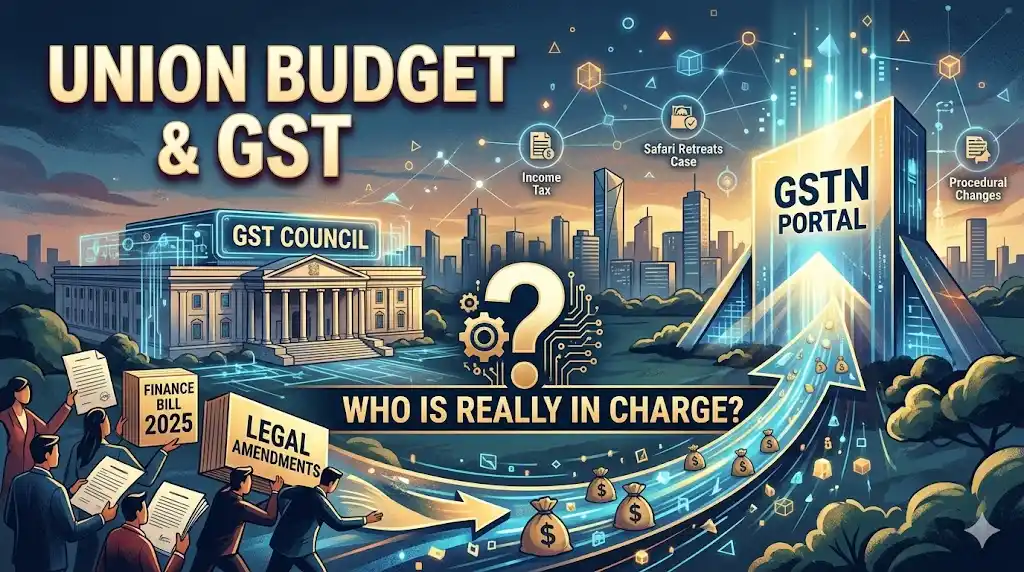
The Union Budget 2026 signals a decisive continuation of structural economic reforms in India, prioritising long-term competitiveness over short-term populism. Rather than focusing on headline announcements, the government has emphasised policy stability, fiscal discipline, and execution-led governance.

For investors, businesses, and policymakers, the message is clear: predictable policy frameworks and systemic reforms will shape India’s economic trajectory in the coming decade.

Policy Philosophy: Structural Reform Over Short-Term Populism

A central theme of Union Budget 2026 economic reforms is the commitment to deep structural transformation rather than temporary stimulus measures.

The policy direction aligns with the broader economic strategy of the Government of India and is implemented through the Ministry of Finance.

This philosophy focuses on:

  • Strengthening institutional frameworks
  • Enhancing regulatory clarity
  • Promoting sustainable economic growth
  • Ensuring long-term macroeconomic stability

Such an approach is designed to build investor confidence while improving the overall business environment in India.

Governance Signal: Continuity and Fiscal Prudence

The budget reinforces the government’s commitment to policy continuity and fiscal prudence.

In recent years, India’s economic policy has increasingly moved toward execution-driven governance, where reforms are implemented gradually but consistently.

Key governance priorities include:

  • Maintaining a disciplined fiscal framework
  • Strengthening institutional capacity
  • Ensuring predictable regulatory environments
  • Improving efficiency in policy implementation

For global investors and domestic businesses alike, policy consistency reduces uncertainty and lowers regulatory risk.

Investor Perspective: Predictability and Confidence

One of the most important outcomes of the reform-oriented approach is the increase in investor confidence.

Stable policy frameworks create a favourable environment for:

  • Domestic investment
  • Foreign direct investment (FDI)
  • Long-term infrastructure financing
  • Capital market participation

When investors perceive lower policy risk and higher regulatory predictability, capital flows tend to increase, strengthening the broader economic ecosystem.

Reform Momentum: 350+ Structural Improvements

India’s reform momentum continues with more than 350 policy and regulatory improvements implemented across multiple sectors.

These reforms cover areas such as:

  • Tax administration and GST processes
  • Labour law rationalisation
  • Quality control standards in manufacturing
  • Digital governance systems

Many of these reforms are implemented through cooperation between the central government and state governments, guided by policy coordination bodies such as the GST Council.

This Centre–State collaboration plays a crucial role in ensuring that reform initiatives translate into real economic outcomes.

Shift Toward Trust-Based Governance

Another key feature of the reform strategy is the transition toward trust-based governance models.

Instead of heavy procedural control, the government is adopting technology-driven monitoring systems combined with risk-based compliance checks.

Key elements of this approach include:

  • Increased automation in regulatory systems
  • Risk-based verification mechanisms
  • Decriminalisation of minor procedural lapses
  • Reduced reliance on manual intervention

These measures are designed to shift governance from control-oriented administration to facilitation-oriented regulation.

Growth Engines: Manufacturing and Services

The budget also highlights the importance of strengthening India’s core economic growth engines.

Manufacturing Expansion

India’s manufacturing strategy focuses on:

  • Building resilient supply chains
  • Deepening domestic value chains
  • Improving quality standards
  • Enhancing export competitiveness

Manufacturing growth supports employment generation and strengthens India’s position in global supply networks.

Services Sector Multipliers

Alongside manufacturing, the services sector continues to play a crucial role in economic expansion.

High-growth segments include:

  • Information technology services
  • Global Capability Centres (GCCs)
  • Data and digital infrastructure
  • Rail connectivity and logistics services

Together, these sectors act as multipliers for productivity and economic growth.

Macro Discipline: Fiscal Consolidation with Growth Support

The budget maintains a strong focus on fiscal discipline while supporting economic growth through capital expenditure.

The fiscal strategy aims to:

  • Maintain a stable debt-to-GDP trajectory
  • Follow a clear deficit reduction glide path
  • Continue strategic public infrastructure investment

This balanced approach ensures that economic expansion is supported without compromising fiscal sustainability.

Why These Reforms Matter for Businesses

For businesses operating in India, the economic reforms outlined in Union Budget 2026 bring several important implications:

  • Greater regulatory clarity
  • Improved ease of doing business
  • Stronger digital governance systems
  • Increased investment opportunities

Companies that align with the evolving policy environment, compliance frameworks, and digital systems will be better positioned to benefit from India’s growth trajectory.

Bottom Line

The Union Budget 2026 economic reform strategy is not about short-term announcements but about systemic transformation of the Indian economy.

The focus is clear:

  • Structural reform instead of temporary policy measures
  • Stable governance frameworks
  • Sustainable fiscal management
  • Long-term competitiveness

In essence, the budget reflects reform by design rather than reform by declaration.The outcome is a policy environment aimed at delivering stability today and stronger economic competitiveness tomorrow.

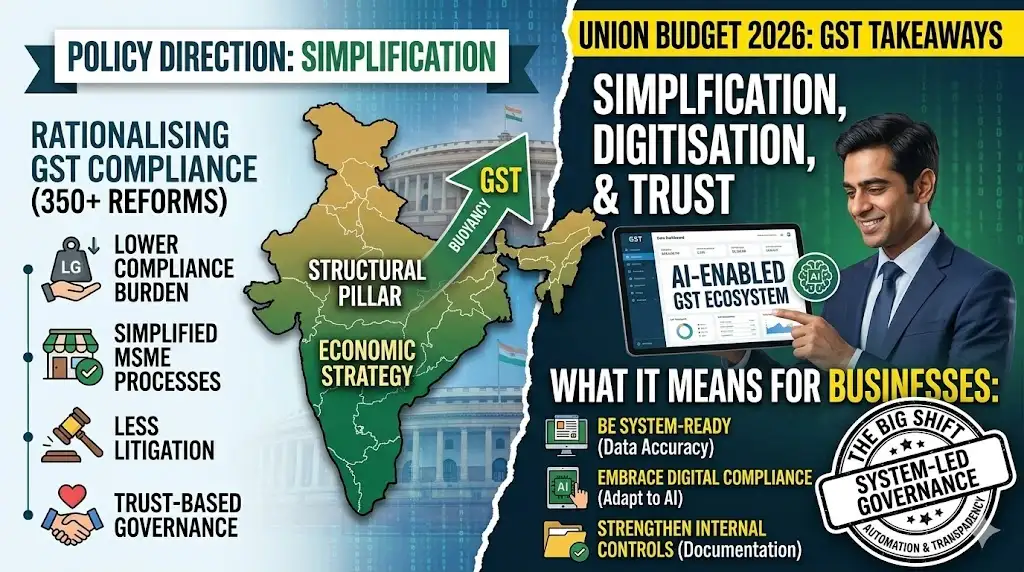
Union Budget 2026: Indirect Tax (GST) – Key Takeaways for Businesses

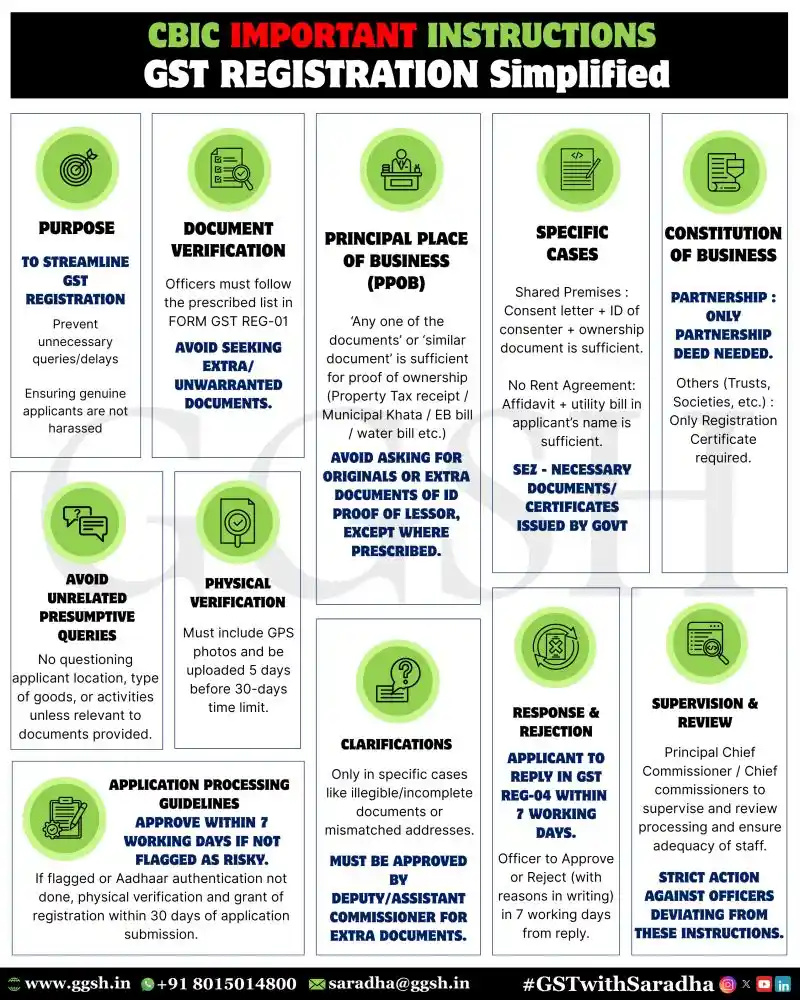
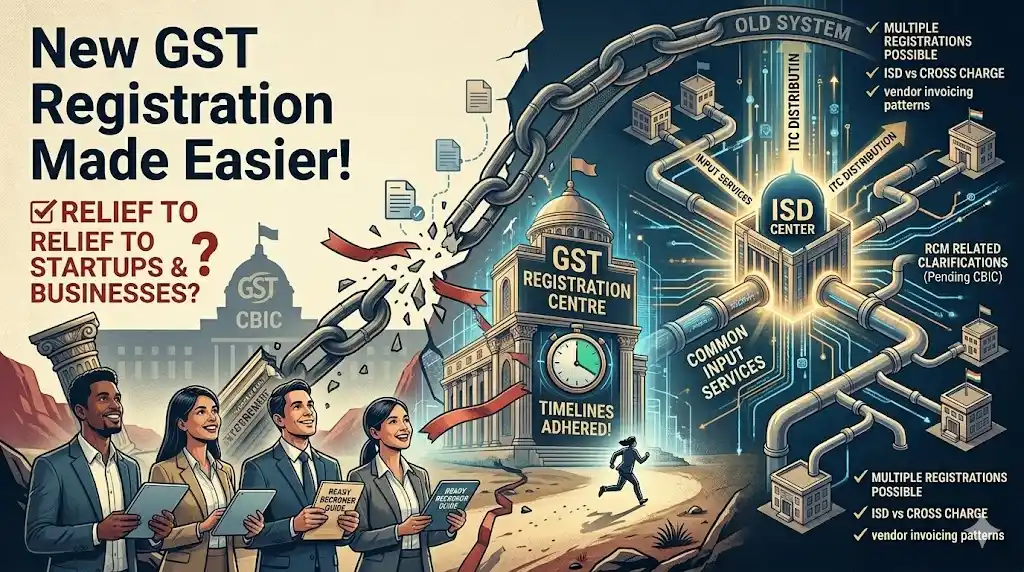
The Union Budget 2026 signals a continued transformation of India’s indirect tax framework, particularly under the Goods and Services Tax (GST) regime. The focus is clearly shifting toward simplified compliance, technology-driven governance, and trust-based administration.

These developments are expected to further strengthen GST as a core structural reform supporting economic growth, formalisation of businesses, and improved tax efficiency.

Policy Direction: Simplify GST and Digitise Governance

A major theme in the indirect tax announcements is the government’s commitment to simplifying GST compliance while strengthening digital governance.

The GST system, administered through the Goods and Services Tax Network under the policy oversight of the GST Council, continues to evolve toward a technology-first compliance environment.

Key objectives include:

  • Simplifying return filing processes
  • Reducing procedural complexity
  • Increasing transparency in tax administration
  • Strengthening taxpayer trust in the system

This policy direction aims to make GST compliance easier while maintaining robust monitoring mechanisms.

Core Focus: Rationalised GST Compliance

The budget reinforces the need for rationalised GST compliance processes.

Businesses have often faced challenges due to multiple return forms, reconciliations, and procedural checks. The government’s approach now focuses on streamlining these processes to reduce compliance fatigue.

This effort supports the broader goal of improving ease of doing business in India, especially for growing enterprises and new market participants.

Execution Signal: 350+ GST Reforms Already Implemented

Over the past few years, the GST ecosystem has undergone continuous procedural improvements.

According to the policy direction highlighted in the budget, more than 350 reforms and process improvements have already been implemented within the GST framework.

These reforms have included:

  • Simplified return filing processes
  • Faster refund mechanisms
  • Improved invoice matching systems
  • Enhanced taxpayer services

Further process clean-ups and system upgrades are expected in the coming years.

Technology as the Backbone of GST Administration

One of the most important shifts highlighted in the budget is the increasing role of advanced technology in GST governance.

Future GST administration will increasingly rely on AI-enabled analytics and automated systems.

Key technology-driven improvements include:

  • AI-based risk management and fraud detection
  • Automated compliance verification
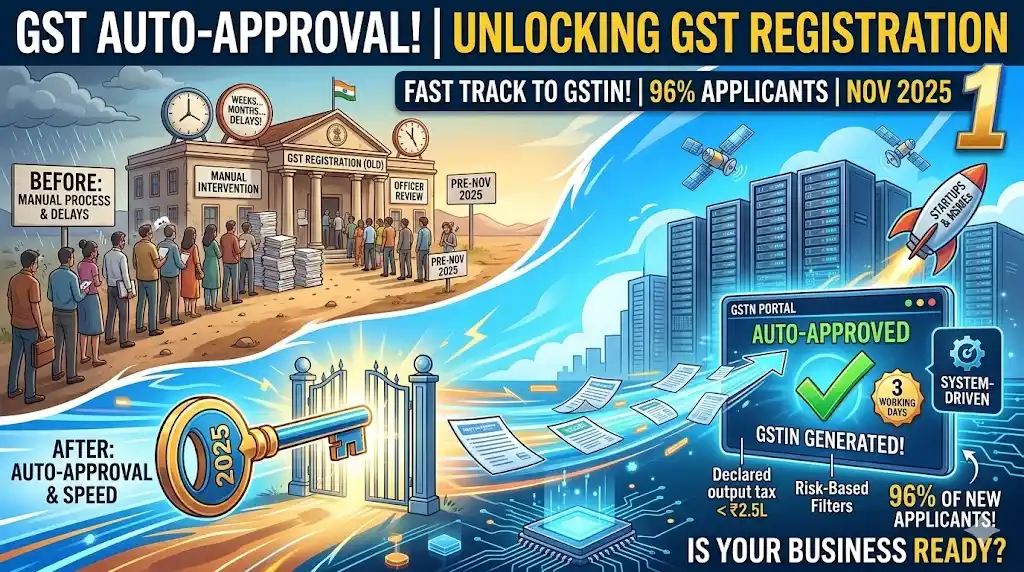
  • Faster processing of applications and refunds
  • Reduced manual intervention in tax administration

These changes are expected to deliver more predictable outcomes for taxpayers while improving regulatory oversight.

Economic Perspective: GST as a Structural Reform

The budget reaffirms GST as a pillar of India’s economic and fiscal framework.

A well-functioning GST system contributes to:

  • Higher tax buoyancy
  • Improved transparency in business transactions
  • Greater formalisation of the economy
  • Stronger fiscal discipline for governments

By strengthening GST processes, the government aims to support sustainable economic growth while improving revenue stability.

MSME Impact: Reduced Compliance Burden

For Micro, Small, and Medium Enterprises (MSMEs), GST compliance has historically been a major operational challenge.

The reforms highlighted in the budget are expected to:

  • Reduce compliance friction for small businesses
  • Encourage voluntary compliance
  • Lower disputes and litigation
  • Promote trust-based governance between taxpayers and authorities

These improvements can help MSMEs focus more on business growth rather than administrative complexities.

Union Budget 2026: What It Means for India’s Marine & Seafood Export Industry

Budgets are often read for headlines and big announcements.

But industries read them for direction.

For the Marine and Seafood Industry, the Union Budget 2026 feels less like a sudden policy announcement and more like a long-awaited signal that the ecosystem is finally being viewed end-to-end.

For years, businesses across the marine value chain — from deep-sea fishing operators to seafood exporters — have operated in an environment where policy uncertainty, export compliance complexity, and fluctuating input costs created operational challenges.

The 2026 Budget policy direction indicates an effort to address these structural concerns.

And for the seafood sector, clarity often matters more than incentives.

Why Policy Clarity Matters for the Marine Export Ecosystem

The marine and seafood industry functions through a complex value chain involving fishing vessels, processors, cold storage operators, exporters, and logistics providers.

Small policy changes can significantly influence the cost structure and export competitiveness of the sector.

When key variables become predictable:

  • Input costs become easier to manage
  • Export planning becomes more stable
  • Compliance risks reduce
  • Investment decisions become easier

In other words, businesses move from firefighting to forward planning.

Key Budget Signals for the Marine and Seafood Sector

The Union Budget 2026 introduces policy directions that affect multiple parts of the marine ecosystem.

1. Easing of Input Cost Pressures

One of the biggest operational challenges for seafood processors and exporters has been rising input costs — including equipment, fuel, processing infrastructure, and logistics.

Policy adjustments in customs and related frameworks are expected to reduce cost pressures across the marine processing ecosystem.

For exporters, this directly influences international competitiveness in global seafood markets.

2. Greater Policy Clarity for Deep-Sea Fishing Operations

Deep-sea fishing has long required clear regulatory frameworks and predictable compliance guidelines.

The Budget’s approach signals an attempt to bring greater clarity and stability to deep-sea fishing operations, helping vessel operators plan investments in:

  • Fishing vessels
  • Equipment and gear
  • Long-distance fishing operations

For operators managing capital-intensive marine assets, predictability reduces financial risk.

3. Improved Export Policy Predictability

India is one of the world’s major seafood exporters, and policy changes affecting exports can have large downstream implications.

The Budget’s focus on improving export frameworks supports:

  • Simplified export procedures
  • More stable export policy treatment
  • Greater clarity on compliance requirements

This strengthens the operational environment for exporters working with agencies such as the Marine Products Export Development Authority.

Why These Changes Matter for the Marine Value Chain

These policy directions will not transform the industry overnight.

However, they address a challenge that the marine sector has faced for years: persistent regulatory uncertainty.

By reducing ambiguity in key policy areas, the Budget helps improve confidence across the marine value chain.

This benefits stakeholders such as:

Seafood Processors

Processing units rely heavily on stable raw material supply, equipment imports, and export channels.

Policy clarity improves operational planning and production capacity utilisation.

Seafood Exporters

Exporters benefit from predictable compliance frameworks and export procedures, which are critical for maintaining international buyer relationships.

Fishing Vessel Operators

Vessel owners and deep-sea operators require long-term capital planning.

Greater regulatory clarity allows for more confident investment in marine infrastructure.

Clarity vs Incentives: What Drives Sustainable Growth

Government incentives can certainly generate excitement in the short term.

But industries often grow faster when they have something even more powerful: clarity.

  • Incentives create opportunity
  • Policy clarity creates confidence

And confidence is what enables long-term investment, capacity expansion, and export growth.

For the marine and seafood industry, removing uncertainty can unlock more growth than short-term fiscal incentives.

Understanding the Impact Across the Marine Ecosystem

At GGSH, we analysed the policy changes introduced in Union Budget 2026 and studied how they impact different segments of the marine value chain.

Our detailed industry study breaks down the implications for:

  • Seafood processors
  • Marine exporters
  • Fishing vessel operators
  • Deep-sea fishing businesses

The analysis connects policy changes to practical business outcomes, helping stakeholders understand where the real impact lies.

Download the Detailed Marine Industry Budget Analysis

If you are part of the marine and seafood value chain, this study can help you:

  • Understand the policy implications of Union Budget 2026
  • Identify cost and compliance impacts on your business
  • Plan your export and operational strategies more effectively

📥 Download the detailed study document to explore the full analysis.

If you would like to discuss how these changes affect your specific business operations, feel free to reach out to the GGSH team.

Final Thoughts

The Union Budget 2026 may not have introduced dramatic incentives for the marine industry.

But it sends a much stronger signal — the sector is finally being looked at as a complete ecosystem.

And when industries receive clarity, predictability, and policy stability, they gain the confidence to invest, expand, and compete globally.For India’s marine and seafood export sector, that confidence may prove more valuable than any short-term incentive.

RoDTEP Annual Return (ARR) FY 2023–24 Extended to 31 March 2026: What Exporters Must Do Now

Sometimes, extensions feel like relief…

But in compliance, they also quietly remind us:
👉 “Don’t push it to the edge again.”

The Directorate General of Foreign Trade (DGFT) has extended the due date for filing the Annual RoDTEP Return (ARR) for FY 2023–24 to:

📅 31st March 2026
💰 With a composition fee of ₹15,000

What This Extension Means

Yes, the extension gives exporters some breathing room…

But it also comes with a clear warning:

Failure to file even by the extended deadline may lead to:

  • Denial of RoDTEP benefits
  • Scroll-out of scrips

👉 In simple terms: your eligible incentives may be lost.

Why ARR Filing Is Critical

For many exporters, RoDTEP (Remission of Duties and Taxes on Exported Products) is not just an incentive:

👉 It is a real contributor to cash flow

Delaying ARR filing can result in:

  • Blocked or denied benefits
  • Financial impact on margins
  • Compliance risks during DGFT review

Why Exporters Delay ARR Filing

Common reasons include:

  • Pending audits
  • Incomplete reconciliations
  • Data gaps across systems
  • Complexity in cost and tax mapping

👉 But postponing only increases the risk.

ARR Is Not a Last-Day Compliance

Filing ARR involves more than just form submission. It requires:

  • Compilation of export data
  • Mapping of operational costs
  • Identification of embedded taxes
  • Proper reconciliation across records

👉 DGFT reviews the data submitted—so accuracy matters as much as timeliness.

Action Plan for Exporters

✔️ Start Data Compilation Now

  • Gather:
    • Export invoices
    • Shipping bill details
    • Cost and tax data

✔️ Reconcile Figures Carefully

  • Align:
    • Financial records
    • GST data
    • Export documentation

✔️ Avoid Last-Minute Filing

  • Early filing helps:
    • Identify errors
    • Reduce stress
    • Ensure compliance accuracy

✔️ Review Before Submission

  • Double-check:
    • Data consistency
    • Eligibility calculations
    • Supporting documentation

Key Reference

📄 Public Notice No. 46/2025–2026 dated 5th February 2026 issued by the Directorate General of Foreign Trade

Conclusion

The ARR filing extension is an opportunity—but also a responsibility.

👉 It gives you time to get it right
👉 But not an excuse to delay again

Final Thought 💬

In export compliance:

Incentives reward you…
But discipline protects you.Don’t let a pending ARR turn into a missed benefit.

Union Budget 2026: Key Direct Tax Takeaways for Businesses & Tax Professionals

The Union Budget 2026 signals a clear shift in India’s direct tax policy framework. The government appears to be moving toward simplification of tax procedures, technology-driven compliance, and reduced litigation, while maintaining strong accountability mechanisms.

The policy direction reflects a balance between ease of doing business and disciplined tax governance, which will significantly influence how taxpayers, businesses, and professionals manage compliance in FY 2026 and beyond.

Policy Direction: Simplification Over Complexity

One of the central themes of the Union Budget 2026 direct tax proposals is the move toward simplified tax administration.

The objective is to reduce unnecessary procedural hurdles while encouraging voluntary compliance and transparency.

The reforms are guided by the policy framework set by the Ministry of Finance under the Government of India.

Key emphasis areas include:

  • Simplified tax rules
  • Reduced litigation and disputes
  • Greater reliance on digital systems
  • Faster resolution of taxpayer matters

This approach signals a shift from adversarial tax enforcement toward cooperative compliance.

Rationalised TDS and TCS Framework

A major structural reform under the budget involves the rationalisation of TDS (Tax Deducted at Source) and TCS (Tax Collected at Source) provisions.

The reforms aim to:

  • Reduce overlapping deduction and collection mechanisms
  • Streamline compliance obligations for businesses
  • Improve efficiency in tax reporting and credit matching

The initiative is expected to lower administrative burden on taxpayers while strengthening the overall tax credit ecosystem.

Automated Lower or Nil TDS Mechanisms

The budget also highlights increased automation in lower or nil TDS deduction approvals.

Through technology integration with the tax administration system operated by the Central Board of Direct Taxes, taxpayers may experience:

  • Faster processing of lower deduction certificate applications
  • Reduced manual intervention
  • Greater transparency in approval processes

This automation is intended to minimise delays and reduce compliance friction for businesses.

Faster Closure of Tax Matters

Another notable policy direction is the emphasis on speedier closure of tax proceedings and disputes.

This reflects the government’s commitment to:

  • Reduce long-pending tax litigation
  • Provide certainty to taxpayers
  • Improve overall tax administration efficiency

Quicker resolution of tax matters can significantly enhance taxpayer confidence and improve the investment environment.

Decriminalisation with Accountability

The budget also continues the trend toward decriminalisation of certain tax offences.

The objective is to ensure that minor procedural errors do not result in criminal prosecution, while maintaining strict action against serious cases of tax evasion or fraud.

This governance approach focuses on:

  • Encouraging voluntary compliance
  • Reducing fear-based enforcement
  • Maintaining accountability for deliberate violations

Market Discipline Through STT and Buyback Tax Changes

Despite the push toward simplification, the budget also reinforces revenue discipline and market integrity.

Measures such as:

  • Higher Securities Transaction Tax (STT)
  • Stricter buyback taxation provisions

demonstrate the government’s attempt to maintain equity in capital markets while protecting tax revenues.

These measures influence trading strategies, corporate restructuring, and investor decision-making.

FY 2026 Outlook: Execution Will Matter

For FY 2026, the focus shifts from interpreting tax rules to effectively implementing them.

Success under the new framework will depend on:

  • System readiness and digital integration
  • Strong documentation practices
  • Alignment between businesses and tax advisors
  • Timely compliance with updated procedures

Businesses that adapt early to the evolving technology-driven tax environment will have a clear advantage.

Union Budget 2026: What It Means for the Marine & Seafood Sector

Budgets are often read for headlines.
But industries read them for direction 🧭

For India’s marine and seafood sector, the Union Budget 2026 feels less like a routine announcement and more like a long-awaited signal of clarity across the ecosystem.

A Shift Towards End-to-End Visibility

The Budget indicates that policymakers are now looking at the sector holistically—not just exports, but:

  • Input costs
  • Fishing operations
  • Export frameworks
  • Compliance structures

👉 This end-to-end recognition is a major step forward for the industry.

Key Positive Signals for the Sector

🐡 Easing of Input Costs

  • Reduction in cost pressures helps:
    • Improve margins
    • Increase competitiveness in global markets

🐡 Clarity in Deep-Sea Fishing Policies

  • Better regulatory clarity supports:
    • Long-term planning
    • Investment in infrastructure and vessels

🐡 Predictability in Export Treatment

  • Stable and consistent export framework ensures:
    • Fewer disputes
    • Smoother compliance
    • Faster decision-making

Why This Matters More Than It Seems

At first glance, these changes may not appear “dramatic.”

But in reality:

👉 Businesses don’t just benefit from cost savings
👉 They gain confidence to plan ahead

And in industries like seafood, where:

  • Seasonality matters
  • Logistics are complex
  • Global competition is intense

👉 Planning always beats firefighting.

The Real Impact: Reducing Long-Standing Uncertainty

For years, the sector has dealt with:

  • Ambiguity in tax treatment
  • Compliance inconsistencies
  • Policy interpretation challenges

The Union Budget 2026 addresses this—not by flashy incentives, but by:

👉 Removing uncertainty

Clarity vs Incentives: What Truly Drives Growth?

There’s a subtle but powerful takeaway here:

  • Incentives excite businesses
  • Clarity sustains them

When policies are:

  • Clear
  • Predictable
  • Consistent

👉 Businesses invest more confidently
👉 Growth becomes stable—not reactive

What This Means for Industry Stakeholders

✔️ Exporters

  • Better planning of shipments and pricing
  • Reduced compliance risks

✔️ Processors & Manufacturers

  • Improved cost control
  • Greater operational efficiency

✔️ Investors

  • Increased confidence in sector stability
  • Better long-term visibility

Conclusion

The Union Budget 2026 may not have introduced dramatic reforms for the marine and seafood sector—but it delivers something far more valuable:

👉 Clarity, consistency, and confidence

Final Thought 💬

In a sector driven by cycles, risks, and global demand:

👉 It’s not just about catching the next opportunity
👉 It’s about knowing the waters are finally predictable

Because in the long run:Incentives may attract growth…
But clarity is what sustains it. 💪🏼

Purchases from Unregistered Persons (URP) Under GST: Simple in Theory, Risky in Practice

Purchasing from Unregistered Persons (URPs) may look like routine procurement…

But in reality, these transactions can quietly trigger multiple GST compliance risks—especially as volumes increase or during audits.

What seems simple on paper often becomes complex in execution.

Why URP Transactions Need Attention

Many businesses treat URP purchases as:

  • Low-risk
  • Operationally convenient
  • Easy to manage

However, these transactions can lead to:

  • Reverse Charge Mechanism (RCM) exposure
  • E-way bill compliance challenges
  • Documentation gaps
  • Reporting mismatches

👉 The risk becomes more visible during assessments and audits.

Key GST Implications on URP Purchases

1. Reverse Charge Mechanism (RCM)

When purchasing from URPs:

  • Tax liability shifts to the recipient (buyer)
  • Applicable under notified categories and scenarios

👉 Businesses must:

  • Identify RCM applicability
  • Pay GST in cash
  • Report correctly in returns

2. Self-Invoicing & Payment Voucher

Under RCM:

  • Buyer must issue a self-invoice
  • Payment voucher must be generated at the time of payment

👉 Timelines and accuracy are critical for compliance.

3. E-Way Bill Responsibility

When the supplier is unregistered:

  • The recipient may be responsible for generating the e-way bill

👉 This depends on:

  • Movement of goods
  • Transaction structure
  • Threshold limits

4. Inter-State vs Intra-State Impact

URP transactions require careful classification:

  • Inter-State → IGST implications
  • Intra-State → CGST + SGST

👉 Misclassification can lead to:

  • Incorrect tax payment
  • Reporting errors

5. Return Reporting Complexity

URP transactions must be accurately reported in:

  • GSTR-3B (RCM liability & ITC claim)
  • GSTR-9 (annual consolidation)
  • GSTR-9C (reconciliation & audit)

👉 Errors here often trigger notices.

The Hidden Risk: Documentation Gaps

Unlike registered vendors, URPs may not provide:

  • GST-compliant invoices
  • Structured documentation

👉 This increases reliance on internal controls and records.

URP Procurement Checklist: What You Should Follow

To manage URP risks effectively, businesses should adopt a structured workflow:

✔️ Vendor Due Diligence (KYV – Know Your Vendor)

  • Verify identity and business background

✔️ PAN & GST Status Verification

  • Confirm unregistered status
  • Ensure correct classification

✔️ Transaction Structuring

  • Identify:
    • Nature of supply
    • Place of supply
    • Tax applicability

✔️ RCM Compliance

  • Raise self-invoice
  • Issue payment voucher
  • Pay tax within timelines

✔️ E-Way Bill Compliance

  • Determine responsibility clearly
  • Generate e-way bill where required

✔️ Return Reporting

  • Ensure accurate disclosure in:
    • GSTR-3B
    • GSTR-9
    • GSTR-9C

✔️ Record Retention & Audit Readiness

  • Maintain:
    • Supporting documents
    • Internal approvals
    • Reconciliation records

Why a Checklist Approach Works

A structured checklist helps:

  • Procurement teams ask the right questions upfront
  • Finance teams ensure accurate tax compliance
  • Businesses avoid downstream disputes and penalties

👉 Most importantly, it ensures compliance without slowing operations.

Conclusion

Purchases from URPs are not inherently risky—but unmanaged URP transactions are.

The key lies in:

  • Strong internal processes
  • Clear documentation
  • Timely compliance actions

Final Thought 💬

In GST:👉 It’s not the transaction that creates risk…
👉 It’s the lack of structure around it

Hard Locking of Auto-Populated Values in GSTR-3B – What Taxpayers Need to Know

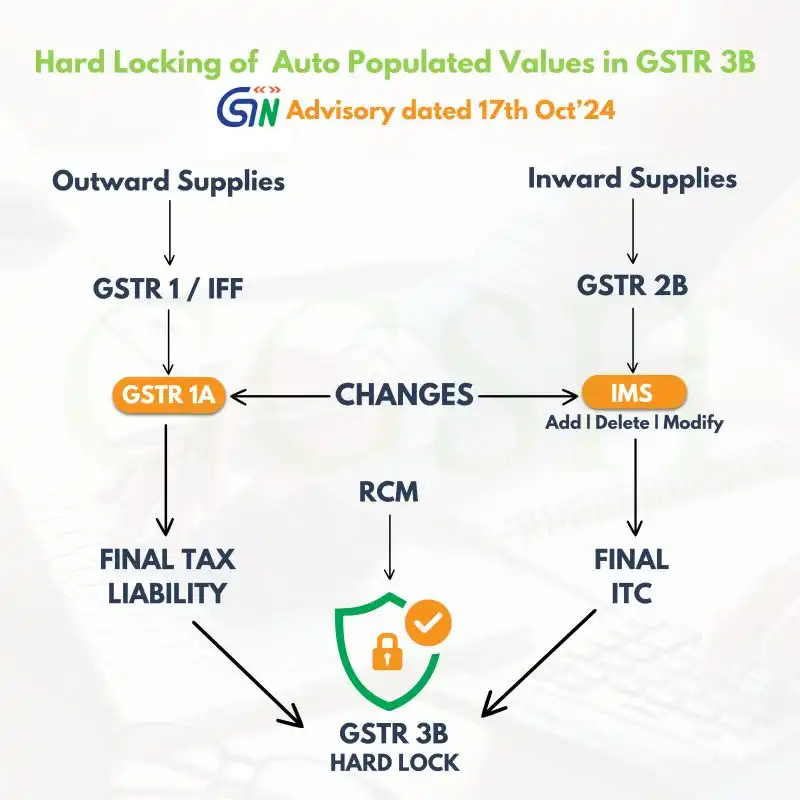
The Goods and Services Tax Network (GSTN) is planning a major compliance change in the GSTR-3B return filing process. According to recent discussions and advisories, auto-populated values in GSTR-3B may become hard-locked and uneditable, tentatively starting from January 2025.

This move has triggered significant discussions among tax professionals, accountants, and businesses across India. The shift from “auto-population” to what appears to be “auto-finalisation” could fundamentally change how GST returns are filed and corrected.

In this blog, we explore what the hard locking of auto-populated values in GSTR-3B means, its potential impact on taxpayers, and the concerns raised by professionals in the GST ecosystem.

Understanding Auto-Population in GSTR-3B

Currently, several values in GSTR-3B are auto-populated from related GST returns, especially from:

  • GSTR-1 (outward supplies statement)
  • GSTR-2B (auto-generated Input Tax Credit statement)

These values act as reference figures to help taxpayers prepare their returns more easily. However, taxpayers are still allowed to edit or adjust the figures if required before filing the return.

The purpose of auto-population was originally to simplify GST compliance, reduce errors, and ensure consistency between different GST returns.

Proposed Hard Locking of Auto-Populated Data

Under the proposed system, the auto-populated values in GSTR-3B may become non-editable, meaning taxpayers will not be able to modify those values directly in the return.

This effectively converts auto-population into auto-finalisation, where the system determines the final numbers based on earlier filings or system-generated data.

If implemented fully, taxpayers would need to make corrections only through prescribed mechanisms, such as:

  • GSTR-1A amendments
  • Invoice Management System (IMS) adjustments
  • Amendments in subsequent returns

Key Concerns Raised by Tax Professionals

1. Impact on the Self-Assessment System

The GST framework in India operates on a self-assessment basis. Taxpayers are responsible for determining their tax liability and filing accurate returns.

However, if auto-populated values in GSTR-3B are locked, taxpayers may lose the flexibility to perform bona fide self-assessment adjustments at the time of filing the return.

It is important to remember:

  • GSTR-1 is only a statement of outward supplies
  • GSTR-3B is the actual tax return

Restricting editing in the return raises questions about whether the taxpayer’s right to self-assessment is being diluted.

2. Legal Validity of Auto-Finalisation

Another major question relates to the legal validity of auto-finalising values in a statutory return.

Professionals have raised concerns about whether system-generated values can override taxpayer-declared values, especially when discrepancies arise due to timing differences, clerical errors, or reconciliation issues.

3. Optional Systems Affecting Mandatory Returns

The proposed mechanism relies heavily on tools such as:

  • GSTR-1A
  • Invoice Management System (IMS)

However, both mechanisms are currently optional.

This raises an important question:

If GSTR-1A and IMS are optional, how can the GSTR-3B return become automatically finalised based on them?

Many experts believe that making GSTR-3B dependent on optional systems may create practical challenges for taxpayers.

GSTN’s Clarification and Updated Advisory

Following strong feedback from industry and tax professionals, the GSTN updated its advisory and clarified an important point.

The advisory now states that:

Hard locking of auto-populated Input Tax Credit (ITC) values in GSTR-3B will be implemented only after the Invoice Management System (IMS) is fully rolled out and issues raised by the trade are addressed.

This means the implementation of ITC locking has been postponed for now, and a separate advisory will be issued in the future once operational issues are resolved.

Possible Impact on Businesses and GST Compliance

If the hard-locking mechanism is implemented, businesses may need to significantly change their GST compliance workflow.

Some expected impacts include:

1. Stronger Reconciliation Requirements

Businesses will need to ensure accurate reconciliation between GSTR-1, GSTR-2B, and GSTR-3B before filing returns.

2. Increased Dependence on Invoice-Level Accuracy

Since corrections may not be allowed directly in GSTR-3B, errors will have to be corrected at the invoice reporting level.

3. More Reliance on GST Technology Systems

Systems like IMS and GSTR-1A amendments may become essential for handling mismatches.

Is This Really “Ease of Doing Business”?

The GST framework has always emphasised ease of doing business and simplified compliance.

However, critics argue that locking auto-populated values in GSTR-3B could make return filing more rigid, especially for small businesses and startups that rely on flexibility during reconciliation.

The coming months will likely see further consultations, advisories, and possible changes before the final rollout.

Conclusion

The proposed hard locking of auto-populated values in GSTR-3B from January 2025 marks a significant potential shift in the GST compliance landscape.

While the objective may be to improve data consistency and prevent tax leakage, the move also raises important questions about:

  • Taxpayer self-assessment rights
  • Legal validity of system-driven finalisation
  • Operational readiness of IMS and amendment systems

For now, taxpayers and professionals should closely monitor GSTN advisories and updates, while ensuring strong reconciliation practices between GSTR-1, GSTR-2B, and GSTR-3B.As the GST ecosystem continues to evolve, staying informed will be the key to maintaining accurate GST compliance and avoiding disputes with tax authorities.

GSTR-9 & GSTR-9C Changes for FY 2024–25: Key Updates Businesses Must Know

Many taxpayers assume that GSTR-9 and GSTR-9C are simply routine annual compliance forms under GST. However, the Financial Year 2024–25 annual return cycle introduces several structural reporting changes, additional disclosures, and tighter reconciliation requirements.

While these updates may not appear dramatic at first glance, the underlying reporting framework for annual GST compliance has become more detailed, requiring businesses and tax professionals to pay closer attention during filing.

Understanding these changes early can help avoid last-minute confusion, reconciliation mismatches, and compliance risks.

Why FY 2024–25 Annual Returns Require Extra Attention

The GST annual return process has gradually evolved with improvements in technology, analytics, and data reconciliation.

The returns are processed through the GST portal managed by the Goods and Services Tax Network, where auto-population, cross-form matching, and analytics-based validations are increasingly used to detect discrepancies.

As a result, GSTR-9 and GSTR-9C filings now require deeper reconciliation between GST returns and financial records.

Key Areas That Need Extra Care in FY 2024–25

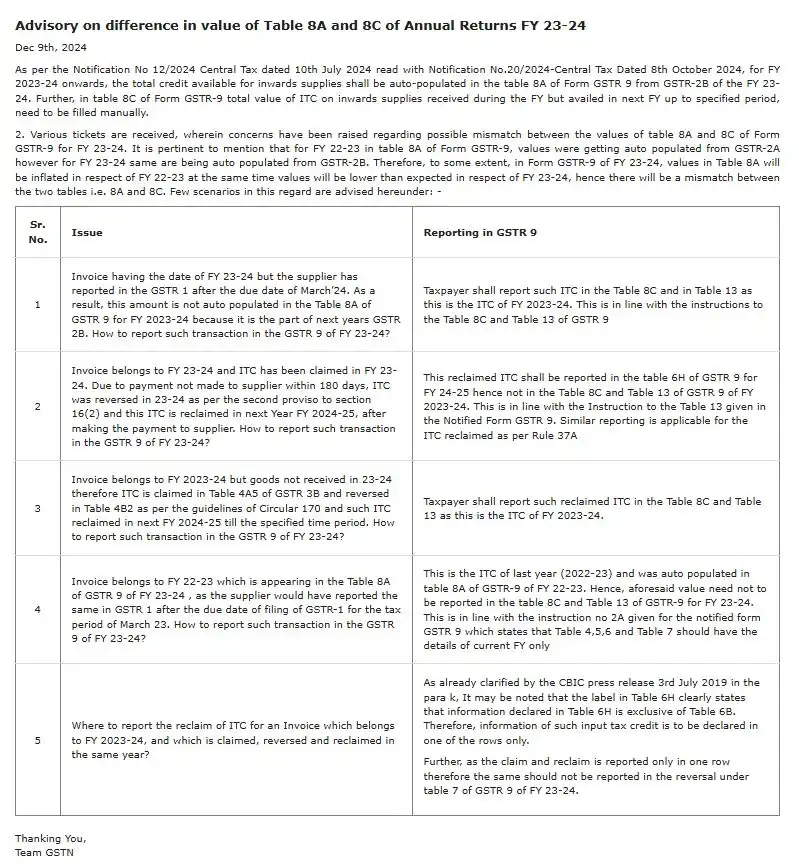
1. Reporting of ITC Reversals and Reclaims

One of the most sensitive areas in GST annual return filing is the reporting of Input Tax Credit (ITC) reversals and subsequent reclaims.

Businesses must carefully ensure that:

  • ITC reversals reported in GSTR-3B are correctly reflected in GSTR-9 tables
  • Any reclaimed ITC is disclosed accurately
  • Differences between books of accounts and GST returns are properly explained in GSTR-9C reconciliation tables

Improper reporting of ITC adjustments can lead to scrutiny or demand notices.

2. Behaviour of Auto-Populated Data

In recent years, the GST portal has introduced auto-population of certain tables in GSTR-9 based on previously filed returns.

However, taxpayers must remember that:

  • Auto-populated values are system-generated references
  • They may not always reflect adjustments made during the year
  • Businesses remain responsible for verifying and reconciling the data before submission

Blindly relying on system values without reconciliation can lead to incorrect disclosures in annual returns.

3. Importance of Reconciliation Explanations

In GSTR-9C, reconciliation tables compare data reported in GST returns with figures in the audited financial statements.

For FY 2024–25, the importance of clear explanations for differences has increased.

Businesses must ensure that any mismatch is supported by:

  • Proper documentation
  • Reconciliation workings
  • Logical explanations in the reconciliation statement

This helps ensure that differences are understood as reporting adjustments rather than compliance issues.

4. Separate Late Fee Mechanism for GSTR-9C

Another development taxpayers should note is that late fees related to GSTR-9C may now operate independently from GSTR-9 compliance.

This means delays or errors in the reconciliation statement filing could result in separate compliance consequences, reinforcing the need for timely and accurate submission.

Why Early Preparation Is Important

Given the additional reporting depth in FY 2024–25, businesses should start preparing their annual return data well in advance.

Early preparation helps in:

  • Reconciling GSTR-1, GSTR-3B, and financial statements
  • Identifying ITC mismatches
  • Validating auto-populated data
  • Preparing explanations for reconciliation differences

This proactive approach reduces the risk of last-minute errors and filing pressure.

Practical Support for GSTR-9 & GSTR-9C Filing

To simplify the process, the Indirect Tax team at GGSH has analysed the latest developments table-by-table, FAQ-by-FAQ, and notification-by-notification.

The analysis highlights practical aspects such as:

  • ITC reporting and adjustments
  • Behaviour of system-generated values
  • Reconciliation documentation requirements
  • Compliance considerations during annual filing

The findings have been compiled into a structured and easy-to-reference study note designed for practical use during the actual filing process.

Final Thoughts

Although GSTR-9 and GSTR-9C remain annual compliance requirements, the reporting framework for FY 2024–25 has become more detailed and reconciliation-focused.

Businesses and tax professionals should approach these filings with careful review, proper documentation, and accurate data mapping across GST returns and financial statements.Preparing early and understanding the latest reporting expectations will help ensure smooth, compliant, and error-free annual GST filings.

Input Tax Credit Reporting in GSTR-9 & GSTR-9C: A Practical Flowchart for GST Compliance

Under the GST framework, Input Tax Credit (ITC) is one of the most valuable yet complex areas of compliance. Between claims, reversals, reclaims, annual adjustments, and cross-form reconciliations, ITC reporting often becomes a technical maze for businesses and tax professionals.

In practice, the journey of ITC under GST has become more intricate than the credit itself. Accurate reporting now depends not only on understanding the GST law, but also on correctly interpreting how different GST returns capture and reconcile ITC data.

To address this challenge, the Indirect Tax Research team at GGSH has prepared a structured flowchart explaining the entire lifecycle of ITC reporting in GSTR-9 and GSTR-9C.

Why ITC Reporting Has Become Complex

Under India’s GST ecosystem, ITC reporting involves multiple stages of verification and reconciliation. Each stage requires careful attention to documentation, timing, and compliance rules.

Businesses must track ITC across:

  • Purchase invoices and vendor documentation
  • Auto-populated data in GSTR-2B
  • Monthly return filings in GSTR-3B
  • Annual consolidation in GSTR-9
  • Reconciliation with financial statements in GSTR-9C

These cross-form linkages make ITC compliance highly dependent on accurate data mapping and reconciliation.

Key Challenges in ITC Compliance

1. ITC Claims and Eligibility

Businesses must verify whether input tax credit claimed in returns meets the eligibility criteria prescribed under GST law.

This includes ensuring that:

  • The supplier has uploaded the invoice correctly
  • The tax has been paid to the government
  • The recipient holds valid documentation

2. ITC Reversals

Certain transactions require reversal of ITC, such as:

  • Ineligible credits
  • Non-business usage
  • Blocked credits under GST provisions
  • Vendor non-compliance

Tracking these reversals correctly is essential to avoid tax demand or compliance notices.

3. ITC Reclaim

In some cases, previously reversed ITC may become eligible for reclaim when conditions are fulfilled later.

Proper reporting of such reclaims is necessary to ensure that ITC balances remain accurate across GST returns.

4. Annual Adjustments and Reconciliation

At the end of the financial year, businesses must reconcile ITC reported in:

  • Monthly GST returns
  • Financial books of accounts
  • Annual returns and reconciliation statements

This reconciliation ensures that disclosures in GSTR-9 and GSTR-9C remain consistent with audited financial data.

Importance of Correct Table Mapping in GSTR-9 & GSTR-9C

One of the most common errors in annual GST compliance is incorrect table mapping of ITC transactions.

Different tables in the annual return and reconciliation statement capture:

  • ITC availed during the year
  • ITC reversed during the year
  • ITC reclaimed later
  • ITC differences between books and GST returns

Understanding where each adjustment should be reported is crucial for accurate annual GST filings.

These returns are filed through the GST system administered by the Goods and Services Tax Network.

A Flowchart Approach to Simplify ITC Reporting

To simplify this complex compliance area, the Indirect Tax Research team at GGSH has created a structured flowchart covering the entire lifecycle of ITC reporting.

The flowchart visually explains:

  • ITC eligibility verification
  • Claim and reversal scenarios
  • Reclaim procedures
  • Table-wise reporting in GSTR-9 and GSTR-9C
  • Cross-linkages between GST returns and financial statements

By presenting the process in a step-by-step visual format, the flowchart helps professionals quickly understand how each ITC event should be reported.

Who Should Use This Resource

This flowchart is especially useful for:

  • Chartered accountants and tax consultants
  • GST compliance professionals
  • Corporate finance and accounting teams
  • Businesses preparing GSTR-9 and GSTR-9C annual filings

It helps ensure accurate ITC reconciliation and consistent GST reporting.

Final Thoughts

The complexity of Input Tax Credit reporting under GST continues to evolve as compliance requirements become more detailed and technology-driven.

With multiple transactions, reversals, reclaims, and reporting tables involved, ITC compliance requires both technical understanding and careful documentation.

Resources such as structured ITC reporting flowcharts can significantly simplify this process by offering a clear, visual roadmap for annual GST compliance.By improving clarity and reducing reporting errors, businesses can strengthen their GST compliance framework and avoid unnecessary disputes or notices.