

“There’s still time. I’ll file it next week.”
For taxpayers with a pending GST appeal, this may sound like a harmless decision.
But when thousands of appeals are expected to reach the GST Appellate Tribunal within a short period, waiting until the final weeks could create unnecessary procedural and logistical challenges.
The situation at the Chennai Bench of GSTAT highlights why taxpayers and professionals should start preparing well in advance.
300+ Appeals Already Received
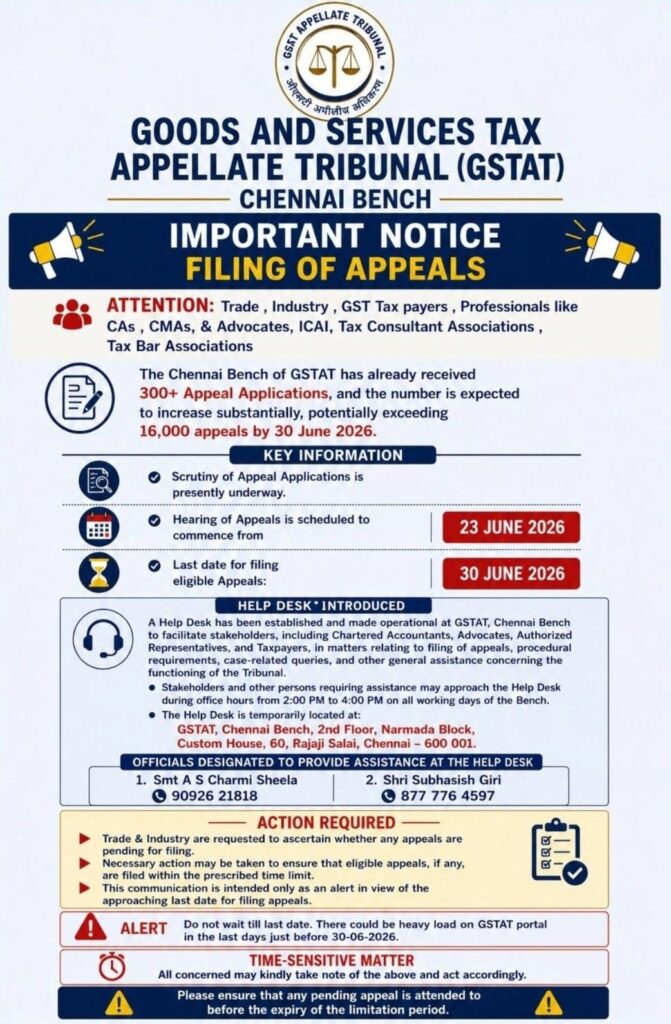
The Chennai Bench of the GST Appellate Tribunal has reportedly already received 300+ appeal applications and estimates that the number could rise significantly, potentially crossing 16,000 appeals before 30 June 2026.
If the expected volume materialises, the final weeks before the deadline could witness a substantial increase in filings.
For taxpayers, this means one thing:
The closer the deadline gets, the greater the filing pressure is likely to become.
Why Should Taxpayers Act Early?
A GSTAT appeal is not simply a matter of uploading a form before the deadline.
Depending on the case, preparation may involve:
- Reviewing the adjudication or appellate order
- Identifying appropriate grounds of appeal
- Preparing the statement of facts
- Drafting and reviewing grounds of appeal
- Collecting supporting documents
- Obtaining certified copies where required
- Calculating the applicable pre-deposit
- Arranging the necessary payment
- Completing the e-filing process
- Addressing any technical or procedural issues
Each of these steps takes time.
Waiting until the final days can turn a manageable filing exercise into a last-minute scramble.
The Tribunal Has Also Set Up a Helpdesk
Recognising the practical challenges faced by stakeholders, the Tribunal has also operationalised a Helpdesk to assist with filing-related queries and procedural requirements.
This is a useful facility for taxpayers and authorised representatives who may encounter difficulties during the filing process.
However, the availability of a Helpdesk should not be viewed as a reason to postpone filing.
If a taxpayer encounters an issue close to the deadline, there may be limited time available to resolve it.
The Right to Appeal Must Be Exercised Within Time
An appeal is not merely a procedural formality.
For a taxpayer who disagrees with an order, the statutory right to challenge that order can be extremely important.
But that right has to be exercised within the applicable limitation period.
A taxpayer may have strong grounds on merits, but failing to take timely procedural steps can create a separate and potentially serious limitation issue.
Therefore, the question should not simply be:
“How many days are left?”
The better question is:
“Is my appeal completely ready to be filed?”
A Simple Pre-Filing Check
If you have a pending GSTAT appeal, consider checking the following immediately:
✓ Is the order eligible for appeal?
✓ What is the applicable limitation period?
✓ Has the limitation deadline been correctly calculated?
✓ Are the grounds of appeal ready?
✓ Are all supporting documents available?
✓ Has the applicable pre-deposit been arranged?
✓ Are certified copies or other required documents ready?
✓ Has the e-filing process been initiated?
✓ Are there any outstanding procedural or portal-related issues?
If the answer to any of these questions is “No”, waiting another week may not be the safest approach.
Don’t Let the Deadline Become the Starting Point
A deadline should be the final checkpoint, not the point at which preparation begins.
With a significant number of appeals expected to be filed before the applicable deadline, taxpayers and professionals would be better served by completing their filings as early as reasonably possible.
Early preparation provides room to identify errors, obtain missing documents, address payment or pre-deposit issues and resolve technical difficulties.
Most importantly, it reduces the pressure of trying to complete everything at the last moment.
The Takeaway
The projected increase in GSTAT filings is a reminder that time available on paper is not necessarily the same as time available in practice.
The right to appeal is valuable only when it is exercised within the prescribed time and through the required procedure.
So, if you have been telling yourself:
“There’s still time. I’ll file it next week.”
This may be the right time to stop postponing it.
Check the limitation.
Prepare the appeal.
Complete the documentation.
Arrange the pre-deposit.
File well before the deadline.
Because 30 June 2026 is not just another date on the calendar for many taxpayers — it could be the last opportunity to exercise their right of appeal.
