

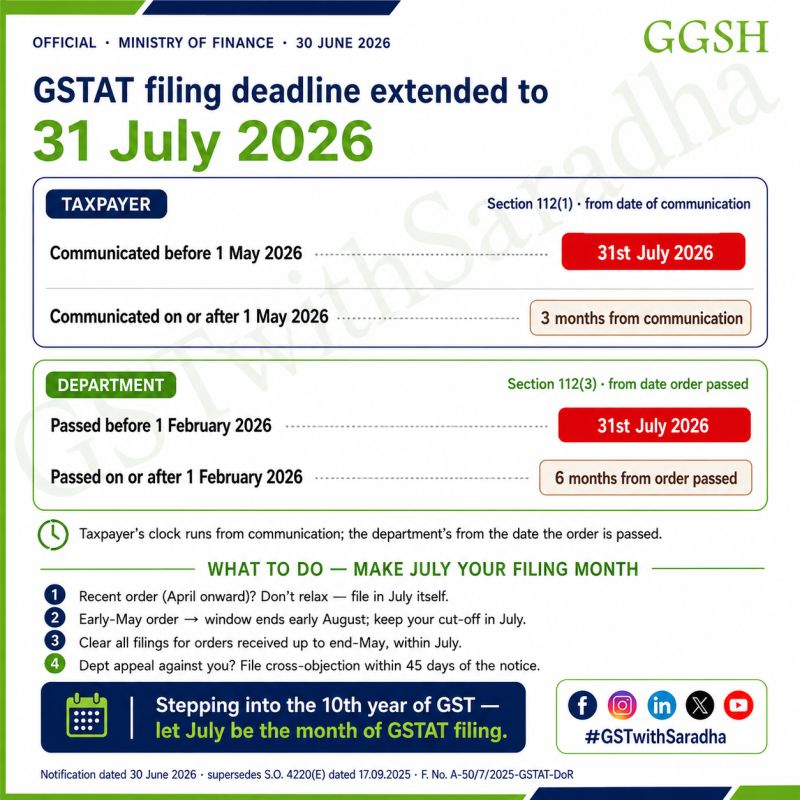
The extension of the deadline for filing appeals and applications before the GST Appellate Tribunal (GSTAT) has been widely welcomed by taxpayers and professionals.
But there is an important question that deserves closer attention:
Does the 31 July 2026 deadline apply to every GST order?
The answer is No.
The benefit of the extended deadline depends on when the order was communicated to the taxpayer and, in the case of departmental appeals, when the order was passed.
Understanding this distinction is critical to avoid incorrectly assuming that every GSTAT appeal can be filed by 31 July 2026.
The Extension — In Simple Terms
The Government, on the recommendations of the GST Council, has extended the time for filing certain appeals/applications before the GST Appellate Tribunal up to 31 July 2026.
The extension operates differently for:
A. Taxpayer appeals — Section 112(1)
B. Departmental appeals — Section 112(3)
The starting point for calculating the limitation period is also different.
A. For the Taxpayer — Section 112(1)
For a taxpayer, the relevant period is generally reckoned from the date of communication of the order.
Order communicated before 1 May 2026
Where the order was communicated before 1 May 2026, the extended deadline is:
31 July 2026
Order communicated on or after 1 May 2026
Where the order was communicated on or after 1 May 2026, the normal limitation period applies.
That means the taxpayer generally has:
3 months from the date of communication of the order.
Therefore, the 31 July 2026 extension should not be interpreted as a universal deadline for all taxpayer appeals.
B. For the Department — Section 112(3)
The calculation is different for departmental appeals.
Here, the relevant date is the date on which the order is passed, rather than the date on which the order is communicated to the taxpayer.
Order passed before 1 February 2026
Where the order was passed before 1 February 2026, the extended deadline is:
31 July 2026
Order passed on or after 1 February 2026
For orders passed on or after 1 February 2026, the normal limitation period applies:
6 months from the date on which the order was passed.
This difference between the taxpayer’s limitation period and the Department’s limitation period is important when analysing GSTAT proceedings.
Why the Date of Communication Matters
One of the most important points for taxpayers is this:
The extension is linked to the date of communication of the order — not merely the date on which the order was passed.
Consider a simple example.
Suppose an order was passed in April 2026 but communicated to the taxpayer only in May 2026.
The relevant date for the taxpayer’s appeal is the date of communication, not the date on which the order was passed.
Therefore, taxpayers should examine the communication date carefully before assuming that the 31 July deadline applies.
Don’t Wait Until the Last Day
Even where the 31 July 2026 deadline is available, waiting until the final day may create unnecessary risks.
A GSTAT appeal may involve several practical steps, including:
- Reviewing the impugned order
- Identifying grounds of appeal
- Preparing the appeal papers
- Arranging supporting documents
- Obtaining certified copies wherever required
- Calculating and arranging the applicable pre-deposit
- Completing the e-filing requirements
- Addressing technical or portal-related issues
A delay at any one of these stages can create last-minute complications.
Therefore, the safer approach is to treat July 2026 as the filing month, rather than treating 31 July as the date on which preparation should begin.
What About an Order Communicated in May 2026?
This is where careful calculation becomes particularly important.
For example, if an order is communicated during the first week of May 2026, the normal three-month limitation period may extend into the first week of August.
However, that does not mean taxpayers should automatically wait until the outermost date.
From a practical risk-management perspective, completing the filing within July can provide a useful buffer against:
Drafting delays.
Document gaps.
Pre-deposit issues.
Certified-copy requirements.
Portal problems.
The safest deadline is often the one you do not have to test.
What If the Department Files an Appeal?
Taxpayers should also remember that GSTAT proceedings are not limited to appeals filed by the taxpayer.
If the Department files an appeal against an order affecting the taxpayer, the taxpayer may need to consider filing a cross-objection within the prescribed 45-day period, where applicable.
This is a separate timeline and can easily be overlooked.
Therefore, taxpayers should monitor GSTAT-related communications carefully rather than assuming that the 31 July 2026 extension covers every procedural requirement.
A Practical GSTAT Checklist
Before relying on the extended deadline, taxpayers should verify:
1. When was the order passed?
2. When was the order communicated?
3. Is the appeal being filed by the taxpayer or by the Department?
4. Which limitation provision applies?
5. Does the 31 July 2026 extension actually apply to the particular order?
6. Has the pre-deposit requirement been calculated and arranged?
7. Are the appeal documents and supporting records ready?
8. Has sufficient time been kept for portal-related issues?
9. If the Department has filed an appeal, has the cross-objection timeline been monitored?
These checks can prevent a seemingly simple deadline from becoming a procedural dispute.
The Larger Picture
As GST moves into its tenth year, the GSTAT framework is becoming increasingly important for resolving disputes arising under the GST regime.
The extension to 31 July 2026 provides relief in eligible cases.
But an extension of time does not eliminate the need for careful limitation analysis.
The key takeaway is simple:
31 July 2026 is not automatically the deadline for every GSTAT appeal.
For taxpayers, the date of communication of the order is critical.
For departmental appeals, the date on which the order was passed becomes relevant.
Understanding these two different timelines is essential before deciding whether the extended deadline applies.
Don’t just mark 31 July on your calendar.
First determine whether 31 July is actually your deadline.
In GST litigation, knowing the limitation period is as important as knowing the merits of the case.
