

An appeal is intended to provide a taxpayer with an opportunity to challenge an order passed during adjudication. But what happens when the Appellate Authority, instead of deciding the appeal, sends the matter back to the original authority for fresh consideration?
Can the Appellate Authority simply remand the matter?
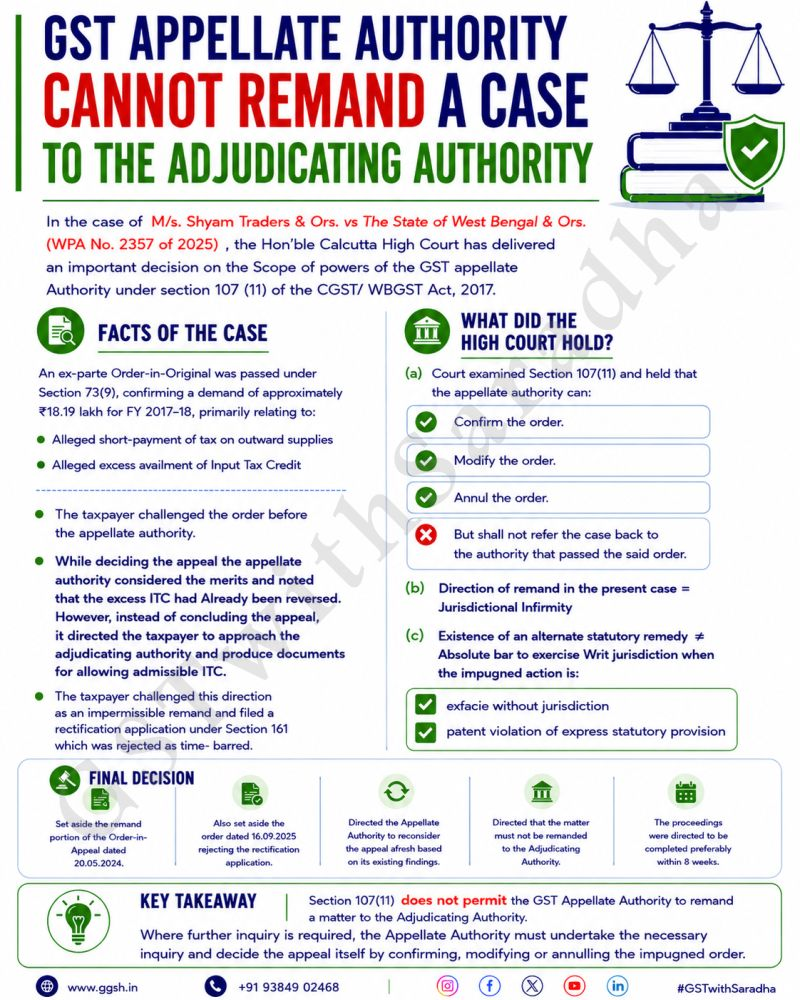
The Calcutta High Court recently examined this question in M/s. Shyam Traders & Ors. v. State of West Bengal & Ors.
What Does Section 107(11) Provide?
Section 107(11) of the GST law sets out the powers available to the Appellate Authority while deciding an appeal.
The Appellate Authority may, after making further inquiry where necessary:
- Confirm the order;
- Modify the order; or
- Annul the order.
The question before the Court was whether these powers also include an independent power to remand the matter back to the original adjudicating authority.
The Court’s View on Remand
The Calcutta High Court held that remand is not one of the powers expressly provided to the Appellate Authority under Section 107(11).
While the provision permits the Appellate Authority to conduct further inquiry where necessary, the Court distinguished such inquiry from sending the entire matter back to the original authority for a fresh decision.
In other words, the power to make further inquiry does not automatically translate into a power to remand.
The statutory powers have to be exercised within the boundaries specifically provided by the legislation.
Why Does This Matter to Taxpayers?
At first glance, remanding a matter may appear to be a procedural step.
For a taxpayer, however, it can have significant practical consequences.
A remand may result in:
- Another round of adjudication;
- Fresh submissions and hearings;
- Additional documentation and explanations;
- Further proceedings before the original authority; and
- Prolonged resolution of the dispute.
An appellate remedy is intended to provide an effective mechanism for challenging an order. Therefore, the scope of the Appellate Authority’s statutory powers becomes particularly important.
Further Inquiry Is Not the Same as Remand
One of the important distinctions emerging from the decision is between conducting further inquiry and remanding the proceedings.
Section 107(11) permits the Appellate Authority to make further inquiry where necessary before arriving at its decision.
However, according to the Court, this does not mean that the Appellate Authority can routinely return the matter to the adjudicating authority and require the entire process to begin again.
The appellate authority must operate within the powers granted to it by the statute.
What Did the High Court Do?
The Calcutta High Court set aside the remand order and directed the Appellate Authority to reconsider the appeal in accordance with law, based on the findings and material available before it.
The decision therefore reinforces the principle that statutory authorities cannot exercise powers beyond the authority conferred upon them by the legislation.
The Broader Legal Principle
The significance of this decision goes beyond the question of remand.
In tax litigation, it is common to focus heavily on the merits of the demand—whether tax is payable, whether ITC is admissible, whether a particular transaction is genuine, or whether a procedural requirement has been satisfied.
But there is another equally important question:
Does the authority actually have the statutory power to take the action it has taken?
An order may therefore be challenged not only on the merits of the tax dispute but also on the ground that the authority has acted beyond its prescribed jurisdiction or statutory powers.
Practical Takeaway for Taxpayers
When an adverse GST appellate order is received, taxpayers should examine more than just the final tax demand.
It is important to consider:
1. What powers does the authority have under the relevant provision?
2. Was the authority acting within those statutory powers?
3. Was the matter properly decided, or was it unnecessarily sent back for another round of proceedings?
4. Does the appellate order comply with the procedure prescribed under the GST law?
Understanding these questions can be particularly important in litigation because jurisdiction and statutory authority can be as significant as the underlying tax issue.
Conclusion
The Shyam Traders decision highlights a fundamental principle of administrative and tax law:
An authority can exercise only those powers that the law has conferred upon it.
Section 107(11) gives the Appellate Authority specific powers to confirm, modify or annul an order, while permitting further inquiry where necessary.
According to the Calcutta High Court, those powers do not include a general power to remand the matter to the original authority.
For taxpayers, the lesson is clear:
In an appeal, don’t look only at the tax demand. Look at the power behind the order.
Understanding the boundaries of statutory authority can sometimes be just as important as contesting the tax liability itself.
Case Citation
M/s. Shyam Traders & Ors. v. State of West Bengal & Ors.
WPA No. 2357 of 2025
Calcutta High Court
Decided on: 9 July 2026
