

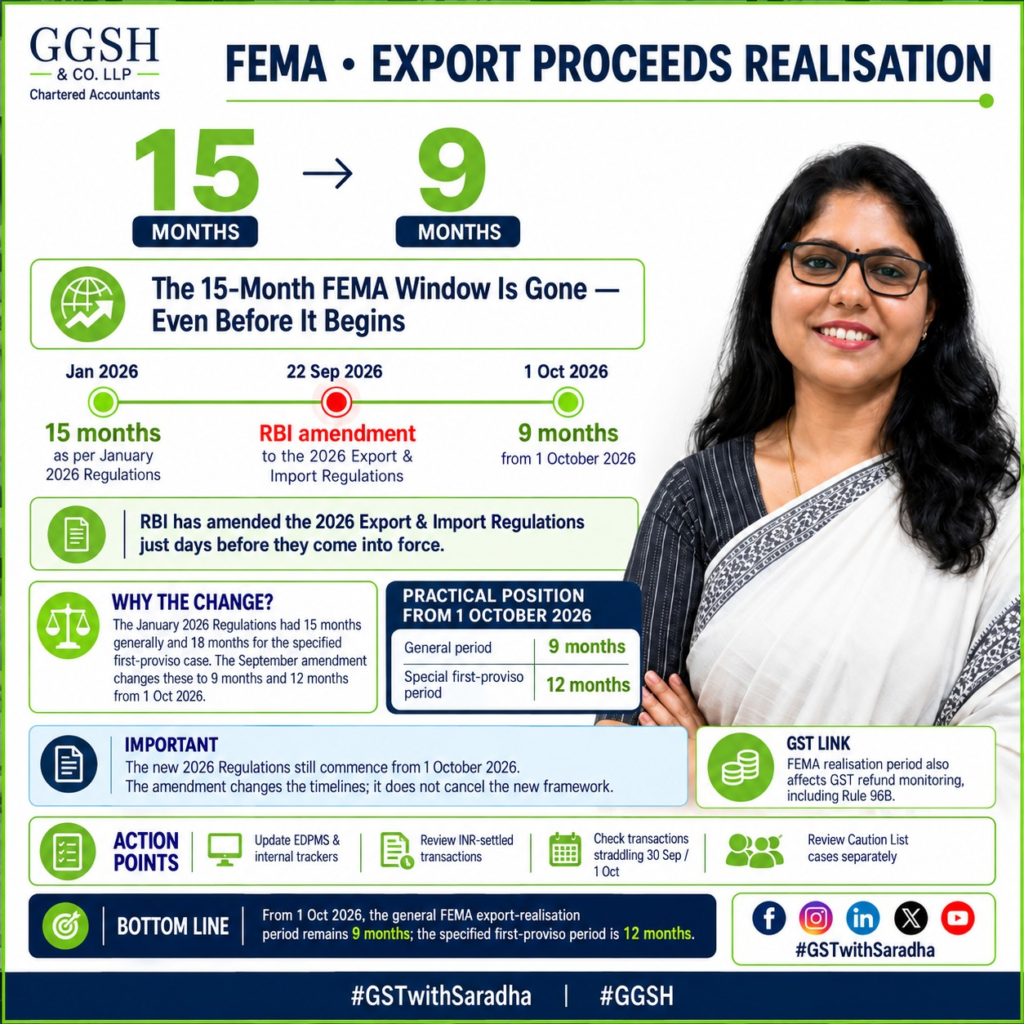
RBI changes the 2026 Export & Import Regulations just days before they come into force
| THE UPDATE IN ONE LINE The 2026 Regulations originally provided a 15-month general export-realisation period and an 18-month period in the specified case. RBI has now amended these to 9 months and 12 months respectively, with effect from 1 October 2026. |
From our earlier article to the latest update
In our earlier article, we tracked the unusual journey of India’s export-realisation timeline: 9 months → 15 months → 9 months → and then, seemingly, back to 15 months from 1 October 2026.
That last step has now changed. Just days before the new Foreign Exchange Management (Export and Import of Goods and Services) Regulations, 2026 were scheduled to come into force, the Reserve Bank of India amended them.
The result is significant: the 15-month realisation period that was written into the January 2026 Regulations will not become the operative general timeline from 1 October 2026.
There is another important change for the specified transactions involving INR settlement: the special 18-month period has been reduced to 12 months.
What changed this time?
RBI Notification No. FEMA 23(R)/(1)/2026-RB dated 22 September 2026 amends the Foreign Exchange Management (Export and Import of Goods and Services) Regulations, 2026. The amendment comes into force on 1 October 2026 — the same date on which the principal 2026 Regulations commence.
| Part of Regulation 5 | January 2026 Regulations | From 1 October 2026 |
| General realisation period | 15 months | 9 months |
| Special period under the first proviso | 18 months | 12 months |
So, was the 15-month period ever really available?
The January 2026 Regulations had prescribed 15 months for the general realisation period, with 18 months under the specified first proviso. However, those Regulations were notified to commence only from 1 October 2026.
Before that commencement date arrived, RBI issued the September amendment. Therefore, businesses should not plan post-1 October 2026 exports on the basis of the original 15-month timeline.
| THE PRACTICAL POSITION FROM 1 OCTOBER 2026 General period: 9 months Special first-proviso period: 12 months |
The FEMA clock has come full circle
The latest amendment makes the timeline we discussed in our earlier article even more relevant.
| Period / Event | Position |
| 2016 | 9 months becomes the standard timeline. |
| 2020 | RBI introduces flexibility to specify a different period from time to time. |
| April 2020 | Temporary COVID-related extension to 15 months. |
| November 2025 | General period moves from 9 → 15 months. |
| June 2026 | The period comes back from 15 → 9 months. |
| January 2026 Regulations | A new framework is notified with 15 months / 18 months, scheduled for October. |
| September 2026 | Before that framework starts, RBI changes it to 9 months / 12 months. |
| 1 October 2026 | The new Regulations commence — but with the shorter timelines. |
But the new 2026 Regulations are still important
It would be a mistake to read this amendment as simply ’15 months changed to 9 months’. The larger 2026 framework still comes into force from 1 October 2026.
The September notification changes specific provisions of the January framework; it does not cancel the new Regulations altogether.
This means exporters still need to transition from the 2015 Regulations to the 2026 Regulations, while applying the amended timelines. The practical exercise is therefore not simply to replace ’15’ with ‘9’ in an Excel sheet. It is to understand which parts of the new framework apply to each transaction from 1 October onwards.
What about exporters already on the Caution List?
The September amendment also addresses a specific transition issue. Exporters who are on the RBI Caution List as on 30 September 2026, pursuant to orders issued under the 2015 Regulations, will continue to be governed by the relevant order until they are removed from the Caution List.
This is an important transition provision. The move to the new Regulations does not automatically erase an existing Caution List position.
One more important change: the role of AD Banks
The September notification also introduces a new Regulation 20 – Powers to Authorised Dealers.
Under this provision, Authorised Dealers can handle certain export, import and merchanting-trade transactions undertaken before 1 October 2026 which previously required RBI approval under the 2015 framework and the relevant Master Directions.
For businesses, this reinforces an important point: the transition is not simply ‘old Regulations end → new Regulations start’. Certain transactions originating under the earlier framework can continue to require regulatory handling after the transition.
And what does this mean for GST refunds?
This is where the September notification connects directly back to the issue discussed in our earlier article.
The FEMA realisation period is not an isolated compliance number. Several GST and export-benefit provisions refer to the period permitted under FEMA.
For example, Rule 96B of the CGST Rules links the recovery of refund amounts to non-realisation of export proceeds within the period allowed under FEMA, including any permitted extension.
| THE LINK TO GST The FEMA clock is also a GST monitoring clock. With the general FEMA period continuing at nine months from 1 October 2026, businesses should not build refund-monitoring systems around the 15-month period that appeared in the original January 2026 Regulations. |
What should exporters do now?
- Keep 9 months as the primary planning period – For exports falling under the amended Regulation 5 framework from 1 October 2026, the general period is 9 months. Do not carry forward the earlier assumption of 15 months.
- Revisit INR-settled transactions – The special period originally stated as 18 months has now been reduced to 12 months. Identify the transactions covered by this proviso.
- Update EDPMS and internal trackers – Update export-realisation trackers, EDPMS monitoring, customer credit-period reviews, GST refund monitoring, FEMA exception reports and management dashboards.
- Do not discard the old transaction trail – Exports and regulatory approvals straddling 30 September / 1 October 2026 should be reviewed based on the applicable framework and transaction date.
- Review Caution List cases separately – If an exporter is covered by an existing Caution List order as on 30 September 2026, that order continues until removal from the list.
The bigger lesson from the FEMA clock
Our earlier article asked: ‘Which FEMA clock is actually ticking?’ The latest notification makes that question even more relevant.
In January, businesses were preparing for a new framework that appeared to provide a longer realisation window. In June, the existing framework had already tightened back to nine months. And now, in September, RBI has amended the incoming framework itself — before it begins — to retain nine months as the general period.
The important takeaway for exporters is therefore not simply that the deadline is nine months. It is that the FEMA realisation period should not be treated as a permanently fixed number.
For finance and compliance teams, the date of export, the applicable regulation and the transaction structure all need to be looked at together.
A simple timeline to remember
| Period | Position |
| Before 13 Nov 2025 | 9 months under the then-applicable framework |
| 13 Nov 2025 – 4 Jun 2026 | 15 months |
| 5 Jun 2026 – 30 Sep 2026 | 9 months |
| From 1 Oct 2026 | 9 months under the amended 2026 Regulations |
| Special first-proviso period from 1 Oct 2026 | 12 months |
| THE BOTTOM LINE 1 October 2026 still marks the beginning of the new FEMA Export & Import Regulations, 2026. But the expected 15-month general realisation period will not come into operation. The amended framework keeps the general period at 9 months and the specified first-proviso period at 12 months. |
Sources
- RBI Notification No. FEMA 23(R)/(1)/2026-RB dated 22 September 2026 – Foreign Exchange Management (Export and Import of Goods and Services) (Amendment) Regulations, 2026.
- FEMA 23(R)/2026-RB dated 13 January 2026 – Foreign Exchange Management (Export and Import of Goods and Services) Regulations, 2026.
- Official Gazette publication dated 24 September 2026.
- CGST Rules, including Rule 96B, for the linkage between export refund recovery and the period allowed under FEMA.
GGSH Disclaimer
This article is intended for informational purposes only and does not constitute legal, tax, FEMA or professional advice. Readers should evaluate the applicability of the discussed provisions to their specific facts and seek professional advice before acting on any matter discussed herein. GGSH & Co. LLP shall not be liable for any action taken or not taken based on this publication.
