

🚫 Supplier default.
🚫 Toll-route discrepancies.
🚫 Missing toll data.
These objections are increasingly becoming part of GST proceedings involving Input Tax Credit (ITC) and refund claims.
But an important question arises:
Can such objections, by themselves, be sufficient to deny a genuine transaction when the taxpayer has otherwise produced the documents required under GST law?
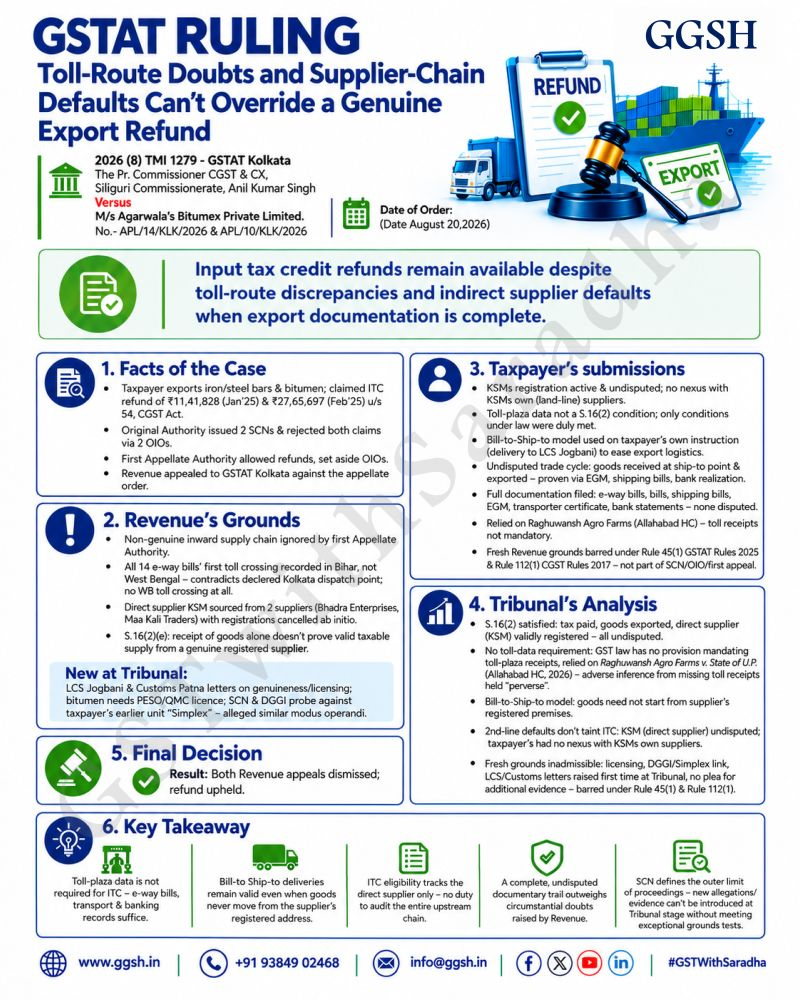
A recent ruling of the GSTAT, Kolkata Bench in Pr. Commissioner, CGST & CX, Siliguri Commissionerate v. M/s Agarwala’s Bitumex Pvt. Ltd. provides useful guidance on this issue. The Tribunal decided Revenue appeals APL/10/KLK/2026 and APL/14/KLK/2026 on 20 August 2026.
The Dispute
The case involved refund of accumulated ITC relating to exports.
The Revenue questioned the transactions using, among other things, toll/FASTag movement data and concerns relating to suppliers further up the supply chain.
The taxpayer, however, had documentary evidence supporting the transactions, including tax invoices, e-way bills, transport documents, shipping bills, export documentation and banking records.
The Tribunal examined whether the absence or mismatch of toll-route data could, by itself, establish that the underlying transactions were not genuine.
1. Toll Data Is Not a Statutory Substitute for Documentary Evidence
One of the significant observations was that toll plaza records are not prescribed by GST law as a mandatory condition for establishing movement of goods or claiming ITC/refund.
In this case, the Tribunal considered the broader documentary trail rather than treating toll data in isolation.
This is particularly relevant where the transaction is supported by documents such as:
- Tax invoices
- E-way bills
- Transport documents/bilties
- Shipping bills
- Export General Manifest (EGM)
- Banking records
- GST returns
The absence of a particular toll record does not automatically establish that goods were never moved. The evidentiary value of toll data must be considered alongside the complete facts and supporting documents.
2. Bill-to-Ship-to Transactions Cannot Be Rejected Merely Because Goods Did Not Move Through the Supplier’s State
The case also involved a Bill-to-Ship-to arrangement.
Under such a commercial structure, the goods may be dispatched directly from a location other than the registered premises of the invoicing supplier.
Therefore, the absence of toll movement through the supplier’s registered State cannot, by itself, establish that the transaction did not take place.
The Tribunal considered the bill-to-ship-to arrangement together with the available transaction and export documentation.
3. Can a Supplier’s Supplier Default Affect the Recipient’s ITC?
Another important issue concerned the second-line or upstream suppliers.
The Revenue raised concerns regarding the registration status of suppliers further up the supply chain.
However, the taxpayer’s direct supplier was a registered entity, and the underlying transaction with the direct supplier was supported by the relevant documentation.
The Tribunal held, in the circumstances of the case, that irregularities concerning the supplier’s supplier could not automatically be used to deny the recipient’s ITC/refund where the taxpayer’s own transaction and the relevant statutory requirements were otherwise established.
This is an important distinction:
A recipient’s entitlement cannot automatically be determined solely by an allegation concerning a party further removed from the taxpayer in the supply chain.
The facts and statutory conditions applicable to the recipient still have to be examined.
4. Can New Grounds Be Introduced at the Tribunal Stage?
There was another significant procedural aspect.
The Revenue sought to rely on grounds that had not formed part of the original proceedings in the manner required.
The Tribunal did not permit the appellate proceedings to become an opportunity to introduce an entirely new factual case that had not been part of the earlier proceedings.
This highlights an important principle in tax litigation:
An appeal is not necessarily an opportunity to introduce entirely new allegations as an afterthought.
The taxpayer should know the case it is required to answer, and the appellate proceedings must operate within the applicable procedural framework.
What Does This Mean for Taxpayers?
The ruling does not mean that toll discrepancies, supplier issues or missing records can never be relevant.
Rather, it reinforces the importance of examining whether the objection:
- Is based on an actual statutory requirement;
- Is supported by evidence;
- Addresses the taxpayer’s own transaction;
- Properly considers the complete documentary trail; and
- Was actually part of the case made out in the earlier proceedings.
A single data point should not automatically be treated as conclusive proof when the overall transaction is supported by credible statutory and commercial documentation.
Practical Takeaway for Businesses
Businesses facing ITC disputes or export-refund proceedings should maintain a complete documentary trail rather than relying on one category of evidence.
Important records may include:
- Tax invoices
- E-way bills
- Lorry receipts/bilties
- Purchase and sales records
- Shipping bills
- EGM/export records
- Bank/payment records
- GST returns
- Agreements and correspondence
- Documents supporting the movement and receipt of goods
And when an objection is raised, one question should always be asked:
“Is this actually a statutory requirement, or is it merely being treated as one?”
The Larger Lesson
The Agarwala’s Bitumex ruling is a useful reminder that GST compliance cannot always be reduced to a single data point.
Toll data may be relevant evidence. Supplier compliance may require scrutiny. Documentation must be genuine and complete.
But where the law prescribes particular conditions, the taxpayer should not ordinarily be required to satisfy an additional requirement merely because a particular database, route record or third-party transaction creates a discrepancy.
For businesses with pending ITC disputes or export-refund claims, the decision is therefore worth keeping on the radar.
The real question is not simply whether there is a discrepancy.
The real question is whether that discrepancy legally establishes the allegation being made against the taxpayer.
This article is for general informational purposes and should not be treated as legal or tax advice. The applicability of the ruling depends on the facts, statutory provisions and procedural history of each case.
