

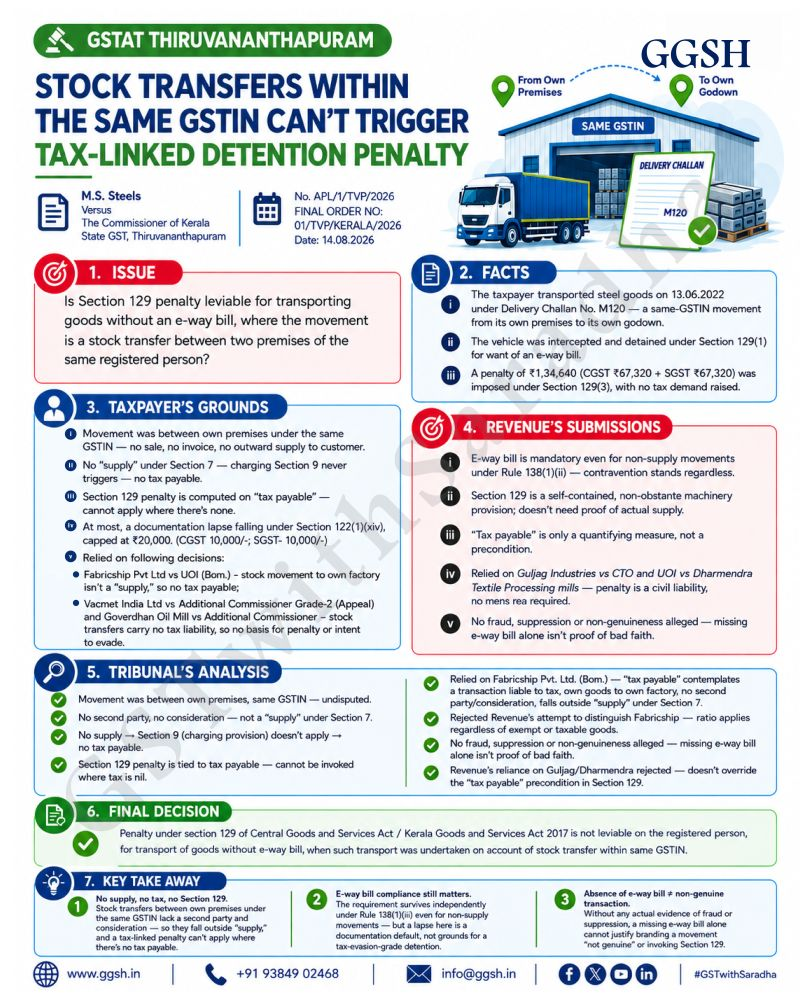
A business may move its own goods from one premises to another.
Same entity. Same GSTIN. No customer. No consideration.
There is movement of goods — but is there a “supply” under GST?
And if there is no taxable supply, can a tax-linked penalty under Section 129 be imposed merely because the e-way bill was not generated?
This question came before the GSTAT, Thiruvananthapuram Bench in M.S. Steels v. Commissioner of Kerala State GST, Thiruvananthapuram.
The Tribunal’s decision draws an important distinction between an e-way bill compliance requirement and the tax-linked consequences of a contravention.
The Facts of the Case
M/s M.S. Steels, a partnership firm dealing in steel goods, transported goods from its own premises to its own godown.
Both locations were covered under the same GSTIN, making the movement an internal stock transfer.
The goods were accompanied by a Delivery Challan, but no e-way bill was available during transportation.
The vehicle was intercepted and the goods were detained under Section 129.
A penalty of ₹1,34,640 was imposed under Section 129(3), comprising ₹67,320 CGST and ₹67,320 SGST.
Importantly, no tax demand was raised. The penalty was imposed in connection with the absence of the e-way bill.
The Core Question
The Tribunal considered whether Section 129 penalty could be imposed when the movement itself did not constitute a taxable supply.
Under GST, tax under the charging provision arises on a supply.
Here, the goods were being moved between premises belonging to the same registered person under the same GSTIN. There was no customer, no transfer to another person and no consideration.
On these facts, the Tribunal treated the movement as a stock transfer rather than a taxable supply.
Therefore, there was no tax payable on the movement against which the Section 129 penalty could be computed.
But Was the E-Way Bill Still Required?
Yes.
This is the part that should not be missed.
The Tribunal did not hold that businesses can ignore e-way bill requirements for stock movements.
Rule 138(1)(ii) specifically contemplates movement of goods for reasons other than supply.
Therefore, the absence of an e-way bill can still constitute a compliance breach.
The Tribunal’s distinction was between:
“Was an e-way bill required?”
and
“Does that breach justify a Section 129 tax-linked penalty?”
Those are two different questions.
Why Section 129 Became the Critical Issue
Section 129 operates in the context of detention, seizure and release of goods and links the applicable penalty to the tax payable on the goods.
In a genuine same-GSTIN stock movement where there is no taxable supply, the Tribunal found that there was no tax payable on the movement.
Consequently, a penalty calculated by notionally applying the GST rate to the value of the goods could not be sustained under Section 129.
The Tribunal instead referred to the general documentation-related penalty provision under Section 122(1)(xiv) for the e-way bill/documentation contravention.
The Important Distinction
This case demonstrates why every GST movement case should be analysed in the correct sequence.
1. Identify the transaction
Is it a sale, stock transfer, job work movement, return, exhibition movement or some other movement?
2. Determine whether there is a taxable supply
Does the movement fall within the scope of “supply” under the GST law?
3. Determine the applicable compliance requirement
Even where there is no supply, does Rule 138 require an e-way bill for the particular movement?
4. Identify the correct consequence
If there is a documentation lapse, which statutory provision actually governs the contravention?
This sequence matters because a procedural lapse does not automatically transform a non-taxable movement into a taxable supply.
What Businesses Should Take Away
Businesses regularly moving goods between their own:
- Warehouses
- Godowns
- Branches
- Manufacturing locations
- Other business premises
should not treat this ruling as permission to skip e-way bill compliance.
Instead, the practical lesson is to maintain proper documentation even for non-sale movements.
A delivery challan, e-way bill where required, stock records and supporting movement documents can help establish the true nature of the transaction if the goods are intercepted.
At the same time, if proceedings are initiated, taxpayers should examine whether the department has correctly identified:
the nature of the transaction → the existence of tax liability → the applicable penal provision.
The Larger Lesson
The M.S. Steels ruling highlights an important principle in GST proceedings:
A documentation lapse and a taxable supply are not necessarily the same thing.
The Tribunal did not eliminate the e-way bill requirement.
It addressed the consequence of failing to comply with that requirement in a specific factual situation where the movement was an internal stock transfer and no tax was payable.
For businesses, the lesson is therefore simple:
First determine what actually happened.
Then determine whether tax was payable.
Only then determine which penal provision applies.
Because sometimes, answering “What is the transaction?” must come before asking “Which section applies?”
Case Citation
M.S. Steels v. Commissioner of Kerala State GST, Thiruvananthapuram
Appeal No. APL/1/TVP/2026
Final Order No. 01/TVP/KERALA/2026
GSTAT, Thiruvananthapuram Bench
Order dated: 14 August 2026
The Tribunal also relied upon the reasoning in Fabricship Pvt. Ltd. v. Union of India concerning the expression “tax payable” in the context of Section 129.
This article is for general informational purposes only and should not be treated as legal or tax advice. The applicability of the ruling depends on the specific facts, nature of movement and applicable statutory provisions.
