

The Central Board of Indirect Taxes and Customs (CBIC) has issued Instruction No. 02/2025-GST dated 7th February 2025 in relation to the waiver scheme under Section 128A.
But the big question is — is there anything significant to celebrate?
✍ IMHO, honestly… not really.
The instruction clarifies that where Department Appeals are filed only on account of interest and/or penalty, and the taxpayer fulfills the conditions under Section 128A, the proper officer may proceed to withdraw such departmental appeals.
Fair enough… but does this really cover all practical scenarios? 🤔
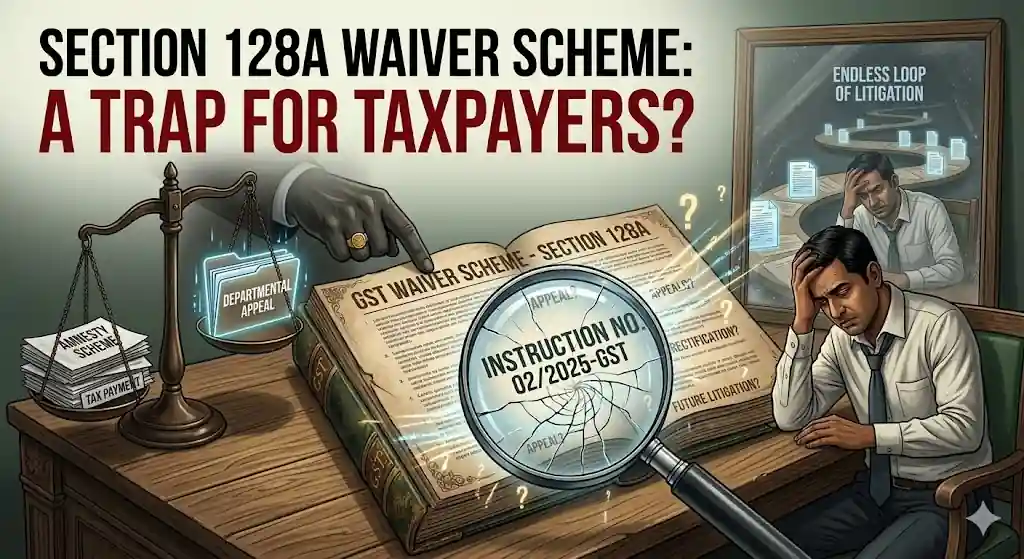
Key Concerns
1️⃣ No Finality Even After Availing Waiver
Even after the waiver benefit is granted, the department is not legally barred from filing appeals or rectification against the order granting waiver.
This means that despite opting for the scheme to settle the dispute and achieve closure, the taxpayer may still face further litigation.
📌 Suggestion:
Introduce a legal provision preventing the department from appealing against orders granting waiver benefits, since proceedings should ideally conclude once Section 128A relief is granted.
Otherwise, it becomes an endless cycle of disputes.
Also, the current instruction covers only departmental appeals relating to interest and/or penalty, making it inadequate in scope.
2️⃣ No Protection from Department Appeals or Rectification
For cases relating to FY 2019-20, there is a real possibility that:
• Taxpayers may apply for amnesty and pay the tax liability, while
• The department may still file an appeal before the limitation period expires (around Feb 2025, depending on order date).
This creates uncertainty — even after opting for the amnesty scheme, taxpayers may still face departmental appeals.
📌 Suggestion:
The Central Board of Indirect Taxes and Customs should issue internal instructions to avoid departmental appeals in cases where taxpayers have opted for the amnesty scheme.
Without this, the objective of dispute settlement remains incomplete.
3️⃣ No Waiver Option for Future Uncertainty
Another practical issue arises where:
• Currently no demand exists, because the department has dropped proceedings, but
• The department may appeal against the drop order, and
• The tax liability may later be confirmed by an appellate authority.
In such situations, taxpayers lose the opportunity to opt for the amnesty scheme, because:
• There is no demand at present, and
• The law does not explicitly allow future access to the scheme if the demand arises later.
📌 Suggestion:
Amend Section 128A to allow cases where NIL demand orders are later enhanced in appeal to also qualify for the amnesty scheme.
Final Thought
While the instruction attempts to address certain procedural aspects, it falls short of providing true dispute finality.
Without stronger safeguards, taxpayers opting for the scheme may still face future appeals, rectifications, and prolonged litigation.
💬 What are your thoughts on this instruction?
Do you think the amnesty scheme achieves its intended objective of dispute resolution?
Share your views below 👇