

A key GST compliance update is coming into effect from April 2025 that every registered taxpayer should be aware of. The GSTN system will begin auto-populating Table 3.2 of GSTR-3B based on the details reported in GSTR-1, GSTR-1A, or IFF (Invoice Furnishing Facility).
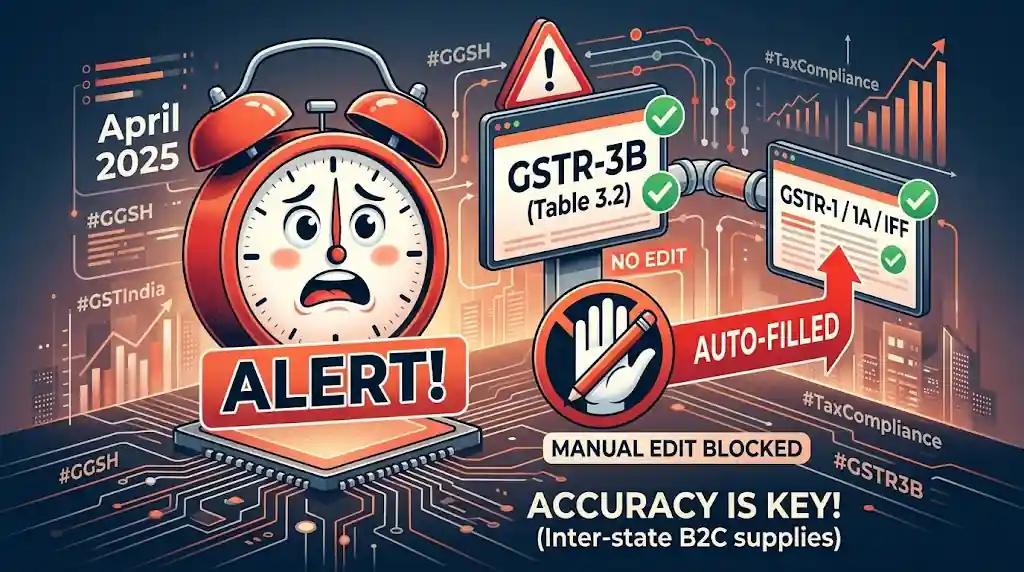
This change is designed to improve accuracy, transparency, and consistency in GST return filing, but it also means businesses must ensure that their outward supply reporting in GSTR-1 is accurate from the start.
For taxpayers dealing with inter-state B2C supplies, this update will directly impact how tax liability is reported in GSTR-3B returns.
What is Changing in GSTR-3B from April 2025?
Beginning with the April 2025 tax period, the GST portal will auto-populate Table 3.2 in GSTR-3B using data filed in:
- GSTR-1
- GSTR-1A
- IFF (Invoice Furnishing Facility)
Most importantly, the values populated in this table cannot be edited manually in GSTR-3B.
This means the system will pull data directly from the outward supply details already reported in the sales return (GSTR-1) and reflect it in the monthly summary return (GSTR-3B).
What is Table 3.2 in GSTR-3B?
Table 3.2 of GSTR-3B captures inter-state outward supplies made to unregistered persons and certain special categories of recipients.
Typically, this includes supplies made to:
- Unregistered persons (B2C inter-state transactions)
- Composition taxpayers
- UIN holders
These transactions are reported state-wise, as the tax collected needs to be allocated to the respective destination states under the GST destination-based taxation principle.
Why This Change Matters for Businesses
The objective behind this update is to align GST returns and reduce mismatches between GSTR-1 and GSTR-3B.
Earlier, taxpayers could manually report figures in GSTR-3B Table 3.2, which sometimes led to differences between:
- Sales reported in GSTR-1
- Tax liability declared in GSTR-3B
By introducing auto-population from GSTR-1, the GST system aims to:
- Improve data consistency across GST returns
- Reduce manual errors in GST filings
- Strengthen GST compliance monitoring
- Ensure accurate tax allocation across states
Impact on Inter-State B2C Supplies
The change particularly affects businesses making inter-state B2C supplies, such as:
- E-commerce sellers
- Online service providers
- Retailers supplying goods across states
- Businesses selling directly to consumers in other states
Since the data will now flow directly from GSTR-1 into GSTR-3B, any mistake in reporting inter-state B2C transactions in GSTR-1 will automatically appear in GSTR-3B and may not be editable there.
This makes accurate reporting in GSTR-1 more critical than ever.
Practical Steps Businesses Should Take
To avoid GST compliance issues, businesses should review their GST return preparation process before filing.
Key action points include:
- Ensure inter-state B2C supplies are correctly reported in GSTR-1
- Verify state-wise reporting of outward supplies
- Reconcile sales data with GST return entries
- Review data carefully before submitting GSTR-1 or IFF
Since Table 3.2 in GSTR-3B will be system-generated, the accuracy of your GSTR-1 filing becomes the foundation of correct GST reporting.
The Bottom Line
The auto-population of GSTR-3B Table 3.2 from GSTR-1 starting April 2025 is an important step toward streamlining GST return filing and improving compliance accuracy.
While the update reduces manual intervention, it also increases the importance of accurate outward supply reporting in GSTR-1.Businesses should therefore treat GSTR-1 as the primary source of truth for GST reporting, ensuring that every detail is verified before filing.