

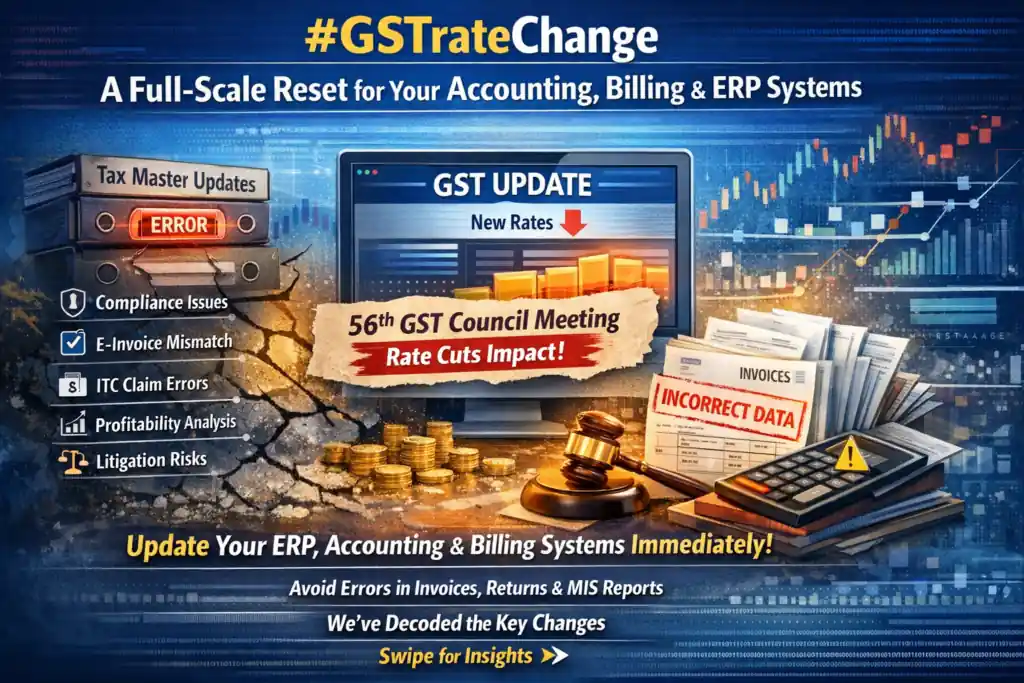
A GST rate change is far more than simply applying a new tax percentage on invoices. For businesses, it triggers a full-scale reset across accounting systems, billing software, and ERP configurations.
With the recommendations from the 56th meeting of the GST Council, several GST rate adjustments have been introduced across industries. These changes require businesses to immediately update their ERP systems and accounting workflows to prevent compliance errors.
Failure to properly implement these updates can lead to invoice mismatches, incorrect Input Tax Credit (ITC) claims, reporting discrepancies, and potential litigation risks.
Why GST Rate Changes Impact ERP and Accounting Systems
When a GST rate revision occurs, it affects multiple operational layers within an organization. The tax percentage is not only reflected on invoices but also influences tax masters, product classifications, return filings, and financial reporting systems.
A single incorrect configuration in an ERP or billing system can result in:
- Incorrect GST calculation on invoices
- Mismatches in e-invoice reporting
- Errors in GST returns such as GSTR-1 or GSTR-3B
- Incorrect Input Tax Credit (ITC) claims
- Distorted profitability and MIS reports
Therefore, ERP and accounting systems must be updated promptly to ensure tax accuracy and compliance under the GST framework.
Key ERP and Accounting Updates Businesses Must Implement
Businesses must conduct a systematic review of their tax configuration across ERP and accounting software.
1. Update Tax Master Data
The tax master configuration in ERP systems must reflect the updated GST rates.
This includes:
- Revised GST percentages
- Updated HSN/SAC tax mappings
- Correct tax applicability for different product categories
Incorrect tax master settings can cause system-wide calculation errors across invoices and returns.
2. Reconfigure Sector-Specific ERP Settings
Certain industries have special ERP configurations based on GST treatment, including:
- manufacturing companies
- trading businesses
- service providers
- export-oriented units
Each sector may require specific tax rule adjustments within the ERP environment to align with the latest GST rate changes.
3. Update Billing and Invoicing Systems
Billing systems must be aligned with the updated tax structure to ensure:
- Correct GST calculation on invoices
- Accurate e-invoice generation
- Proper GST reporting in sales registers
Errors at the invoicing stage often cascade into compliance mismatches across the entire tax reporting cycle.
4. Review Input Tax Credit (ITC) Mapping
Changes in GST rates can affect Input Tax Credit eligibility and reporting structures.
Businesses must review:
- ITC mapping rules
- purchase tax configurations
- reconciliation processes
This ensures accurate ITC claims and avoids disputes during GST audits or assessments.
5. Align MIS and Financial Reporting
GST rate updates can also influence profitability analysis, cost allocation, and management reporting.
Companies must ensure their MIS reports and financial dashboards reflect the updated tax treatment to maintain accurate business performance analysis.
Risks of Not Updating ERP Systems After GST Rate Changes
Businesses that delay ERP updates after GST rate changes may face multiple compliance and operational risks.
These include:
- GST return mismatches
- e-invoice validation failures
- incorrect tax payments
- ITC disputes
- potential litigation with tax authorities
Early system updates help businesses maintain smooth compliance and avoid costly corrections later.
Why Proactive GST System Updates Are Critical
GST compliance is increasingly technology-driven, especially with the integration of:
- e-invoicing systems
- automated return matching
- digital GST audits
As a result, even minor system configuration errors can create large-scale reporting discrepancies across multiple tax filings.
Proactive ERP configuration updates ensure businesses remain fully compliant with evolving GST regulations.
Final Thoughts
The GST rate revisions introduced after the 56th GST Council meeting highlight the importance of aligning technology systems with tax regulations.
Businesses should treat GST rate changes not merely as tax adjustments but as a comprehensive operational update across accounting, billing, and ERP platforms.By updating systems early and correctly, organizations can avoid compliance issues and ensure accurate financial and tax reporting.