

When GST rates change, determining the correct tax rate is not always straightforward. Businesses must carefully evaluate when the supply is deemed to occur, especially when supply, invoicing, and payment happen on different dates.
With several GST rate revisions coming into effect from 22 September 2025 following recommendations of the GST Council, businesses must now apply the provisions of Section 14 of the Central Goods and Services Tax Act, 2017 to determine the correct tax rate.
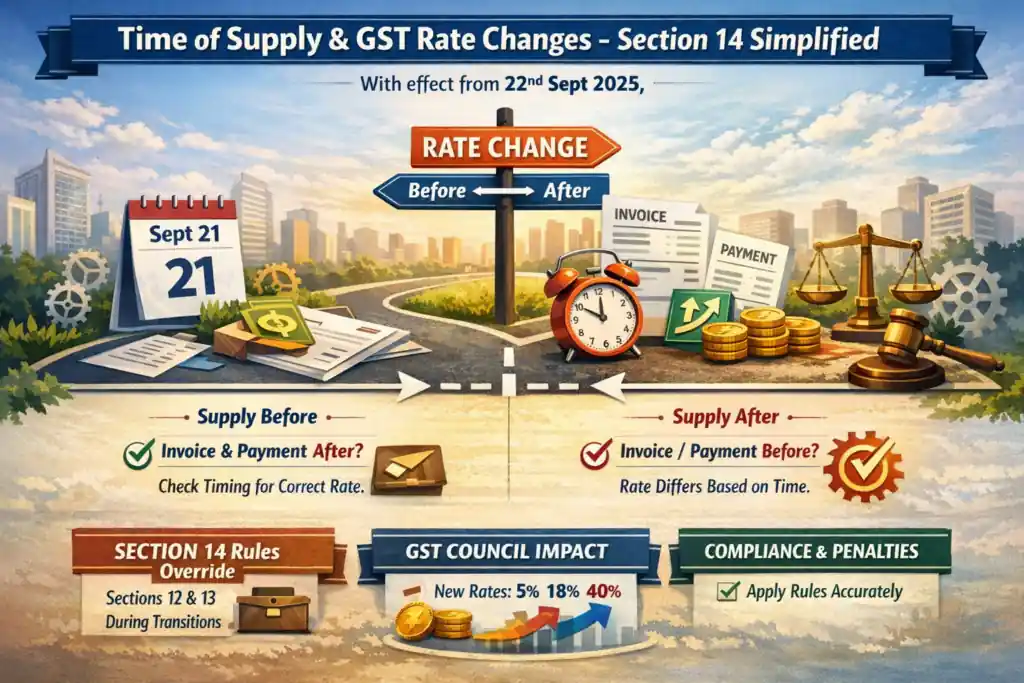
Section 14 specifically deals with taxability when there is a change in the GST rate, and it overrides the general time of supply provisions under Sections 12 and 13 during such transitions.
Understanding this rule is essential to ensure accurate GST compliance and avoid tax disputes or penalties.
What Is Time of Supply Under GST?
Under the GST framework, the time of supply determines the point at which tax becomes payable.
Normally, the time of supply is determined under:
- Section 12 – Time of supply for goods
- Section 13 – Time of supply for services
However, when there is a GST rate change, these provisions are temporarily overridden by Section 14, which introduces specific rules for determining the applicable rate.
Why Section 14 Becomes Important During GST Rate Changes
When GST rates change, transactions may span across different timelines.
For example:
- Supply may occur before the rate change
- Invoice may be issued after the rate change
- Payment may be received either before or after the change
Without clear rules, such scenarios could lead to confusion, inconsistent tax treatment, and disputes with tax authorities.
Section 14 ensures uniform application of GST rates during transitional periods.
Key Scenarios Under Section 14 of the CGST Act
Section 14 provides rules for determining the applicable GST rate based on the timing of three key events:
- Date of supply
- Date of invoice
- Date of payment
Scenario 1: Supply Before Rate Change
If the supply occurs before the GST rate change, the applicable rate depends on the timing of the invoice and payment.
Examples include:
- Supply before rate change and invoice issued after → Payment timing determines the applicable rate
- Supply before rate change and payment received before → Old rate may apply
This requires careful review of both invoicing records and payment dates.
Scenario 2: Supply After Rate Change
If the supply occurs after the GST rate change, the applicable rate may still depend on whether the invoice or payment was made before the change.
For example:
- Supply after rate change but invoice issued earlier
- Supply after rate change but payment received earlier
In such cases, Section 14 rules determine whether the old GST rate or new GST rate should apply.
GST Rate Changes Following the 56th GST Council Meeting
The 56th meeting of the GST Council introduced several changes to GST rate slabs across different sectors.
Certain goods and services have now moved to revised tax brackets, including:
- 5% GST slab
- 18% GST slab
- 40% GST slab in specific cases
These rate changes make it even more critical for businesses to apply Section 14 correctly when transactions cross the rate-change date of 22 September 2025.
Compliance Risks if Time of Supply Rules Are Misapplied
Incorrect application of Section 14 provisions may lead to multiple compliance risks, such as:
- Incorrect GST rate applied on invoices
- Mismatches between GSTR-1 and GSTR-3B returns
- ITC disputes with recipients
- Possible tax demands, interest, and penalties
Therefore, finance teams must carefully evaluate transaction timelines and supporting documentation.
Best Practices for Businesses During GST Rate Transitions
To avoid compliance issues, businesses should take the following steps:
Review Pending Transactions
Identify transactions where supply, invoicing, or payment fall across the rate change date.
Update ERP and Accounting Systems
Ensure ERP systems correctly capture the applicable GST rate based on Section 14 logic.
Train Finance and Billing Teams
Accounting teams must understand how time of supply rules change during GST rate transitions.
Maintain Proper Documentation
Maintain clear records of supply dates, invoice dates, and payment receipts to support the tax treatment applied.
Final Thoughts
GST rate changes often create transitional complexities for businesses. Section 14 of the CGST Act plays a critical role in ensuring consistency and clarity during these periods.
With the new rate revisions coming into effect from 22 September 2025, businesses must carefully determine the time of supply to apply the correct GST rate.In many cases, the difference between compliance and non-compliance comes down to correctly identifying when the supply is deemed to occur.