

India’s Goods and Services Tax (GST) framework continues to evolve as policymakers move toward a more simplified and efficient indirect tax structure. The discussions and recommendations from the 56th meeting of the GST Council have introduced significant GST rate rationalisation measures, impacting multiple sectors across the economy.
Often referred to as part of the broader “GST 2.0 reforms”, these changes aim to create a simpler tax structure, reduce classification disputes, and enhance compliance clarity for businesses.
However, with multiple updates announced simultaneously, many taxpayers, finance teams, and tax professionals are seeking clear answers regarding revised GST rates, Input Tax Credit (ITC) implications, and sector-specific changes.
To help businesses navigate these updates smoothly, the GGSH Indirect Tax Advisory Team has prepared a comprehensive FAQ note explaining the key aspects of GST rate rationalisation.
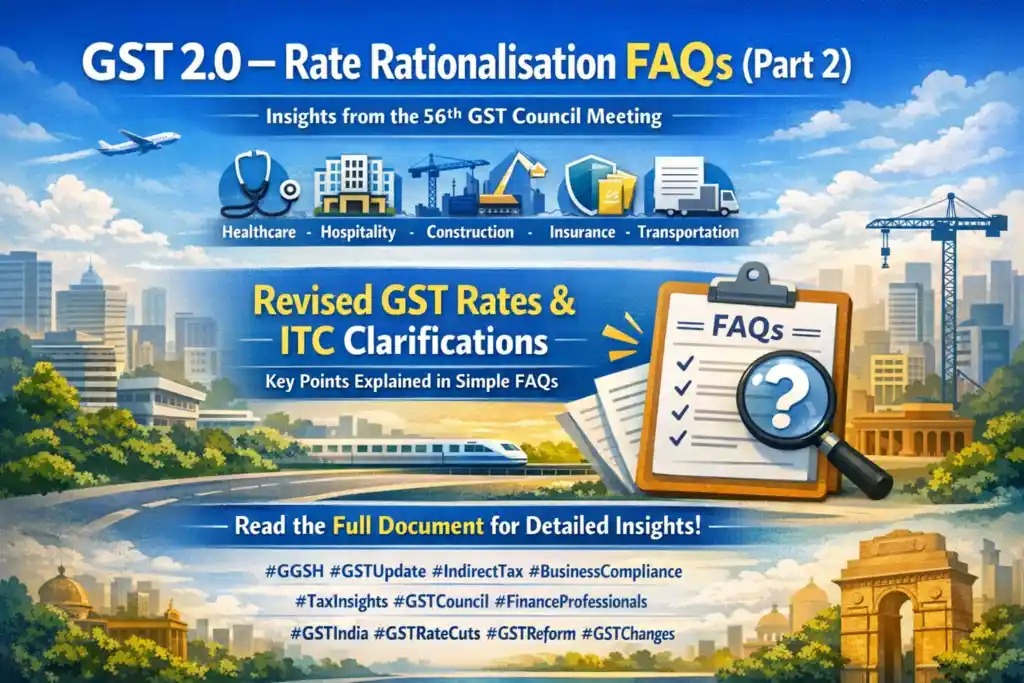
What Is GST Rate Rationalisation?
GST rate rationalisation refers to the process of restructuring existing GST tax slabs to make the system simpler, more efficient, and economically balanced.
Over time, India’s GST structure has evolved into multiple tax slabs, including:
- 5% GST
- 12% GST
- 18% GST
- 28% GST
Through rate rationalisation, the government aims to:
- Reduce complex tax classifications
- Improve ease of compliance for businesses
- Align GST rates with economic realities and sectoral needs
These reforms are considered a key part of the next phase of GST policy evolution in India.
Key Sectors Impacted by GST 2.0 Rate Changes
The latest GST Council discussions have introduced changes affecting a wide range of industries.
Some of the most impacted sectors include:
Healthcare
Changes related to medical services, healthcare products, and wellness services may alter GST applicability and exemptions.
Businesses operating in this sector must carefully review tax classification and invoicing practices.
Hospitality and Tourism
The hospitality sector, including hotels, restaurants, and tourism services, may experience revised GST treatments affecting pricing structures and input tax credit eligibility.
This can impact billing systems, service charges, and tax calculations.
Construction and Real Estate
GST rationalisation also affects construction services and real estate transactions, requiring developers and contractors to evaluate:
- tax rates on services
- input tax credit restrictions
- pricing strategies for ongoing projects
Insurance Sector
Changes in GST treatment for certain insurance products and services may influence premium pricing and compliance requirements.
Insurance companies and intermediaries should review their tax reporting systems and invoicing structures.
Transportation and Logistics
The transportation and logistics industry may also see revised GST implications, particularly in areas related to freight services, logistics operations, and supply chain management.
Businesses must ensure that ERP systems and billing platforms reflect updated GST rates correctly.
Clarifications on Input Tax Credit (ITC)
One of the most important aspects covered in the GST 2.0 FAQ guidance is the treatment of Input Tax Credit (ITC).
Businesses must carefully examine:
- Whether ITC eligibility changes under revised GST rates
- How rate rationalisation affects existing credit balances
- Documentation requirements for proper ITC claims
Clear ITC planning is essential to ensure accurate tax reporting and avoid future disputes with tax authorities.
Why Businesses Must Review Their GST Systems
GST rate rationalisation does not affect only tax calculations; it also impacts internal business systems and compliance processes.
Companies should review the following areas:
- ERP tax master configurations
- accounting software GST settings
- invoicing and billing systems
- pricing models and contracts
- GST return reconciliation processes
Without proper updates, businesses may face invoice mismatches, incorrect ITC claims, and compliance risks.
Importance of Understanding GST 2.0 Reforms
The evolving GST 2.0 framework represents a broader attempt to modernise India’s indirect tax system.
For businesses, understanding these changes early can help:
- improve compliance accuracy
- avoid costly tax disputes
- optimize tax planning strategies
- adapt pricing and operational structures effectively
Professional guidance and structured interpretation of these updates can significantly reduce confusion during the transition phase.
Final Thoughts
The GST rate rationalisation measures introduced after the 56th GST Council meeting represent another step toward a simpler and more transparent GST system in India.
However, businesses must stay informed and proactive to ensure they correctly interpret revised GST rates and Input Tax Credit rules.By reviewing the detailed GST 2.0 FAQ guidance, organizations can better understand the impact of these reforms and remain fully compliant with evolving tax regulations.