

Time limits under the GST law play a critical role in determining whether a tax demand raised by the department is legally valid or time-barred. Over the years, one of the most debated aspects of GST litigation has been the statutory period available to the tax department for issuing a Show Cause Notice (SCN) and passing the final adjudication order.
With the introduction of Section 74A under the Central Goods and Services Tax Act, 2017, the timelines for initiating and completing proceedings are set to change significantly from Financial Year 2024–25 onwards.
Understanding these revised timelines is essential for businesses, tax professionals, and compliance teams dealing with GST disputes, demand notices, and litigation risk management.
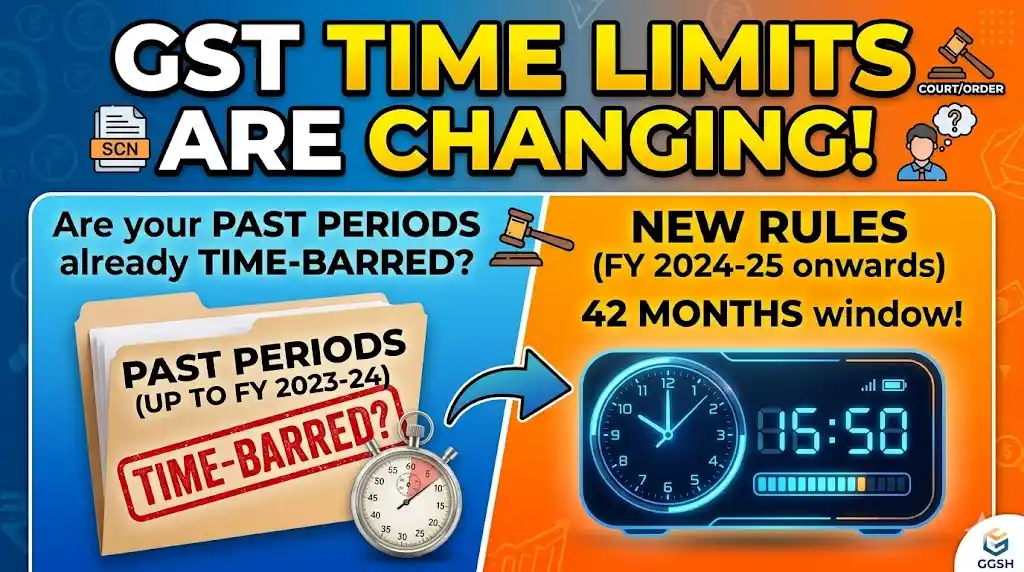
Why GST Time Limits Matter in Litigation
In GST proceedings, time limitation is a decisive legal factor. If the tax department fails to issue an SCN or pass an order within the statutory time limits, the demand may become legally unenforceable.
These limitation periods determine whether:
- A tax demand is valid or time-barred
- The department has jurisdiction to proceed with the case
- Taxpayers can challenge the validity of notices in litigation
Therefore, reviewing the timeline of a Show Cause Notice is often the first step when responding to a GST demand.
Existing Framework: Sections 73 and 74 (Up to FY 2023–24)
For tax periods up to FY 2023–24, GST demand proceedings continue to follow the existing provisions under:
- Section 73 of the Central Goods and Services Tax Act – cases involving non-fraud or bona fide errors
- Section 74 of the Central Goods and Services Tax Act – cases involving fraud, wilful misstatement, or suppression of facts
Section 73 – Non-Fraud Cases
In cases where the department alleges tax short payment without fraud, the time limits are relatively shorter.
Typically, the department must:
- Issue the Show Cause Notice before the prescribed limitation period, and
- Pass the final order within the statutory timeline.
These cases generally involve clerical errors, interpretation issues, or reconciliation mismatches.
Section 74 – Fraud or Suppression Cases
Where the department alleges fraud, wilful misstatement, or suppression of facts, the limitation period is longer.
This extended timeline allows the department additional time to investigate and pursue serious tax evasion cases.
However, even in such cases, proceedings must still comply with statutory time limits to remain legally valid.
New Provision from FY 2024–25: Section 74A
A new provision, **Section 74A of the Central Goods and Services Tax Act, applies to tax periods starting from FY 2024–25.
This section introduces a restructured timeline for issuing SCNs and passing final orders.
Key Timeline Under Section 74A
Under the new framework:
- Show Cause Notice (SCN) must be issued within 42 months from the due date of filing the annual return for the relevant financial year.
- After issuing the SCN, the department has 12 months to pass the final adjudication order.
- An additional extension of up to 6 months may be granted in certain cases.
This effectively creates a new statutory litigation timeline structure under GST.
How the New Timeline Works
The revised structure ensures that GST demand proceedings are tied directly to the annual return filing timeline.
For example:
- The due date for the annual return (GSTR-9) becomes the reference point.
- From this date, the department gets 42 months to issue an SCN.
- Once the SCN is issued, the department must complete adjudication within the next 12 months.
This framework introduces greater clarity and predictability for both taxpayers and tax authorities.
Practical Implications for Businesses
The revised timelines under Section 74A have several practical implications for businesses.
1. Litigation Strategy
Businesses involved in GST disputes must carefully verify whether an SCN has been issued within the statutory limitation period.
If the notice is issued after the permissible period, the demand may be challenged as time-barred.
2. Closure of Historical Exposure
Once the limitation period expires, the department typically loses the legal authority to initiate proceedings for that tax period.
This allows taxpayers to close their exposure for those financial years with greater certainty.
3. Better Risk Management
Understanding statutory timelines helps finance and tax teams track potential litigation risks and maintain proper documentation for relevant years.
4. Importance of Annual Return Timelines
Since the due date of the annual return becomes the reference point for calculating limitation, accurate and timely filing of GSTR-9 becomes even more significant.
Key Compliance Tip for Taxpayers
Whenever a Show Cause Notice under GST is received, taxpayers should immediately verify:
- The tax period involved
- The date of SCN issuance
- The applicable limitation provision (Section 73, 74, or 74A)
- Whether the notice falls within the permissible statutory window
This preliminary check can significantly impact the defense strategy in GST litigation.
Final Thoughts
The introduction of Section 74A under the GST law marks an important shift in how limitation periods for GST demand proceedings will operate from FY 2024–25 onwards.
While earlier tax periods continue to follow the frameworks under Sections 73 and 74, the new structure introduces clearer timelines linked to the annual return filing cycle.
For businesses, this means that tracking statutory timelines has become more critical than ever.
Before responding to any GST demand notice, it is always advisable to review the issuance timeline carefully, as a notice issued beyond the permissible period may not sustain in legal proceedings.Understanding these timelines can help taxpayers avoid unnecessary litigation, challenge invalid demands, and manage GST compliance risks more effectively.