

Under the GST framework, Input Tax Credit (ITC) is one of the most valuable yet complex areas of compliance. Between claims, reversals, reclaims, annual adjustments, and cross-form reconciliations, ITC reporting often becomes a technical maze for businesses and tax professionals.
In practice, the journey of ITC under GST has become more intricate than the credit itself. Accurate reporting now depends not only on understanding the GST law, but also on correctly interpreting how different GST returns capture and reconcile ITC data.
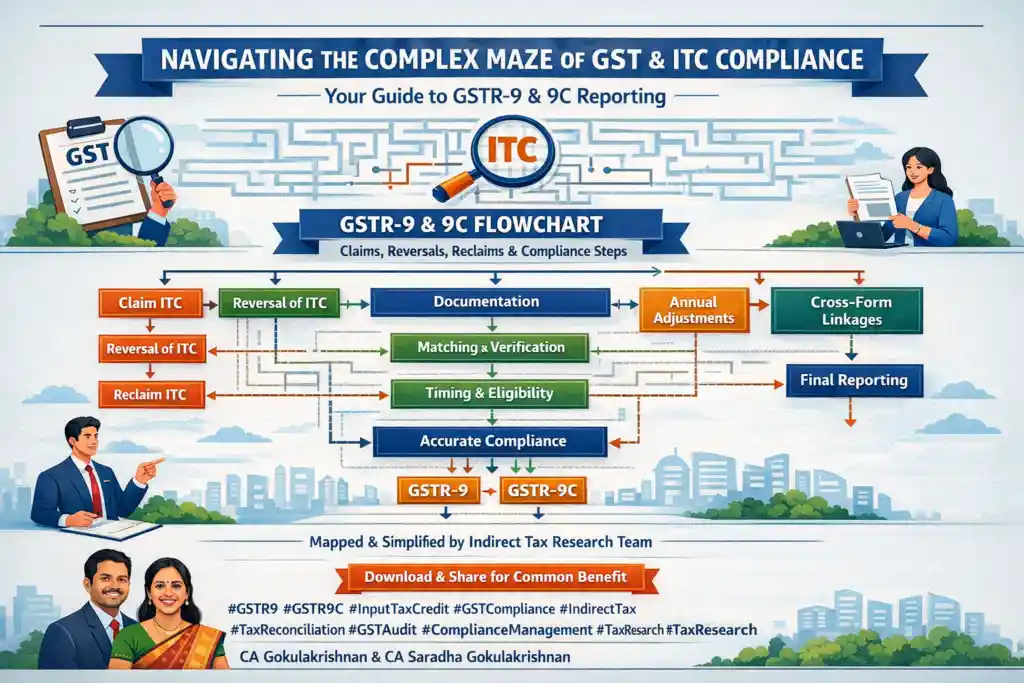
To address this challenge, the Indirect Tax Research team at GGSH has prepared a structured flowchart explaining the entire lifecycle of ITC reporting in GSTR-9 and GSTR-9C.
Why ITC Reporting Has Become Complex
Under India’s GST ecosystem, ITC reporting involves multiple stages of verification and reconciliation. Each stage requires careful attention to documentation, timing, and compliance rules.
Businesses must track ITC across:
- Purchase invoices and vendor documentation
- Auto-populated data in GSTR-2B
- Monthly return filings in GSTR-3B
- Annual consolidation in GSTR-9
- Reconciliation with financial statements in GSTR-9C
These cross-form linkages make ITC compliance highly dependent on accurate data mapping and reconciliation.
Key Challenges in ITC Compliance
1. ITC Claims and Eligibility
Businesses must verify whether input tax credit claimed in returns meets the eligibility criteria prescribed under GST law.
This includes ensuring that:
- The supplier has uploaded the invoice correctly
- The tax has been paid to the government
- The recipient holds valid documentation
2. ITC Reversals
Certain transactions require reversal of ITC, such as:
- Ineligible credits
- Non-business usage
- Blocked credits under GST provisions
- Vendor non-compliance
Tracking these reversals correctly is essential to avoid tax demand or compliance notices.
3. ITC Reclaim
In some cases, previously reversed ITC may become eligible for reclaim when conditions are fulfilled later.
Proper reporting of such reclaims is necessary to ensure that ITC balances remain accurate across GST returns.
4. Annual Adjustments and Reconciliation
At the end of the financial year, businesses must reconcile ITC reported in:
- Monthly GST returns
- Financial books of accounts
- Annual returns and reconciliation statements
This reconciliation ensures that disclosures in GSTR-9 and GSTR-9C remain consistent with audited financial data.
Importance of Correct Table Mapping in GSTR-9 & GSTR-9C
One of the most common errors in annual GST compliance is incorrect table mapping of ITC transactions.
Different tables in the annual return and reconciliation statement capture:
- ITC availed during the year
- ITC reversed during the year
- ITC reclaimed later
- ITC differences between books and GST returns
Understanding where each adjustment should be reported is crucial for accurate annual GST filings.
These returns are filed through the GST system administered by the Goods and Services Tax Network.
A Flowchart Approach to Simplify ITC Reporting
To simplify this complex compliance area, the Indirect Tax Research team at GGSH has created a structured flowchart covering the entire lifecycle of ITC reporting.
The flowchart visually explains:
- ITC eligibility verification
- Claim and reversal scenarios
- Reclaim procedures
- Table-wise reporting in GSTR-9 and GSTR-9C
- Cross-linkages between GST returns and financial statements
By presenting the process in a step-by-step visual format, the flowchart helps professionals quickly understand how each ITC event should be reported.
Who Should Use This Resource
This flowchart is especially useful for:
- Chartered accountants and tax consultants
- GST compliance professionals
- Corporate finance and accounting teams
- Businesses preparing GSTR-9 and GSTR-9C annual filings
It helps ensure accurate ITC reconciliation and consistent GST reporting.
Final Thoughts
The complexity of Input Tax Credit reporting under GST continues to evolve as compliance requirements become more detailed and technology-driven.
With multiple transactions, reversals, reclaims, and reporting tables involved, ITC compliance requires both technical understanding and careful documentation.
Resources such as structured ITC reporting flowcharts can significantly simplify this process by offering a clear, visual roadmap for annual GST compliance.By improving clarity and reducing reporting errors, businesses can strengthen their GST compliance framework and avoid unnecessary disputes or notices.