

The Union Budget 2026 signals a continued transformation of India’s indirect tax framework, particularly under the Goods and Services Tax (GST) regime. The focus is clearly shifting toward simplified compliance, technology-driven governance, and trust-based administration.
These developments are expected to further strengthen GST as a core structural reform supporting economic growth, formalisation of businesses, and improved tax efficiency.
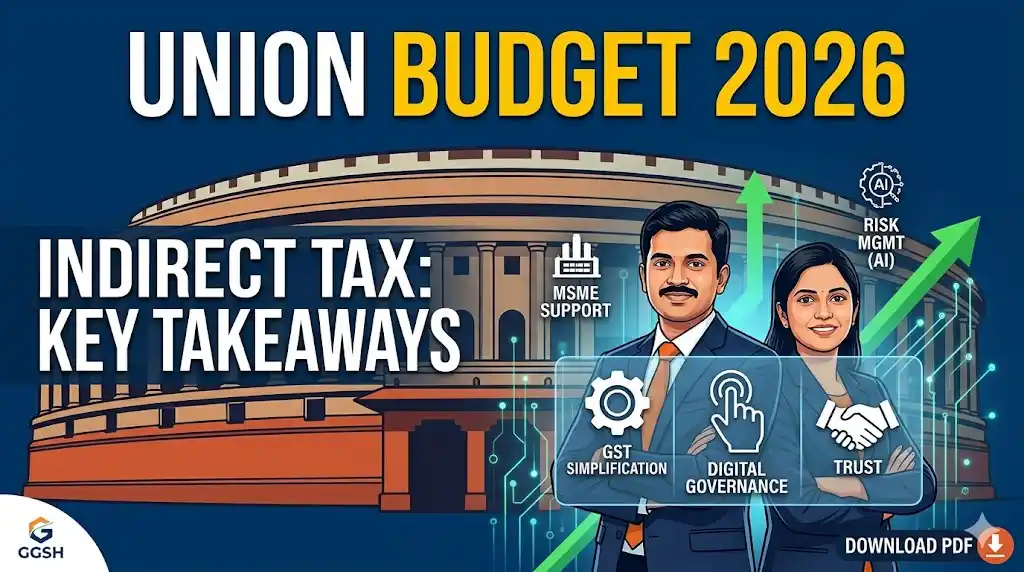
Policy Direction: Simplify GST and Digitise Governance
A major theme in the indirect tax announcements is the government’s commitment to simplifying GST compliance while strengthening digital governance.
The GST system, administered through the Goods and Services Tax Network under the policy oversight of the GST Council, continues to evolve toward a technology-first compliance environment.
Key objectives include:
- Simplifying return filing processes
- Reducing procedural complexity
- Increasing transparency in tax administration
- Strengthening taxpayer trust in the system
This policy direction aims to make GST compliance easier while maintaining robust monitoring mechanisms.
Core Focus: Rationalised GST Compliance
The budget reinforces the need for rationalised GST compliance processes.
Businesses have often faced challenges due to multiple return forms, reconciliations, and procedural checks. The government’s approach now focuses on streamlining these processes to reduce compliance fatigue.
This effort supports the broader goal of improving ease of doing business in India, especially for growing enterprises and new market participants.
Execution Signal: 350+ GST Reforms Already Implemented
Over the past few years, the GST ecosystem has undergone continuous procedural improvements.
According to the policy direction highlighted in the budget, more than 350 reforms and process improvements have already been implemented within the GST framework.
These reforms have included:
- Simplified return filing processes
- Faster refund mechanisms
- Improved invoice matching systems
- Enhanced taxpayer services
Further process clean-ups and system upgrades are expected in the coming years.
Technology as the Backbone of GST Administration
One of the most important shifts highlighted in the budget is the increasing role of advanced technology in GST governance.
Future GST administration will increasingly rely on AI-enabled analytics and automated systems.
Key technology-driven improvements include:
- AI-based risk management and fraud detection
- Automated compliance verification
- Faster processing of applications and refunds
- Reduced manual intervention in tax administration
These changes are expected to deliver more predictable outcomes for taxpayers while improving regulatory oversight.
Economic Perspective: GST as a Structural Reform
The budget reaffirms GST as a pillar of India’s economic and fiscal framework.
A well-functioning GST system contributes to:
- Higher tax buoyancy
- Improved transparency in business transactions
- Greater formalisation of the economy
- Stronger fiscal discipline for governments
By strengthening GST processes, the government aims to support sustainable economic growth while improving revenue stability.
MSME Impact: Reduced Compliance Burden
For Micro, Small, and Medium Enterprises (MSMEs), GST compliance has historically been a major operational challenge.
The reforms highlighted in the budget are expected to:
- Reduce compliance friction for small businesses
- Encourage voluntary compliance
- Lower disputes and litigation
- Promote trust-based governance between taxpayers and authorities
These improvements can help MSMEs focus more on business growth rather than administrative complexities.