

Budgets are often read for headlines and big announcements.
But industries read them for direction.
For the Marine and Seafood Industry, the Union Budget 2026 feels less like a sudden policy announcement and more like a long-awaited signal that the ecosystem is finally being viewed end-to-end.
For years, businesses across the marine value chain — from deep-sea fishing operators to seafood exporters — have operated in an environment where policy uncertainty, export compliance complexity, and fluctuating input costs created operational challenges.
The 2026 Budget policy direction indicates an effort to address these structural concerns.
And for the seafood sector, clarity often matters more than incentives.
Why Policy Clarity Matters for the Marine Export Ecosystem
The marine and seafood industry functions through a complex value chain involving fishing vessels, processors, cold storage operators, exporters, and logistics providers.
Small policy changes can significantly influence the cost structure and export competitiveness of the sector.
When key variables become predictable:
- Input costs become easier to manage
- Export planning becomes more stable
- Compliance risks reduce
- Investment decisions become easier
In other words, businesses move from firefighting to forward planning.
Key Budget Signals for the Marine and Seafood Sector
The Union Budget 2026 introduces policy directions that affect multiple parts of the marine ecosystem.
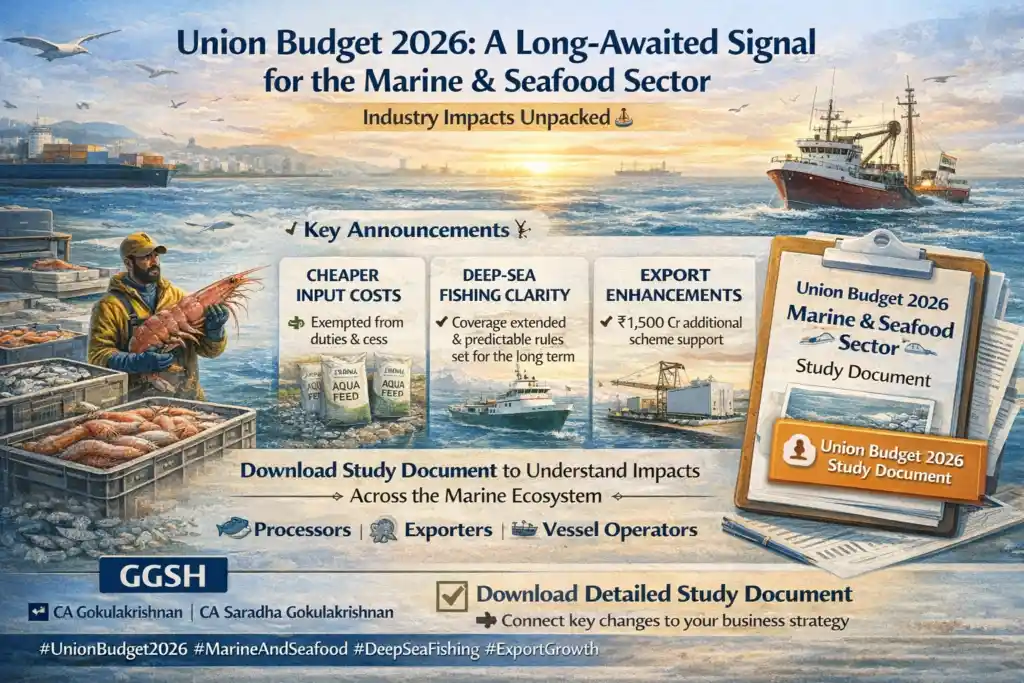
1. Easing of Input Cost Pressures
One of the biggest operational challenges for seafood processors and exporters has been rising input costs — including equipment, fuel, processing infrastructure, and logistics.
Policy adjustments in customs and related frameworks are expected to reduce cost pressures across the marine processing ecosystem.
For exporters, this directly influences international competitiveness in global seafood markets.
2. Greater Policy Clarity for Deep-Sea Fishing Operations
Deep-sea fishing has long required clear regulatory frameworks and predictable compliance guidelines.
The Budget’s approach signals an attempt to bring greater clarity and stability to deep-sea fishing operations, helping vessel operators plan investments in:
- Fishing vessels
- Equipment and gear
- Long-distance fishing operations
For operators managing capital-intensive marine assets, predictability reduces financial risk.
3. Improved Export Policy Predictability
India is one of the world’s major seafood exporters, and policy changes affecting exports can have large downstream implications.
The Budget’s focus on improving export frameworks supports:
- Simplified export procedures
- More stable export policy treatment
- Greater clarity on compliance requirements
This strengthens the operational environment for exporters working with agencies such as the Marine Products Export Development Authority.
Why These Changes Matter for the Marine Value Chain
These policy directions will not transform the industry overnight.
However, they address a challenge that the marine sector has faced for years: persistent regulatory uncertainty.
By reducing ambiguity in key policy areas, the Budget helps improve confidence across the marine value chain.
This benefits stakeholders such as:
Seafood Processors
Processing units rely heavily on stable raw material supply, equipment imports, and export channels.
Policy clarity improves operational planning and production capacity utilisation.
Seafood Exporters
Exporters benefit from predictable compliance frameworks and export procedures, which are critical for maintaining international buyer relationships.
Fishing Vessel Operators
Vessel owners and deep-sea operators require long-term capital planning.
Greater regulatory clarity allows for more confident investment in marine infrastructure.
Clarity vs Incentives: What Drives Sustainable Growth
Government incentives can certainly generate excitement in the short term.
But industries often grow faster when they have something even more powerful: clarity.
- Incentives create opportunity
- Policy clarity creates confidence
And confidence is what enables long-term investment, capacity expansion, and export growth.
For the marine and seafood industry, removing uncertainty can unlock more growth than short-term fiscal incentives.
Understanding the Impact Across the Marine Ecosystem
At GGSH, we analysed the policy changes introduced in Union Budget 2026 and studied how they impact different segments of the marine value chain.
Our detailed industry study breaks down the implications for:
- Seafood processors
- Marine exporters
- Fishing vessel operators
- Deep-sea fishing businesses
The analysis connects policy changes to practical business outcomes, helping stakeholders understand where the real impact lies.
Download the Detailed Marine Industry Budget Analysis
If you are part of the marine and seafood value chain, this study can help you:
- Understand the policy implications of Union Budget 2026
- Identify cost and compliance impacts on your business
- Plan your export and operational strategies more effectively
📥 Download the detailed study document to explore the full analysis.
If you would like to discuss how these changes affect your specific business operations, feel free to reach out to the GGSH team.
Final Thoughts
The Union Budget 2026 may not have introduced dramatic incentives for the marine industry.
But it sends a much stronger signal — the sector is finally being looked at as a complete ecosystem.
And when industries receive clarity, predictability, and policy stability, they gain the confidence to invest, expand, and compete globally.For India’s marine and seafood export sector, that confidence may prove more valuable than any short-term incentive.