

Many exporters believe that once RoDTEP benefits are credited, the compliance cycle is complete.
However, there is one additional requirement that often goes unnoticed — the RoDTEP Annual Return (ARR).
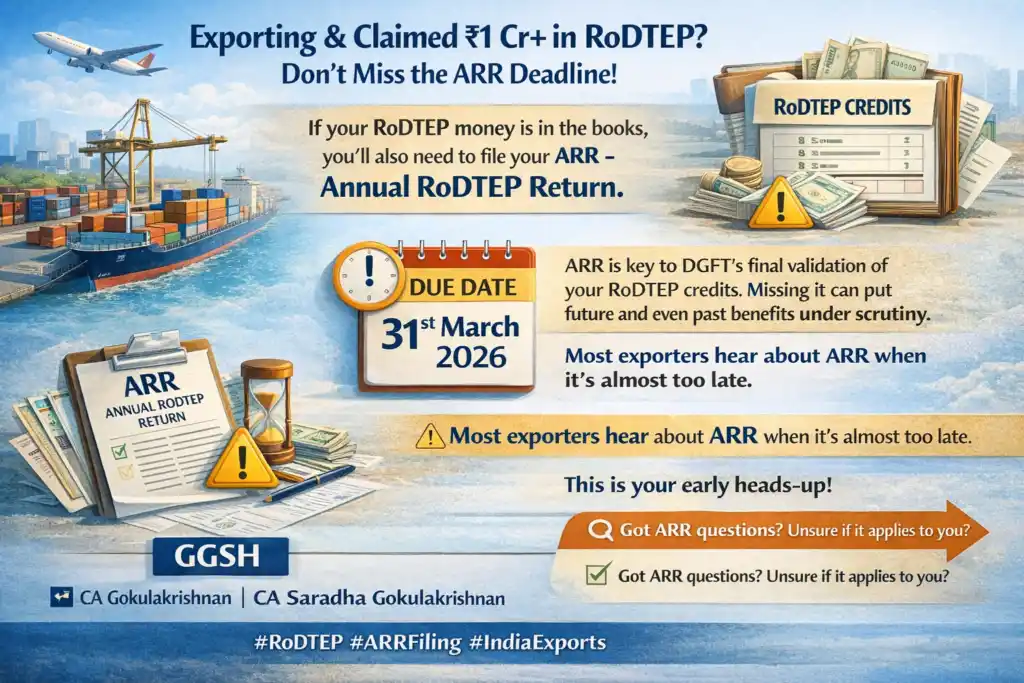
For exporters who claimed ₹1 crore or more under the Remission of Duties and Taxes on Exported Products (RoDTEP) during FY 2024–25, filing the ARR is mandatory.
The due date for submitting the ARR is 31 March 2026.
Understanding this requirement early can help exporters avoid compliance risks, delays in future incentives, or scrutiny from authorities.
What is the RoDTEP Annual Return (ARR)?
The RoDTEP Annual Return (ARR) is a compliance requirement designed to verify the accuracy and legitimacy of export incentive claims.
The return is submitted through the Directorate General of Foreign Trade (DGFT) portal and serves as a post-benefit validation mechanism.
In simple terms, ARR helps authorities confirm that:
- RoDTEP benefits claimed by exporters were accurately calculated
- The export transactions and documentation match the incentive claimed
- The remission granted aligns with the applicable scheme rules
This makes ARR a crucial step linking export incentives with final regulatory verification.
Who Needs to File the RoDTEP ARR?
Exporters must file the ARR if they meet the following condition:
Total RoDTEP benefits claimed during FY 2024–25 are ₹1 crore or more.
This threshold applies to exporters across sectors, including:
- Manufacturing exporters
- Merchant exporters
- Large export houses
- Sector-specific exporters such as textiles, marine products, engineering goods, and pharmaceuticals
If the threshold is crossed, ARR filing becomes mandatory compliance.
Due Date for RoDTEP ARR Filing
For exporters covered under the requirement:
Due Date:
📅 31 March 2026
Missing the deadline may lead to regulatory scrutiny and operational complications in future RoDTEP claims.
Exporters are therefore advised to review their RoDTEP credits well in advance and determine whether the ARR filing requirement applies.
Why ARR Filing is Important for Exporters
Many exporters become aware of ARR only when the deadline is approaching.
However, this return plays a critical role in maintaining export incentive eligibility and compliance integrity.
Key reasons ARR filing matters
1. Validation of RoDTEP benefits
ARR helps DGFT validate whether the incentives claimed were legitimate and properly calculated.
2. Protection of future RoDTEP credits
Failure to file ARR may affect eligibility for future export incentive claims.
3. Risk mitigation for past benefits
Non-compliance could lead to questions on previously claimed RoDTEP credits.
4. Strengthening compliance transparency
ARR filing ensures exporters maintain accurate documentation and reporting alignment with export records.
Common Mistake Many Exporters Make
A frequent issue is that exporters assume RoDTEP compliance ends once the credit is received in the electronic ledger.
In reality, the process includes post-benefit compliance verification through ARR filing.
Because awareness about ARR remains limited, many exporters discover this requirement close to the due date, leaving very little time for preparation.
Steps Exporters Should Take Now
If your business claimed RoDTEP benefits in FY 2024–25, consider the following steps early:
Review total RoDTEP benefits claimed
Check whether the ₹1 crore threshold has been crossed.
Verify export documentation
Ensure that shipping bills, export invoices, and RoDTEP claims align accurately.
Prepare ARR data early
Advance preparation reduces last-minute compliance pressure.
Seek professional guidance if required
Export incentive regulations can be complex, especially when dealing with large benefit amounts and multiple shipments.
Final Thoughts
Export incentives such as RoDTEP play an important role in improving global competitiveness for Indian exporters.
However, these benefits also come with compliance responsibilities.
The RoDTEP Annual Return (ARR) acts as the final checkpoint between incentive claims and regulatory validation.Exporters who stay informed and prepare early can ensure smooth compliance, uninterrupted incentives, and reduced regulatory risk.