

A major transformation has been introduced in the GST assessment and litigation framework with the insertion of Section 74A, applicable from FY 2024-25 onwards.
This new provision replaces the earlier Sections 73 and 74 of the CGST Act and introduces a uniform approach to tax assessments, significantly impacting GST litigation in India.
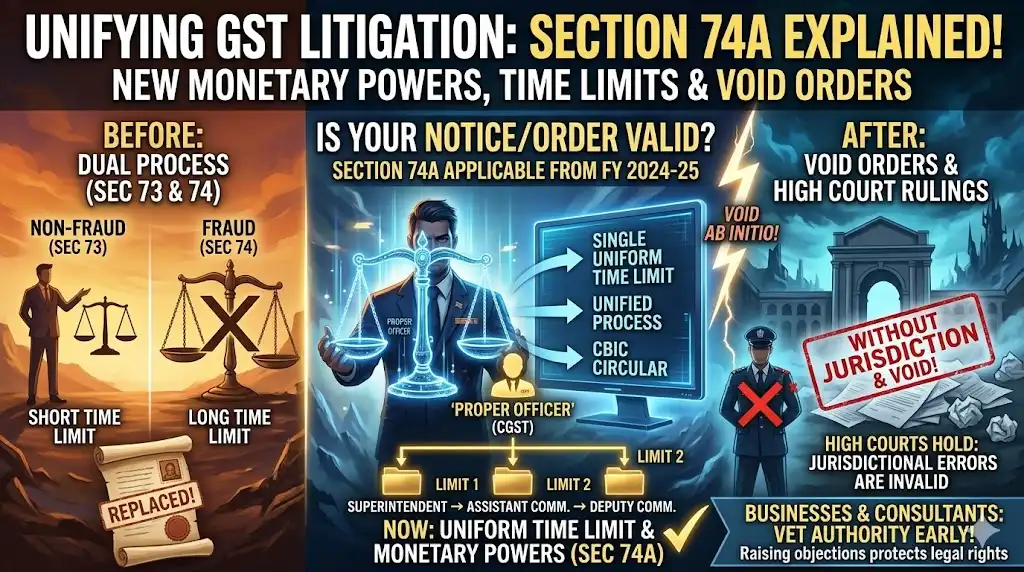
What is Section 74A in GST?
Section 74A is a newly introduced provision under GST that:
- Replaces Section 73 (non-fraud cases) and Section 74 (fraud cases)
- Introduces uniform time limits for issuing notices and passing orders
- Simplifies the GST assessment process
This marks a shift toward a more streamlined and consistent tax litigation framework.
Key Change: Uniform Time Limit for All Cases
Earlier, GST law differentiated between:
- Fraud cases (longer time limits)
- Non-fraud cases (shorter time limits)
With Section 74A:
👉 A single, uniform time limit now applies to both categories.
Impact:
- Reduces complexity in interpretation
- Brings clarity for taxpayers and tax officers
- Minimizes disputes on limitation
CBIC Circular on Monetary Limits for Officers
The Central Board of Indirect Taxes and Customs (CBIC) has issued a circular prescribing monetary limits for tax officers under Section 74A.
What the Circular Covers:
- Specifies jurisdictional limits for issuing:
- Show Cause Notices (SCN)
- Adjudication orders
- Show Cause Notices (SCN)
- Assigns the “Proper Officer” under:
- Section 74A
- Section 75(2)
- Section 122
- Section 74A
Applicability of Monetary Limits
- These limits currently apply to Central GST officers
- State Governments may:
- Adopt the same limits
- Issue separate circulars for State GST officers
- Adopt the same limits
Legal Consequence: Orders Beyond Power Are Void
One of the most critical aspects of this update is:
⚠️ Any notice or order issued beyond the prescribed monetary limit is without jurisdiction and legally void
This is a crucial safeguard for taxpayers.
Judicial Backing from High Courts
Various High Courts of India have consistently held that:
- Orders passed beyond the authority of officers are invalid
- Jurisdictional errors cannot be cured later
- Such proceedings are liable to be set aside
This principle applies under both:
- Existing GST law
- Earlier indirect tax regimes
What Businesses & Tax Consultants Must Do
With Section 74A in force, it is essential for:
Businesses:
- Review SCNs and orders carefully
- Check whether the issuing officer has proper authority
- Track monetary limits applicable
Tax Consultants:
- Identify jurisdictional errors early
- Raise objections where powers are exceeded
- Advise clients on legal remedies
👉 Awareness is key to protecting your legal rights
Practical Example
If a lower-ranking officer issues:
- A high-value SCN beyond their monetary limit, or
- Passes an order exceeding their jurisdiction
➡️ Such action can be challenged as void ab initio (invalid from the beginning).
Why Section 74A Matters
This reform aims to:
- Bring consistency in GST assessments
- Reduce litigation complexity
- Ensure proper allocation of authority
- Strengthen legal certainty in tax administration
Conclusion
The introduction of Section 74A under GST is a significant step toward a more structured and transparent tax litigation system.
However, with new powers come new responsibilities — both for tax authorities and taxpayers.
Understanding monetary limits and jurisdictional boundaries is now essential to ensure compliance and safeguard legal rights.
Final Thoughts 💬
In GST litigation, knowledge is power.Are you reviewing whether your notices and orders are issued by the right authority within prescribed limits?