

Imagine getting your GST registration in India completed in just 3 hours.
Not 30 days.
Not even 3 days.
With the introduction of the Simplified GST Registration Scheme effective from 1st November 2025, this is now becoming a reality for eligible applicants.
This reform marks a major leap toward improving the ease of doing business in India, especially for startups, MSMEs, and small businesses.
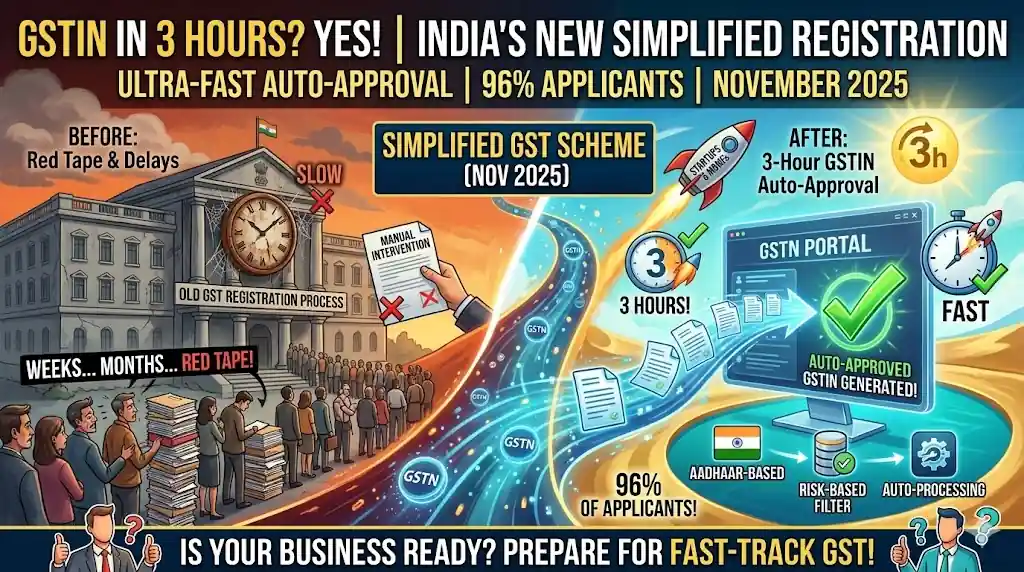
A Game-Changing Shift in GST Registration
The new system, powered by the Goods and Services Tax Network (GSTN), introduces a fully automated, Aadhaar-based GST registration process.
In several cases, businesses have already experienced:
- GSTIN issued within just a few hours
- No manual intervention
- Seamless, end-to-end digital processing
This is a significant improvement over the earlier system, which often involved delays, document queries, and procedural bottlenecks.
What is the Simplified GST Registration Scheme?
The Simplified GST Registration Scheme is designed to:
- Enable auto-approval of GST registration
- Reduce human intervention
- Eliminate unnecessary delays
- Promote faster business onboarding
At its core, the scheme relies on:
- Aadhaar authentication
- Risk-based verification systems
- Automated processing workflows
Eligibility Criteria for Fast-Track GST Registration
To qualify for this auto-approved GST registration, applicants must meet certain conditions:
✔️ Turnover Threshold
- B2B supplies up to ₹2.5 lakh GST per month (CGST + SGST + IGST)
✔️ No Restriction on B2C Supplies
- Businesses can have unlimited B2C transactions
✔️ Aadhaar-Based Authentication
- Mandatory for faster approval and system validation
Flexibility to Exit the Scheme
One of the key advantages is flexibility:
- Businesses can exit anytime once they outgrow the threshold
- Exit is governed by Rule 14A under GST
- The process is system-driven and seamless
Key Features of the New GST Registration System
⚡ Ultra-Fast Processing
- GST registration possible within hours instead of days
📲 100% Online Process
- No physical verification in most cases
- Fully digital and transparent
🤖 Automation-Driven Approval
- Minimal officer intervention
- Faster decision-making
📊 Risk-Based Screening
- High-risk cases still subject to scrutiny
- Ensures balance between speed and compliance
Impact on Businesses and Entrepreneurs
This reform is a major boost for:
- Startups launching new ventures
- MSMEs and small-scale manufacturers
- Service providers entering the GST system
- Growing businesses expanding operations
Key Benefits:
- Faster market entry
- Reduced compliance delays
- Improved business agility
- Lower administrative burden
Important Considerations
While the system is faster, businesses must ensure:
- Accuracy in PAN, address, and bank details
- Correct classification using HSN/SAC codes
- Consistency in submitted data
👉 Automation works efficiently only when the input data is clean and reliable.
A Structural Reform in GST Compliance
This is not just a procedural update — it is a structural reform in India’s GST ecosystem.
By reducing friction in the registration process, the government is:
- Encouraging formalization of businesses
- Enhancing digital governance
- Strengthening the overall tax compliance framework
Role of Professional Guidance
Despite automation, professional expertise remains crucial:
- Interpreting eligibility conditions
- Ensuring compliance accuracy
- Managing transitions and exit from the scheme
A well-guided approach helps businesses avoid errors, rejections, and future complications.
Conclusion
The possibility of getting a GST registration within 3 hours highlights how far India’s tax system has evolved.
The Simplified GST Registration Scheme (effective November 2025) is a bold step toward making compliance:
- Faster
- Smarter
- More business-friendly
Final Thoughts 💬
From delays and red tape to speed and automation, GST registration in India is entering a new era.Are you ready to leverage this ultra-fast GST registration system for your business?