

The issue of bunching of Show Cause Notices (SCNs) across multiple financial years (FYs) has recently become one of the most debated topics in GST litigation in India.
With divergent rulings from various High Courts, the legal position is far from settled. Businesses, tax professionals, and revenue authorities are navigating a rapidly evolving landscape where headlines often outpace clarity.
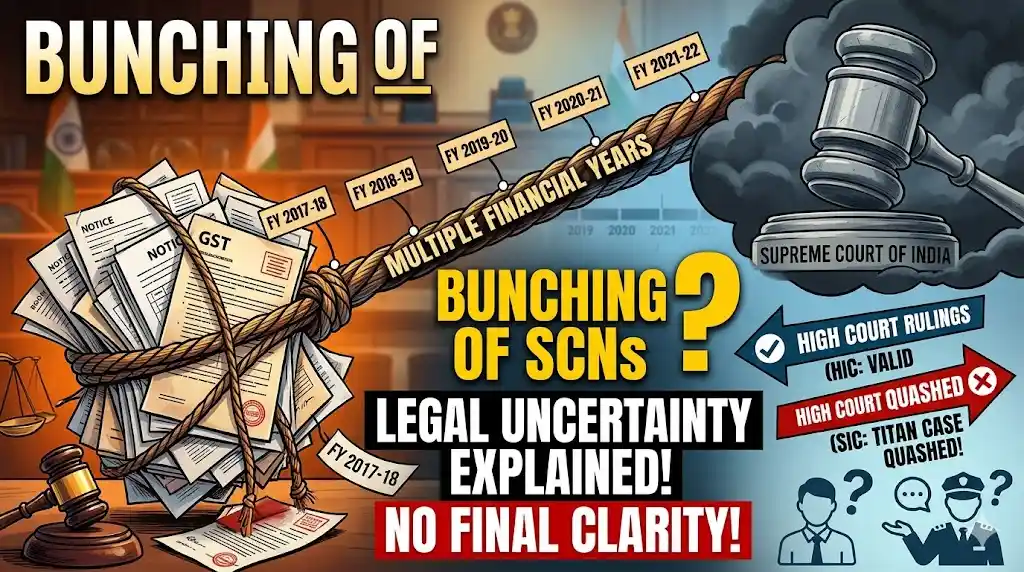
What is “Bunching of SCNs” in GST?
Bunching refers to the practice where:
- A single SCN is issued covering multiple financial years, and
- A common adjudication order is passed for those years
This approach is often questioned when:
- It attempts to include time-barred periods, or
- It conflicts with financial year-based limitation under GST law
Current Legal Position: No Final Clarity Yet
Across India, various High Courts of India have delivered conflicting rulings on this issue.
Key Reality Check:
- ⚖️ Divergent judicial views continue
- 📌 No ruling can yet be termed a landmark precedent
- 🏛️ No final decision from the Supreme Court of India
- 🔄 The issue remains open and evolving
Important Legal Insights You Must Know
1. Supreme Court Has Not Settled the Issue
- The matter is yet to be conclusively decided by the apex court
- Earlier references trace back to a 1965 J&K decision, but its applicability under GST is still untested
2. SLP Outcomes Can Be Misleading
Understanding Supreme Court procedures is critical:
- ❌ SLP dismissal ≠ confirmation of High Court ruling
- ❌ SLP withdrawal ≠ success of the opposite party
👉 These are procedural outcomes, not judgments on merits.
3. High Court Judgments Are Often Fact-Specific
- Many rulings depend on specific facts and circumstances
- Blind reliance on case law can be risky
👉 Always check:
- Jurisdiction
- Facts of your case
- Applicability to your situation
4. Status of Appeals Matters
Before relying on any High Court decision:
- Verify if an appeal before Division Bench is pending or decided
- Example: The much-discussed Titan ruling from the Madras High Court was later quashed in appeal
5. CBIC Internal Communications Are Not Binding
- A memo issued by the Central Board of Indirect Taxes and Customs (CBIC) seeking inputs:
- Is not a circular
- Has no binding legal force
- Is not a circular
👉 Only officially notified circulars have legal standing.
6. Sub Judice Matters: Only Courts Matter
When an issue is under litigation:
- Only judicial pronouncements carry authority
- Internal departmental communications do not
7. Risk Mitigation for Taxpayers
From a practical standpoint:
- If time-barred periods are not included, risk is relatively lower
- If separate Orders-in-Original (OIOs) are issued year-wise:
- Exposure may be limited
- Exposure may be limited
8. Appeals & Pre-Deposit Remain Separate
Even in bunching scenarios:
- Appeals must be filed year-wise
- Pre-deposit requirements apply individually for each financial year
Practical Guidance for Businesses & Professionals
Before adopting any legal position on SCN bunching:
✔️ Do:
- Analyze jurisdiction-specific rulings
- Verify current status of case law
- Evaluate facts carefully
❌ Don’t:
- Assume uniform legal position across India
- Rely solely on headlines or summaries
- Ignore appeal status of judgments
👉 Always seek a professional tax opinion before taking a position.
Disclaimer & Important Note
- This analysis is based on developments available in the public domain as of 30.11.2025
- It is intended for informational purposes only
- It does not constitute legal or tax advice
- Applicability must be evaluated case-by-case
Conclusion
The issue of bunching of SCNs under GST remains a grey area in Indian tax jurisprudence.
Until the Supreme Court of India provides final clarity, stakeholders must proceed with caution, relying on fact-specific analysis and professional guidance.
Final Thoughts 💬
In a landscape where legal interpretations are still evolving, informed decision-making is your strongest safeguard.Do you think the Supreme Court should step in soon to settle the issue of SCN bunching once and for all?