

“Knowing your weakness is a strength.”
In GST compliance, this couldn’t be more relevant.
Not every court decision favors taxpayers. Not every mistake qualifies as a “minor error.” And sometimes, what truly determines the outcome is not the error itself—but how quickly and carefully you respond to it.
A recent ruling by the Madhya Pradesh High Court in Amara Raja Batteries Ltd. vs State of M.P. (Dec 2025) reinforces this principle with clarity.
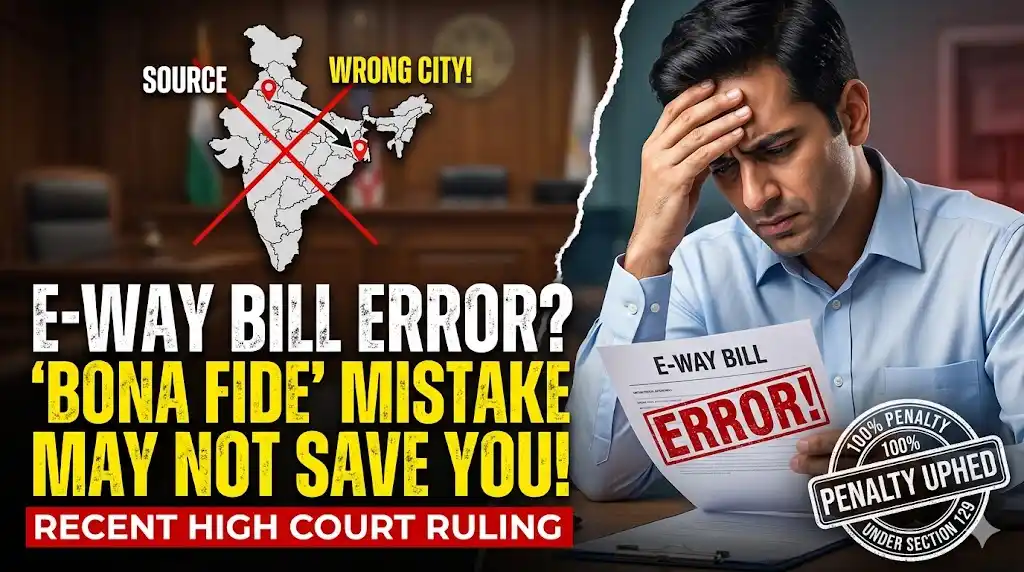
Case Overview: When One Small Error Changed Everything
At first glance, the transaction seemed compliant:
- ✅ Tax properly paid
- ✅ Valid invoices available
- ✅ Genuine movement of goods
However, one critical issue arose:
👉 Incorrect destination city mentioned in the E-Way Bill
More importantly:
👉 The error was not corrected despite having time and opportunity
Court’s Observation: Conduct Matters More Than Intent
The Court took a strict view, especially considering the nature of the transaction:
🔹 Self-Consignment (Branch Transfer)
- Movement within the same entity
- Expectation of higher internal accuracy
The Court noted:
- Errors in one’s own branch details are harder to justify
- Lack of internal movement records weakens the taxpayer’s position
Key Legal Outcome
- 100% penalty upheld under Section 129 of GST Act
This sends a strong message:
👉 Compliance failures during transit are taken seriously—even if tax is already paid.
Critical Takeaways from the Judgment
1. “Bona Fide Error” Is Not Automatic Protection
- Intent alone is not enough
- Authorities examine:
- Conduct
- Timeliness of correction
- Supporting evidence
- Conduct
👉 A genuine mistake must also be promptly corrected and properly documented.
2. Minor Error Circulars Are Not a Blanket Shield
- Circulars offering relief for minor errors:
- Apply only in specific conditions
- Cannot override factual negligence
- Apply only in specific conditions
👉 Misplaced reliance on circulars can backfire.
3. Delay in Correction Can Be Costly
- The taxpayer had the opportunity to fix the mistake
- Failure to act in time influenced the outcome
👉 In GST, delay = risk.
4. Documentation Is Your Strongest Defense
The absence of:
- Internal movement records
- Supporting documentation
…significantly weakened the case.
👉 Proper records are not optional—they are critical evidence.
Practical Lessons for Businesses & Professionals
✔️ Before Movement of Goods
- Double-check:
- Destination details
- E-way bill entries
- Invoice alignment
- Destination details
✔️ During Transit
- Monitor shipments actively
- Identify discrepancies early
✔️ If an Error Is Found
- Correct it immediately
- Maintain:
- Correction logs
- Internal communication records
- Correction logs
✔️ For Branch Transfers
- Maintain robust internal documentation
- Ensure consistency across systems
The Bigger Message
This judgment highlights a subtle but powerful shift:
👉 GST compliance is no longer just about intent
👉 It is equally about discipline, systems, and timely action
A transaction may look compliant on paper—but a single unchecked detail can change how the law interprets it.
Conclusion
The ruling by the Madhya Pradesh High Court is a reminder that:
- “Bona fide error” is not a guaranteed defense
- Transit compliance requires precision and responsiveness
- Corrective action delayed can be as risky as no action at all
Final Thought 💬
In GST, the question is not just:
“What went wrong?”
But also:
“What did you do once it went wrong?”