

“Can we go directly to High Court?”
“Can we avoid pre-deposit through a writ petition?”
These are among the most common questions in GST litigation strategy.
But here’s the reality:
👉 A writ petition is an exception—not the default remedy.
A recent ruling by the Gujarat High Court reinforces this principle with clarity, especially in cases involving Input Tax Credit (ITC) disputes.
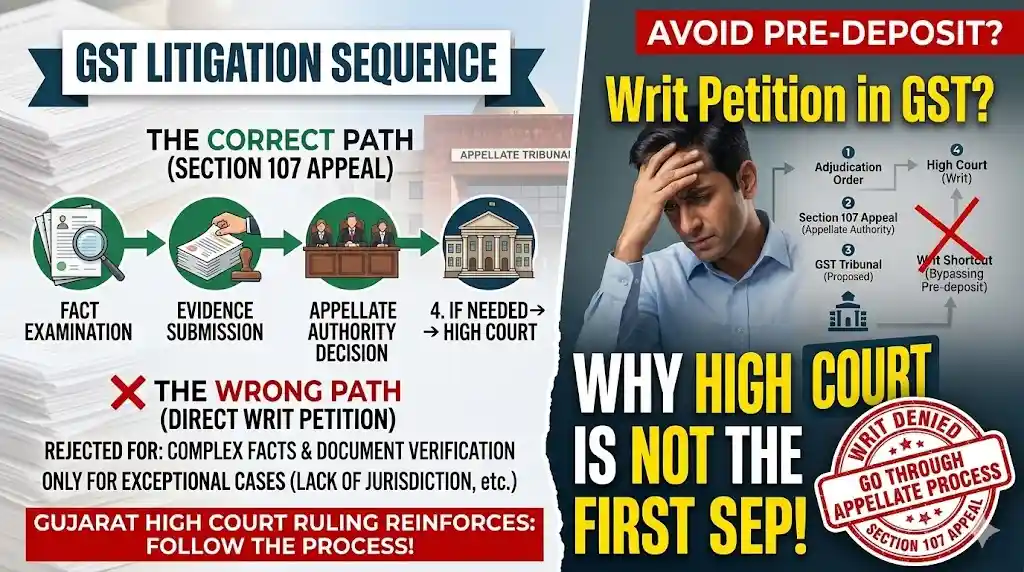
Case Background: ITC Denial & Direct Writ Approach
In this case:
- ITC was denied under Section 16(2)(c) of GST law
- The taxpayer approached the High Court directly
- Grounds raised included:
- Constitutional validity
- Alleged violation of natural justice
- Constitutional validity
At first glance, these seem like strong reasons to invoke writ jurisdiction.
But the Court chose a different approach.
Court’s Stand: Process Before Protest
Instead of examining the merits of ITC eligibility, the Gujarat High Court focused on a more fundamental question:
👉 Was the correct legal process followed?
The Court observed:
- The dispute involved:
- Examination of facts
- Verification of documents
- Assessment of supplier conduct
- Examination of facts
👉 These are matters best handled through the statutory appellate mechanism, not writ jurisdiction.
Section 107 Appeal: Not Just a Formality
Under GST law:
- Section 107 provides the right to appeal against orders
- It includes:
- Detailed fact examination
- Opportunity for evidence submission
- Structured adjudication
- Detailed fact examination
The Court emphasized:
👉 This appellate route is not optional—it is the correct first step in most cases.
When Can a Writ Petition Be Filed?
Writ jurisdiction is meant for exceptional situations, such as:
✔️ Lack of Jurisdiction
- Authority acted beyond legal powers
✔️ Violation of Natural Justice
- No hearing given
- Bias or procedural unfairness
✔️ Constitutional Challenges
- Validity of law itself is questioned
✔️ Patent Legal Errors
- Clear, undisputed legal mistakes
👉 Even in such cases, courts exercise caution.
Why Courts Discourage Direct Writs in GST Matters
The reasoning is practical:
- GST disputes often involve complex facts
- Require document verification
- Need technical analysis
High Courts are not designed to function as fact-finding authorities in the first instance.
Key Takeaways for GST Litigation Strategy
1. Two Critical Decisions in Every Dispute
Every GST case involves:
👉 WHAT to challenge (legal issue)
👉 HOW to challenge (correct forum & process)
Both are equally important.
2. Avoid Using Writ as a Shortcut
- Filing a writ to bypass:
- Pre-deposit
- Appellate procedures
- Pre-deposit
…may backfire.
👉 Courts may simply redirect you to the proper forum.
3. Respect the Litigation Sequence
- Adjudication → Appeal → Higher forums
👉 Skipping steps weakens your position.
4. Build Your Case at the Right Stage
- Appellate authorities allow:
- Evidence submission
- Detailed arguments
- Fact-based defense
- Evidence submission
👉 This foundation is crucial for future litigation.
Practical Advice for Businesses & Professionals
✔️ Before Filing a Writ
- Ask:
- Is this truly an exceptional case?
- Are facts disputed?
- Is evidence evaluation required?
- Is this truly an exceptional case?
✔️ Prefer Appeal Route When:
- ITC eligibility is in question
- Supplier compliance is involved
- Documentation needs scrutiny
✔️ Use Writ Strategically
- Only when:
- Legal error is clear
- Process is fundamentally flawed
- Legal error is clear
Conclusion
The ruling by the Gujarat High Court serves as an important reminder:
👉 Writ jurisdiction is not a shortcut—it is a safeguard.
In GST litigation, success is not just about legal strength, but also about:
- Proper sequencing
- Forum selection
- Strategic restraint
Final Thought 💬
In every GST dispute, the real question is not just:
“Can we go to High Court?”
But:
“Should we go there now—or later?”