

In a decisive 6–3 verdict, the Supreme Court of the United States has struck down sweeping tariffs imposed under the Trump administration—marking a significant constitutional and economic moment.
At the heart of the case:
👉 Whether the President could impose broad tariffs under the International Emergency Economic Powers Act (IEEPA)
The Court’s answer was clear:
No.
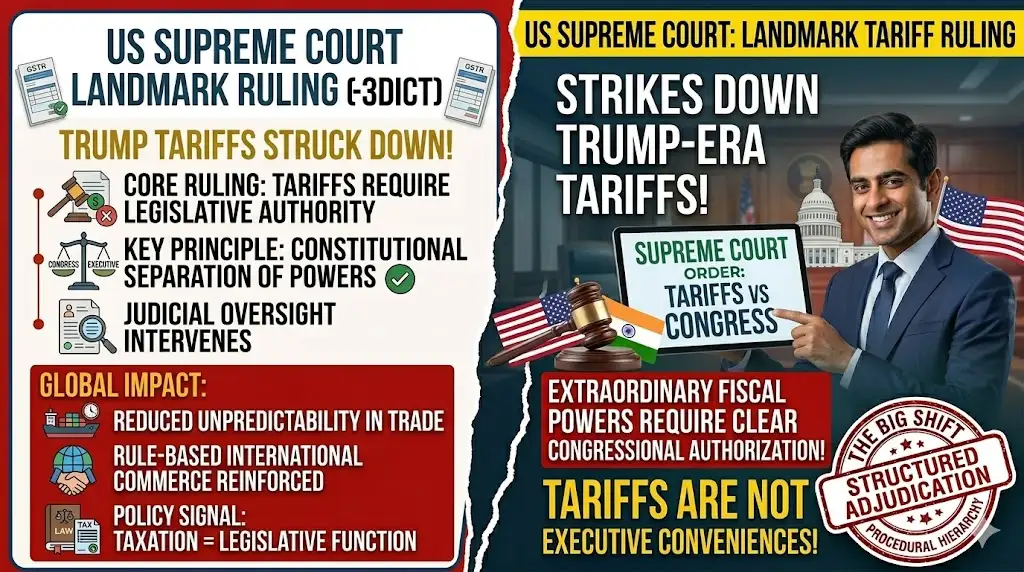
⚖️ What the Court Held
The Supreme Court of the United States rejected the government’s argument that IEEPA allows the President to regulate tariffs under emergency powers.
It observed:
- The interpretation would lead to an “unbounded expansion” of executive authority
- The term “regulate” does not equate to imposing tariffs at will
- Such powers would fundamentally alter the constitutional balance
🏛️ Core Constitutional Principle
The ruling strongly reaffirms:
👉 Tariff powers lie with the legislature, not the executive
As emphasized by the Court:
- The United States Congress alone holds tariff authority
- Any delegation must be:
- Explicit
- Limited
- Clearly defined
- Explicit
💡 Key takeaway:
“Extraordinary fiscal powers require clear congressional authorization.”
🌍 Why This Matters Globally
This is not just a US domestic ruling—it has global ripple effects:
🔹 Trade Stability
- Reduces unpredictability in tariff regimes
- Reinforces rule-based international trade
🔹 Legal Certainty
- Limits unilateral executive action
- Strengthens institutional checks and balances
🔹 Policy Signal
- Taxation and tariffs are not administrative tools
- They are constitutionally governed powers
🇮🇳 Impact on Indian Exporters
For Indian exporters, this ruling brings a wave of relief:
- Earlier, US tariffs had gone as high as 50%, later reduced to ~18%
- This judgment undermines the legal basis of such emergency tariffs
Key Beneficiaries:
- Textiles 👕
- Engineering goods ⚙️
- Food products 🍤
- Chemicals 🧪
👉 Result:
Improved pricing certainty + better export planning
🧠 What Tax Professionals Should Note
This ruling sets a powerful global precedent:
✔️ Taxation = Legislative Function
- Cannot be expanded through broad executive interpretation
✔️ Delegation Must Be Precise
- Vague statutory language is not enough
✔️ Judicial Oversight Matters
- Courts will intervene where constitutional limits are crossed
🔍 The Bigger Message
Across jurisdictions, one principle stands reinforced:
Tax and tariff powers are constitutional in nature—not executive conveniences.
💬 Final Thought
In an era of shifting geopolitics and economic nationalism, this ruling is a reminder:👉 Institutions matter. Boundaries matter. Law matters.