

In GST proceedings, documentation plays a crucial role in establishing the genuineness of a transaction. However, an important question arises when certain supporting documents are unavailable: Can the absence of one particular document, by itself, be sufficient to disprove an otherwise supported transaction?
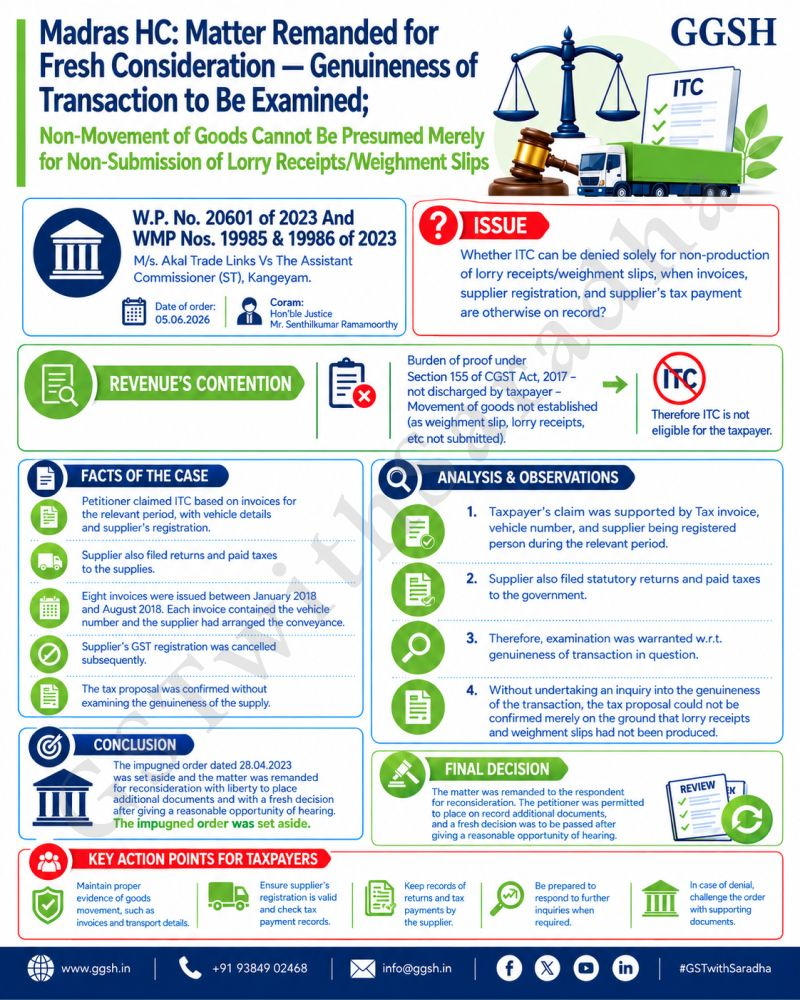
The Madras High Court recently considered this issue in M/s. Akal Trade Links, Rep. by its Partner Sri R. Sangar Ganesh v. The Assistant Commissioner (ST), Kangeyam, W.P. No. 20601 of 2023 & W.M.P. Nos. 19985 & 19986 of 2023, decided on 5 June 2026.
The case concerned a dispute over Input Tax Credit (ITC) where the Department questioned the movement and genuineness of goods primarily because certain transportation-related documents, including lorry receipts and weighment slips, had not been produced.
The Question Before the Court
The taxpayer had several pieces of evidence supporting the underlying transactions, including:
- Tax invoices
- Vehicle details
- A registered supplier
- Supplier compliance records
- Evidence that the supplier had filed its returns
- Evidence that tax had been paid by the supplier
Despite these circumstances, the ITC claim was questioned on the ground that certain transport documents were unavailable and the physical movement of goods had therefore not been sufficiently established.
This brought the issue into focus:
Does the non-production of a particular transport document automatically establish that the underlying transaction was not genuine?
The Court’s Approach
The Court’s approach highlights an important distinction.
The burden of establishing eligibility for ITC does not disappear merely because other evidence exists. A taxpayer is still expected to substantiate the transaction and satisfy the applicable requirements.
However, the examination cannot necessarily stop at the absence of one category of document.
The genuineness of the transaction has to be examined on the basis of the evidence available as a whole.
Therefore, the mere non-production of lorry receipts, weighment slips or similar transport documents cannot, by itself, become the sole basis for concluding that the transaction never took place, particularly where other supporting evidence is available.
This becomes even more significant where the supplier is registered, has reported the transaction in its returns and has discharged the corresponding tax liability.
Why This Matters for ITC Claims
GST assessments often involve examination of multiple interconnected documents.
An invoice may establish the commercial transaction. An e-way bill may support movement of goods. Banking records may establish payment. Supplier returns may provide evidence of reporting and tax compliance. Vehicle details and other records may further strengthen the factual trail.
No single document necessarily exists in isolation.
Therefore, while the absence of a particular document may raise a question requiring explanation, it should not automatically replace the broader examination of the transaction itself.
The real question should be whether the overall evidence establishes the genuineness of the supply and the taxpayer’s entitlement to ITC.
A Similar Question Had Arisen Earlier
The issue also brings to mind the earlier Raghuvansh Agro Farms ruling of the Allahabad High Court, where questions concerning supplier existence, e-way bills, banking transactions and additional transportation-related evidence were considered.
The broader principle emerging from such cases is not that documentation is unimportant.
Rather, it is that documentation must be evaluated in context.
A missing document may be a deficiency. But a deficiency in one document should not necessarily be treated as conclusive proof that the entire transaction is fictitious, particularly when substantial independent evidence supports the transaction.
Practical Takeaway for Businesses
For businesses claiming ITC, the safest approach remains complete and consistent documentation.
Businesses should, wherever applicable, maintain:
1. Tax Invoices
Ensure invoices are properly issued, recorded and reconciled.
2. E-Way Bills
Maintain e-way bill records wherever applicable.
3. Transportation Evidence
Preserve lorry receipts, delivery challans, weighment slips, transporter records and other available evidence relating to movement of goods.
4. Payment Trails
Maintain bank statements and payment records supporting the transaction.
5. Supplier Compliance Records
Where possible, retain evidence supporting the supplier’s registration, return filing and tax compliance.
6. Accounting & Stock Records
Purchase registers, stock records, inward registers and corresponding accounting entries can also help establish the commercial substance of the transaction.
The Larger Lesson
This judgment should not be interpreted as a relaxation of documentation requirements.
Businesses should not treat missing documents casually.
Instead, the decision serves as a reminder of an equally important principle:
The absence of one document should not automatically become the absence of the transaction.
The objective of an assessment should be to determine whether the transaction is genuine by considering the entire evidentiary trail, rather than allowing one missing piece of documentation to conclusively determine the outcome.
For taxpayers, the message is clear:
Be complete in maintaining evidence.
And when that evidence is evaluated, look at the complete picture.
Case: M/s. Akal Trade Links, Rep. by its Partner Sri R. Sangar Ganesh v. The Assistant Commissioner (ST), Kangeyam
W.P. No.: 20601 of 2023 & W.M.P. Nos. 19985 & 19986 of 2023
Court: Madras High Court
Date: 5 June 2026