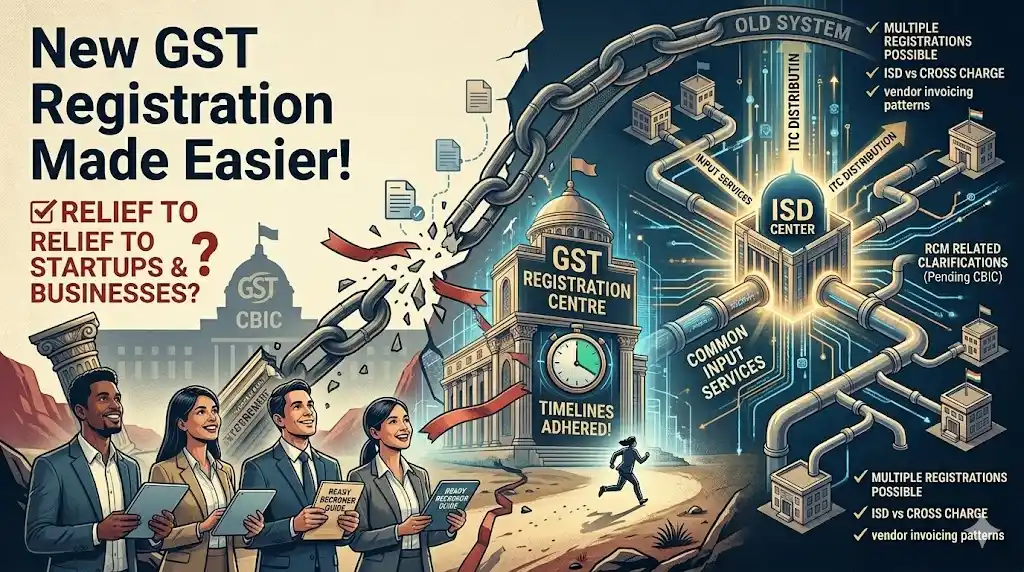
New GST Registration Made Easier in India: CBIC’s Latest Instructions Bring Relief to Startups & Businesses

Starting a new business in India or planning a business expansion always begins with one crucial step — GST registration. Whether you’re an entrepreneur, startup founder, or expanding enterprise, obtaining a new GST registration has often been one of the most challenging and frustrating parts of the journey.

However, a recent update from the Central Board of Indirect Taxes and Customs (CBIC) is set to change that experience significantly.
Why GST Registration Has Been a Pain Point for Businesses

For years, businesses across India have faced multiple hurdles while applying for GST registration, such as:

  • Excessive document requirements
  • Unclear guidelines from officers
  • Frequent back-and-forth queries
  • Delays in approval timelines
  • Inconsistent verification processes

This created unnecessary stress, especially for startups and small businesses, impacting the overall ease of doing business in India.

CBIC’s New GST Registration Guidelines – A Welcome Change

In a major relief to taxpayers, CBIC has issued Instruction No. 03/2025-GST (dated 17 April 2025) to streamline the GST registration process.

Key Highlights of the New GST Registration Instructions

1. Standardized Document Requirements

Officers are now required to follow a defined and limited list of documents for GST registration.

  • No more unnecessary demands
  • Reduced ambiguity in document submission
  • Faster processing of applications

2. Clarity on Business Premises Documentation

The new guidelines clearly specify acceptable documents for different types of business premises:

  • Owned properties
  • Rented spaces (with or without rental agreements)
  • Shared or co-working spaces

This ensures that applicants are not subjected to unreasonable document requests.

3. Reduced Harassment & Improved Transparency

CBIC has acknowledged concerns regarding taxpayer harassment and has instructed officers to:

  • Avoid unnecessary clarifications
  • Follow a structured verification process
  • Ensure transparency in approvals

4. Strict Timelines for Approval

The instructions emphasize adherence to defined timelines, ensuring quicker GST registration approvals and reducing delays.

What This Means for Entrepreneurs, Startups & Businesses

This update is a major step toward improving ease of doing business in India, especially for:

  • Entrepreneurs starting new ventures
  • Startups applying for GST registration
  • Businesses expanding to new locations
  • CFOs, accountants, and GST consultants handling compliance

With simplified procedures and reduced compliance burden, businesses can now focus more on growth and operations rather than paperwork.

Ready Reckoner for GST Registration Documents

To make things even easier, a concise and practical guide has been created by simplifying the detailed 8-page CBIC instruction into a 3-page ready reckoner.

This guide includes:

  • Complete list of required documents
  • Clear explanation of acceptable proofs
  • Easy-to-follow GST registration checklist

It’s highly useful for:

  • Entrepreneurs
  • CEOs & CFOs
  • Directors
  • Accountants
  • GST consultants

Conclusion: A Step Towards Ease of Doing Business in India

The latest CBIC instructions mark a positive shift in India’s GST compliance ecosystem. By reducing ambiguity, limiting documentation, and improving transparency, the government is clearly moving toward a more business-friendly environment.

If implemented effectively, these changes can significantly reduce the friction involved in new GST registration and encourage more businesses to formalize and grow.

What Do You Think?

Do you believe these new GST registration guidelines will truly improve the ease of doing business in India?

Share your thoughts and experiences in the comments!
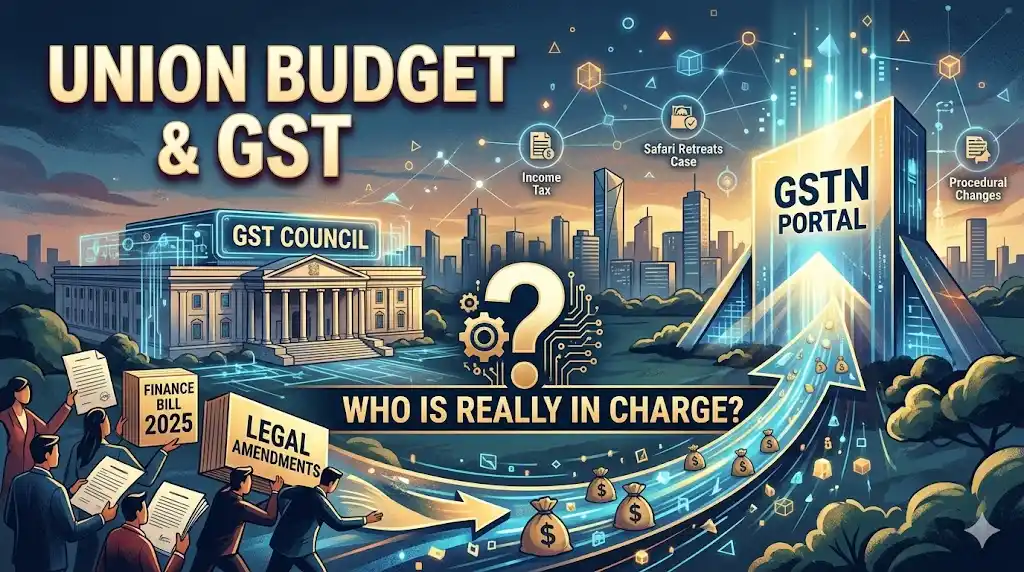
📊 Union Budget & GST – What’s Really Driving the Change?

For most people, Union Budget Day is all about the surprises in Income Tax. But when it comes to GST, the real game-changer is usually the recommendations of the GST Council, which later translate into legal amendments through the Finance Bill.

However, in recent times, it almost appears that the Goods and Services Tax Network (GSTN) portal itself is influencing the direction of these amendments!

A day ahead of the Union Budget 2025, here are some key GST changes that are likely to find their way into the Finance Bill 2025:

• The retrospective amendment to address the drafting issue of “and” vs “or”—effectively ratifying the landmark Safari Retreats Pvt Ltd v. Chief Commissioner of CGST ruling.
• Possible statutory backing for Invoice Management System (IMS) actions.
• Several procedural changes emerging from recent GST Council recommendations.

🔍 What’s Next?

• How will these policy decisions translate into the final law?
• Will the amendments truly reflect the intent behind the recommendations?
• Which provisions may face judicial scrutiny in the courts?
• How should businesses prepare for the upcoming GST changes?

💭 The bigger question remains:

Are we slowly witnessing a shift where GSTN portal practices are driving legal amendments rather than the other way around?

Share your views in the comments! 👇

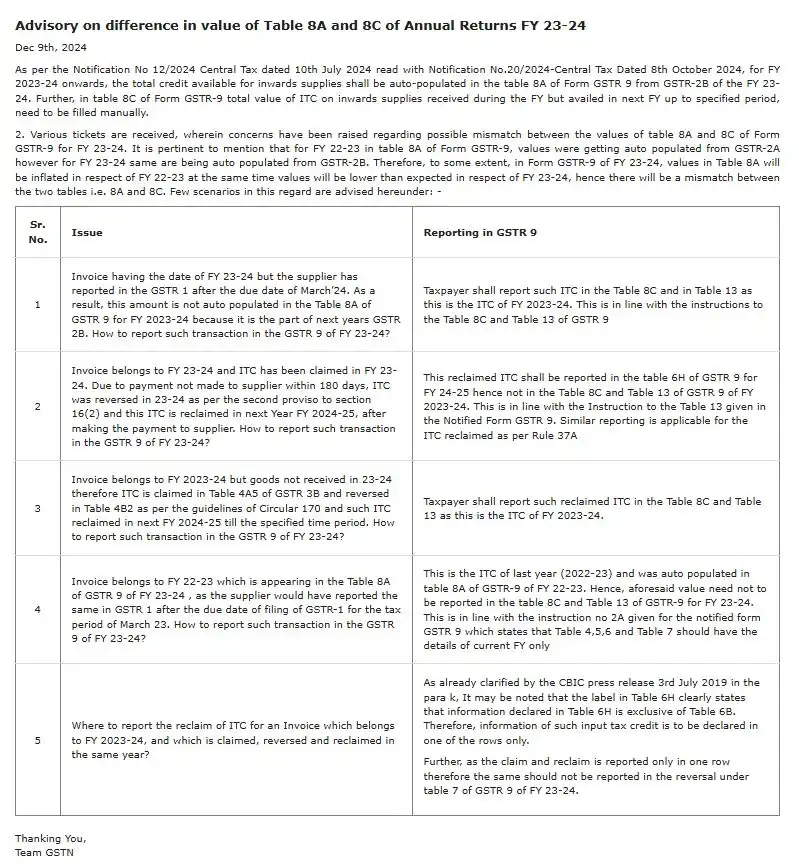
🔔 Advisory: Difference in Table 8A & 8C of GSTR-9 for FY 2023-24

Recent updates in GSTR-9 reporting may lead to differences between Table 8A and Table 8C values for FY 2023-24.

As per Goods and Services Tax Network (GSTN) advisory dated 09-12-2024, changes introduced through Notification No. 12/2024 and Notification No. 20/2024 affect the auto-population of ITC values in the Annual Return.

📌 Key Change

  • For FY 2023-24, Table 8A is auto-populated from GSTR-2B.
  • For FY 2022-23, it was auto-populated from GSTR-2A.

This shift may result in mismatches between Table 8A and Table 8C while filing GSTR-9.

Reporting Scenarios

1️⃣ Invoice dated FY 2023-24 but reported late by supplier

  • ITC should be reported in Table 8C and Table 13 of GSTR-9 for FY 2023-24.

2️⃣ ITC reclaimed in next FY due to late payment to supplier

  • Report reclaimed ITC in Table 6H of GSTR-9 for FY 2024-25.
  • Do not report in Table 8C or Table 13 of FY 2023-24.

3️⃣ Invoice of FY 2023-24 but goods received in next FY

  • Report reclaimed ITC in Table 8C and Table 13 of GSTR-9 for FY 2023-24.

4️⃣ Invoice of FY 2022-23 appearing in Table 8A of FY 2023-24

  • Do not report in Table 8C or Table 13 of GSTR-9 for FY 2023-24.

5️⃣ Reclaim of ITC for invoice of FY 2023-24 within the same year

  • Report in Table 6H of GSTR-9 for FY 2023-24, not in Table 7.

📊 Takeaway

Due to the shift from GSTR-2A to GSTR-2B for auto-population, taxpayers may notice differences between Table 8A and Table 8C. Proper classification in the relevant tables will help avoid reconciliation issues and compliance errors.

Stay updated. Stay compliant. ✅

ITC on Advances and Refund of Accumulated ITC in GST: Key Insights from the L&T IHI Consortium Case

The eligibility of Input Tax Credit (ITC) on advances remains one of the most debated topics under the Goods and Services Tax (GST) framework in India. A major concern raised by taxpayers is the apparent inconsistency in GST law—while GST is often payable on advances received, the corresponding ITC is generally allowed only after the actual supply of goods or services.

Another major issue frequently debated is the refund of accumulated ITC in joint venture (JV) projects, especially when such projects conclude and the entity ceases operations. A significant judgment delivered in the L&T IHI Consortium case (WP No. 2980 of 2019 dated 14 November 2024) provides important legal insights on both these issues.

Although the judgment does not create a broad precedent, it offers valuable interpretational guidance for GST professionals, tax litigators, and businesses dealing with large infrastructure projects.

Background of the Case

The case involved the L&T IHI Consortium, which executed the Mumbai Trans Harbour Link (Atal Setu) infrastructure project. During the execution of the project, the consortium received advance payments from the project authority and paid GST on those advances as required under GST law.

However, disputes arose regarding:

  • Eligibility to claim ITC on advances based on receipt vouchers
  • Refund of accumulated ITC after the project was completed
  • Constitutional validity of certain GST provisions

The case involved detailed arguments regarding the interpretation of GST provisions governing supply, time of supply, input tax credit eligibility, and refund mechanisms.

Major Legal Issues Examined

The petition challenged the interpretation and validity of several important provisions under the GST law, including:

  • Section 7 – Definition of supply
  • Sections 12 and 13 – Time of supply provisions
  • Section 16(2)(b) – Conditions for claiming Input Tax Credit
  • Section 54(3) – Refund of unutilized input tax credit

The petitioner argued that certain provisions resulted in financial hardship and discriminatory outcomes, particularly in cases where GST was paid on advances but ITC could not be utilized immediately.

Key Findings of the Court

1. Constitutional Validity of GST Provisions Upheld

The court rejected the challenge to the constitutional validity of Sections 7, 12, 13, and 16(2)(b) of the GST law.

It held that the definition of supply under Section 7 is valid and does not violate constitutional provisions. The court confirmed that the law can validly cover supplies agreed to be made in the future, including transactions involving advances.

The provisions were also held to be consistent with constitutional protections relating to equality before law, freedom of trade, and property rights.

2. ITC Allowed Based on Receipt Voucher in the Specific Facts of the Case

A significant observation in the case was the court’s decision to allow Input Tax Credit based on receipt vouchers issued for advances.

The court considered the unique circumstances of the project, where GST had already been paid on advances received for the infrastructure project. In such peculiar facts, the court allowed ITC under Section 16.

However, the court clearly stated that this relief was limited to the specific facts of the case and cannot automatically be treated as a general precedent applicable to all taxpayers.

The statutory principle that ITC is normally available only after receipt of goods or services remains unchanged.

3. Utilization of ITC Left Open for Future Determination

The court clarified that the question regarding how ITC can be utilized under GST law remains open.

This means the judgment does not conclusively decide broader issues relating to ITC utilization rights under GST, leaving scope for further legal interpretation in future disputes.

4. Refund of Accumulated ITC for Joint Venture Projects

Another important issue raised in the case was the refund of accumulated ITC when a joint venture project is completed and operations cease.

In many infrastructure projects, joint ventures are created solely for the duration of the project. Once the project is completed, the entity may no longer have taxable supplies, leaving unutilized ITC balances.

The petitioner argued that denial of refund in such cases is discriminatory, particularly for unincorporated joint ventures.

However, the court did not provide a final ruling on this issue because a statutory appeal regarding the matter was already pending. Therefore, the question regarding refund eligibility under Section 54(3) was kept open.

5. Refund Claims Not Finally Adjudicated

Because issues relating to ITC utilization and refund were pending in appellate proceedings, the court did not finally adjudicate the refund claims.

Instead, both parties were given liberty to present their arguments in the ongoing appeals.

6. Issue Regarding Receipt Vouchers and ITC Documentation

The case also highlighted a technical issue in GST compliance.

Receipt vouchers issued for advances are not specifically included as valid tax-paying documents under Rule 36. This exclusion can create difficulties for taxpayers attempting to claim ITC when GST has already been paid on advances.

The case therefore brought attention to a potential gap in GST rules relating to documentation for claiming ITC on advance transactions.

Importance of the Judgment for GST Litigation

Although the decision does not establish a universal legal precedent, it remains an important reference for GST practitioners.

The case provides:

  • A detailed interpretation of ITC eligibility on advances
  • Judicial analysis of supply and time of supply provisions
  • Important arguments regarding refund of accumulated ITC in project-based entities
  • Insights useful for GST litigation and advisory work

For tax litigators, the judgment offers a valuable opportunity to re-examine GST provisions from new legal perspectives.

Conclusion

The L&T IHI Consortium judgment provides important insights into two complex GST issues—ITC eligibility on advances and refund of accumulated ITC for project-based entities.

While the court upheld the validity of key GST provisions, it granted limited relief based on the unique facts of the case and left broader issues regarding ITC utilization and refund eligibility open for future determination.For businesses involved in large infrastructure projects, joint ventures, and advance-based contracts, this case highlights the need for careful GST planning, documentation, and legal analysis when dealing with Input Tax Credit and refund claims.

ITC on Advances and Refund of Accumulated ITC: Insights from the L&T IHI Consortium Judgment

The issue of Input Tax Credit (ITC) eligibility on advances remains one of the most debated topics under the Goods and Services Tax (GST) regime in India. A key concern often raised by taxpayers is the inconsistency between GST being payable on advances while ITC eligibility is restricted until the supply of goods or services is actually received.

Another closely related issue arises in cases involving refund of accumulated ITC for joint venture (JV) projects, particularly when such projects conclude and the entity ceases operations.

A recent judgment by the Bombay High Court in the case of L&T IHI Consortium v. Union of India provides important insights into these issues. Although the decision does not establish a general precedent, it offers valuable legal reasoning and interpretational guidance for tax professionals and litigators.

Background of the Case

The case involved the L&T IHI Consortium, which executed the Mumbai Trans Harbour Link (Atal Setu) project for the Mumbai Metropolitan Region Development Authority (MMRDA).

The consortium received advance payments for the project and paid GST on those advances. However, disputes arose regarding:

  • Eligibility to claim ITC based on receipt vouchers for advances
  • Refund of accumulated ITC after completion of the project
  • Constitutional validity of certain GST provisions

The arguments presented by Arvind Datar provided a deep analysis of GST law and constitutional principles.

Key Issues Examined by the Court

The petition raised challenges relating to several provisions of the Central Goods and Services Tax Act, 2017, including:

  • Section 7 – Definition of supply
  • Section 12 and Section 13 – Time of supply
  • Section 16(2)(b) – Conditions for claiming ITC
  • Section 54(3) – Refund of unutilized ITC

The court carefully examined whether these provisions violated constitutional guarantees.

Key Findings of the Bombay High Court

1. Constitutional Validity of GST Provisions Upheld

The Bombay High Court rejected the petitioner’s challenge to the constitutional validity of Sections 7, 12, 13, and 16(2)(b) of the Central Goods and Services Tax Act, 2017.

The court held that Section 7, which defines “supply,” is not ultra vires the Constitution, including Article 246A and Article 366(12A).

The court also concluded that the provision does not violate fundamental rights under:

  • Article 14 (Equality before law)
  • Article 19(1)(g) (Freedom to carry on trade or business)
  • Article 300A (Right to property)

2. ITC Allowed Based on Receipt Voucher in Specific Circumstances

In the peculiar facts of the case, the court allowed Input Tax Credit under Section 16 based on receipt vouchers issued for advances received from the Mumbai Metropolitan Region Development Authority.

However, the court emphasized an important point:

  • Under the statutory framework, ITC is generally available only after receipt of goods or services.

Therefore, the relief granted was limited strictly to the specific facts of the case, meaning it cannot be automatically treated as a binding precedent for other taxpayers unless the facts are closely identical.

3. Utilization of ITC Left Open

The court clarified that all contentions regarding utilization of ITC under the CGST and MGST Acts remain open.

This means that the judgment does not conclusively settle broader issues related to ITC utilization, leaving room for further legal interpretation in future cases.

4. Challenge to Section 54(3) on Refund of ITC Kept Open

Another significant issue involved refund of accumulated ITC when the joint venture ceased operations after completing the project.

The petitioner argued that denial of refund under Section 54(3) is discriminatory, especially for unincorporated joint ventures that exist only for the duration of a project.

However, the court did not decide this issue finally and kept the question open, since a statutory appeal on the matter is still pending.

5. Refund Claim Not Adjudicated

Because issues relating to ITC utilization and refund are pending in appellate proceedings, the court did not adjudicate the refund claims in this writ petition.

Both parties have been given liberty to raise their arguments in the ongoing appeals.

6. Issue with Rule 36 and Receipt Vouchers

Another technical concern highlighted in the case was the non-inclusion of receipt vouchers in Rule 36 as valid documents for claiming ITC.

This gap in the rules was argued to have deprived the petitioner of ITC benefits, particularly in cases where GST was already paid on advances.

Importance of the Judgment for GST Litigation

Although the decision does not create a binding precedent for all taxpayers, it is still significant for several reasons.

The judgment provides:

  • Detailed interpretation of GST provisions related to advances and ITC
  • Constitutional analysis of supply and ITC provisions
  • Legal arguments that may guide future GST litigation

For tax professionals and litigators, the case offers valuable insights into how courts may approach disputes involving ITC eligibility and refund issues.

Conclusion

The ruling of the Bombay High Court in the L&T IHI Consortium v. Union of India case sheds light on complex GST issues such as ITC eligibility on advances and refund of accumulated ITC for joint venture projects.

While the court upheld the constitutional validity of several GST provisions, it granted limited relief based on the specific facts of the case and left important questions regarding ITC utilization and refund under Section 54(3) open for future determination.For GST practitioners, this judgment serves as an important analytical resource and guiding reference when dealing with similar disputes in tax litigation.

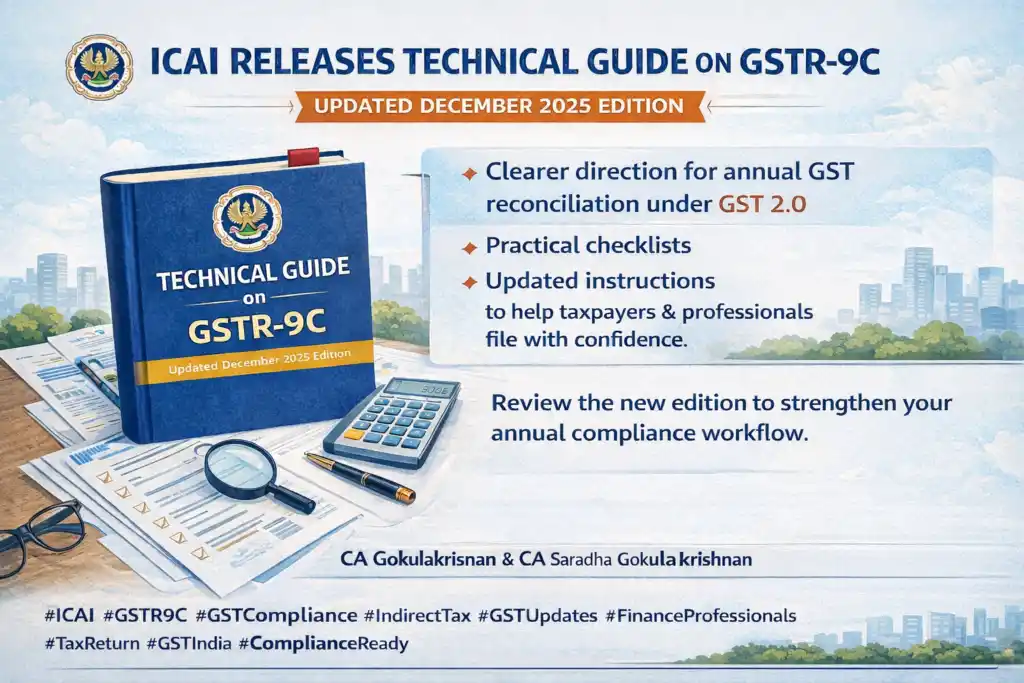
ICAI Releases Updated Technical Guide on GSTR-9C (December 2025): A Practical Reference for GST Reconciliation

The Institute of Chartered Accountants of India (ICAI) has released the updated December 2025 edition of the Technical Guide on GSTR-9C, providing comprehensive guidance for businesses and professionals preparing the GST reconciliation statement.

With the evolving GST framework and the broader transition toward GST 2.0 compliance practices, the updated guide offers clearer direction on reconciliation methodology, reporting requirements, and practical compliance procedures.

For taxpayers and professionals handling annual GST reconciliations, this guide serves as a valuable technical reference to ensure accurate reporting and regulatory compliance.

What Is GSTR-9C Under GST?

GSTR-9C is the GST reconciliation statement that compares the data reported in GST returns with the figures appearing in the taxpayer’s audited financial statements.

It is an important compliance document that helps ensure alignment between:

  • Turnover reported in financial statements
  • Taxable supplies declared in GST returns
  • Input Tax Credit (ITC) claimed during the year
  • Tax liability and tax payments reported

The reconciliation statement helps identify differences, adjustments, and additional disclosures, strengthening transparency in GST reporting.

Key Highlights of the Updated ICAI Technical Guide

The updated guide issued by the Institute of Chartered Accountants of India incorporates amendments and practical clarifications up to December 2025.

It provides professionals with a structured framework for handling GSTR-9C reconciliation under evolving GST rules.

1. Practical Reconciliation Framework

The guide explains how to reconcile turnover, tax liability, and Input Tax Credit between GST returns and audited books of accounts, helping taxpayers maintain consistency across financial records.

2. Updated Reporting Guidance

Clear instructions are provided on reporting requirements for various tables in GSTR-9C, enabling professionals to prepare the reconciliation statement with greater accuracy.

3. Compliance Checklists

One of the most valuable additions in the updated guide is the inclusion of practical compliance checklists, which help businesses and consultants verify:

  • Data accuracy
  • Reconciliation completeness
  • Correct disclosure of adjustments

4. Error Prevention and Best Practices

The guide highlights common errors in annual GST reconciliation and suggests best practices to avoid mismatches between GST returns and financial statements.

Importance for Businesses and GST Professionals

The updated GSTR-9C technical guide is particularly useful for:

  • Chartered accountants and tax consultants
  • Corporate finance and compliance teams
  • Businesses with complex GST reporting structures
  • Professionals responsible for annual GST reconciliation

Using the guide helps improve accuracy in GST annual filings and reduces the risk of scrutiny or notices from tax authorities.

Strengthening GST Compliance Under GST 2.0

As India’s GST system evolves with technology-driven compliance tools and deeper data analytics, annual reconciliation has become more important than ever.

Resources like the ICAI Technical Guide on GSTR-9C help businesses align their financial reporting, GST returns, and compliance documentation, creating a stronger compliance framework.

Final Thoughts

The December 2025 edition of the GSTR-9C Technical Guide released by the Institute of Chartered Accountants of India is a valuable resource for navigating the complexities of annual GST reconciliation.

With practical checklists, updated instructions, and structured reconciliation guidance, the guide helps taxpayers and professionals approach GSTR-9C filing with greater clarity and confidence.Reviewing the updated edition can significantly strengthen your annual GST compliance workflow and reporting accuracy.

GST Registration in Just 3 Hours? India’s Simplified GST Registration Scheme Explained

India’s GST ecosystem is witnessing a major shift toward speed, automation, and ease of doing business. In several recent cases, businesses have reported receiving their GST registration and active GSTIN within just 3 hours of application submission.

While GST registration approvals previously took several days or even weeks, the newly introduced Simplified GST Registration Scheme, effective 1 November 2025, is transforming the onboarding experience for businesses.

This reform is part of the broader digital compliance initiatives overseen by the Goods and Services Tax Network and implemented under the policy framework of the GST Council.

The initiative aims to automate GST registration approvals for low-risk applicants, significantly reducing procedural delays.

What Is the Simplified GST Registration Scheme?

The Simplified GST Registration Scheme introduces an auto-approval mechanism for eligible applicants based on Aadhaar authentication and system-based risk assessment.

Under this framework:

  • Applications that pass data validation and risk filters are approved automatically.
  • Manual intervention by tax officers is minimized.
  • GSTIN can be issued within hours or within a few working days, depending on the verification outcome.

This shift represents a major step toward technology-driven tax administration and faster business onboarding.

Eligibility Criteria for Simplified GST Registration

Businesses must meet certain parameters to qualify for the auto-approval registration mechanism.

B2B Supply Threshold

Eligible businesses should have B2B supplies generating GST liability of up to ₹2.5 lakh per month (including CGST, SGST, and IGST).

No Cap on B2C Transactions

The scheme does not impose any limit on B2C transactions, allowing businesses to freely serve retail customers without affecting eligibility.

Aadhaar-Based Authentication

Applicants must successfully complete Aadhaar authentication, which enables system-driven identity verification and reduces the need for physical checks.

Digital Application Process

The entire GST registration workflow remains fully online through the GST portal, ensuring transparency and faster approvals.

Exit Option Under Rule 14A

Businesses that outgrow the eligibility limits under the scheme are not locked into the system.

They can exit the simplified mechanism smoothly through Rule 14A procedures, allowing them to transition into the regular GST compliance framework without disruptions.

This ensures the scheme remains flexible and scalable as businesses grow.

Why This Reform Matters for Small Businesses

The Simplified GST Registration Scheme is designed primarily to support:

  • Startups and new entrepreneurs
  • Micro, Small, and Medium Enterprises (MSMEs)
  • Small-scale manufacturers
  • Service providers entering the formal economy

By reducing approval time and administrative barriers, the reform encourages greater participation in the formal tax system.

It also aligns with India’s broader policy objective of improving the ease of doing business and supporting small enterprise growth.

Benefits of Automated GST Registration

The automation-driven approach offers several advantages.

Faster Business Onboarding

Businesses can start operations and issue GST-compliant invoices almost immediately after registration approval.

Reduced Administrative Delays

The system minimizes manual verification steps that historically caused registration backlogs and approval delays.

Transparent and Data-Driven Compliance

By relying on system-based risk analysis, the GST portal ensures that approvals remain efficient while maintaining compliance oversight.

Improved Startup Ecosystem

Faster GST registrations help entrepreneurs participate in B2B supply chains, e-commerce platforms, and government tenders without unnecessary delays.

Importance of Proper Implementation

While the speed of approval is a welcome development, businesses must ensure that accuracy and compliance standards remain intact.

Incorrect data in the registration application — such as PAN mismatches, incorrect HSN/SAC classification, or inconsistent bank details — could still trigger system alerts or additional verification.

Professional guidance from tax experts can help ensure that applications are submitted correctly and approved without complications.

Final Thoughts

The Simplified GST Registration Scheme effective from 1 November 2025 represents a meaningful structural reform in India’s GST framework.

By enabling auto-approval mechanisms, Aadhaar-based authentication, and digital verification, the system dramatically reduces the time required to obtain a GST registration.

For emerging entrepreneurs and growing businesses, this reform signals a more efficient, technology-driven compliance environment.However, as with any new system, careful implementation and accurate documentation remain essential to ensure smooth approvals and long-term GST compliance.

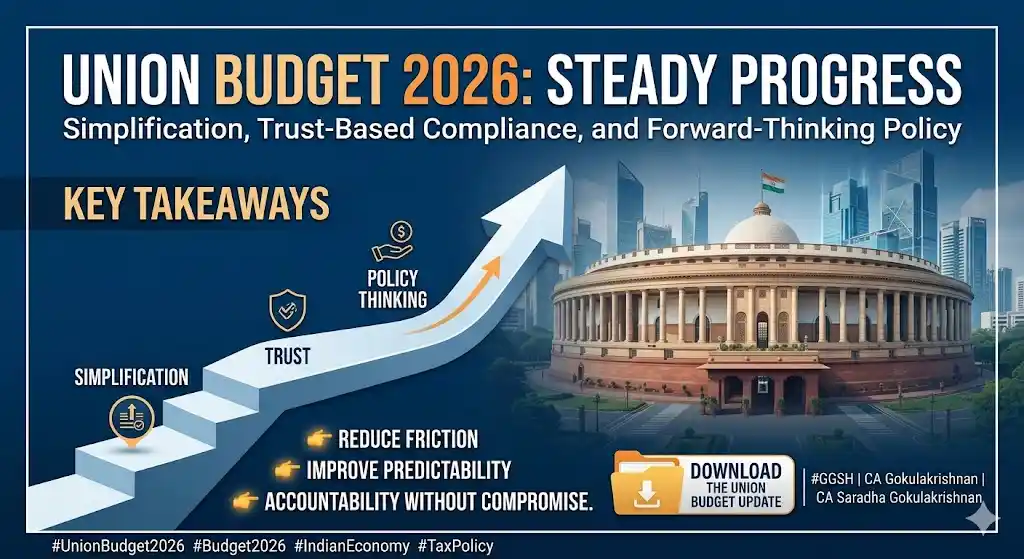
Union Budget 2026: Key Takeaways for Businesses, Tax Professionals & Compliance Strategy

The Union Budget 2026 does not attempt a dramatic overhaul of India’s tax and compliance ecosystem.

Instead, it continues a clear policy direction that has been developing over the last few years — a gradual shift toward simplified taxation, trust-based compliance, and predictable regulatory frameworks.

For businesses, finance professionals, and tax practitioners, this Budget signals something important: policy stability with structural refinement.

Rather than disruptive reforms, Union Budget 2026 focuses on reducing friction in compliance while maintaining accountability in tax administration.

The Core Policy Direction Behind Union Budget 2026

Across direct taxes, GST, customs, and export policies, the government’s approach appears consistent and strategic.

The Budget framework is built around three central objectives:

  • Reduce compliance friction for businesses and taxpayers
  • Improve predictability in tax administration
  • Strengthen accountability without increasing regulatory burden

This reflects the government’s broader move toward a modern tax ecosystem where transparency, digital monitoring, and simplified processes coexist.

For businesses operating in India’s evolving regulatory environment, this means greater clarity in compliance expectations and fewer interpretational disputes.

TDS and TCS Rationalisation: Simplifying the Direct Tax Landscape

One of the significant focus areas in Union Budget 2026 is the rationalisation of TDS (Tax Deducted at Source) and TCS (Tax Collected at Source) provisions.

These changes aim to address a long-standing concern among businesses and professionals — the complexity of multiple rates, thresholds, and overlapping provisions.

Key objectives behind TDS/TCS reforms

  • Reduce administrative burden for taxpayers
  • Improve ease of compliance for businesses
  • Minimise disputes related to interpretation
  • Streamline tax collection mechanisms

For finance teams, accountants, and tax consultants, these rationalisation measures could significantly improve year-end tax planning and compliance efficiency.

Litigation Relief Measures: Reducing the Compliance Backlog

Another notable policy direction in the Budget is reducing tax litigation pressure.

Over the years, India’s tax ecosystem has faced challenges related to pending disputes and prolonged litigation cycles. The Budget’s approach appears to prioritise:

  • Faster dispute resolution mechanisms
  • Reduction of unnecessary litigation
  • Encouraging voluntary compliance

For businesses, this shift signals a move toward a more collaborative tax administration environment rather than a purely enforcement-driven approach.

GST Policy Adjustments: Incremental but Impactful

The Goods and Services Tax framework continues to evolve through measured policy adjustments rather than sweeping changes.

In Union Budget 2026, the focus appears to be on:

  • Improving GST compliance frameworks
  • Reducing procedural complexities
  • Enhancing clarity in tax administration

For small businesses, startups, and growing enterprises, this incremental refinement could result in more predictable GST compliance processes and fewer operational uncertainties.

Customs and Export Framework: Strengthening Global Trade

The Budget also introduces targeted improvements in customs duty structures and export-oriented policies.

These measures aim to support:

  • Domestic manufacturing growth
  • Export competitiveness
  • Integration of Indian businesses into global supply chains

By rationalising customs frameworks and improving export policies, the government is signalling its continued commitment to making India a stronger participant in global trade.

What Union Budget 2026 Means for Businesses and Finance Professionals

For business owners, CFOs, tax professionals, and compliance teams, the real takeaway from Union Budget 2026 is not about headline announcements.

It is about preparing early and responding strategically.

Businesses should consider:

1. Reviewing tax compliance frameworks

Evaluate whether internal processes align with new simplification initiatives and policy adjustments.

2. Strengthening year-end tax planning

With TDS/TCS rationalisation and litigation relief measures, organisations may need to update their tax risk management strategies.

3. Improving compliance automation

The direction toward predictable and digital compliance systems suggests that businesses should continue investing in technology-driven tax management solutions.

The Bigger Policy Signal

The Union Budget 2026 reinforces a broader shift in India’s tax policy architecture.

Rather than chasing short-term disruption, the government appears focused on building:

  • A predictable tax environment
  • A simplified compliance structure
  • A trust-based regulatory relationship between taxpayers and authorities

For professionals working in taxation, finance, accounting, and compliance, this means less uncertainty and more emphasis on proactive compliance strategy.

Final Thoughts

The Union Budget 2026 may not introduce dramatic policy shifts, but its significance lies in continuity and structural refinement.

By prioritising simplification, predictability, and accountability, the government continues to move India toward a more stable and business-friendly tax ecosystem.For businesses and professionals alike, the key is not just understanding what changed — but interpreting what these policy signals mean for future compliance strategy and operational planning.

CCFS-2026: MCA’s Compliance Window to Clear Pending ROC Filings at Reduced Fees

Corporate compliance delays are more common than many companies publicly acknowledge.

Over time, missed ROC filings, accumulating additional fees, and unresolved compliance obligations can create a significant regulatory burden.

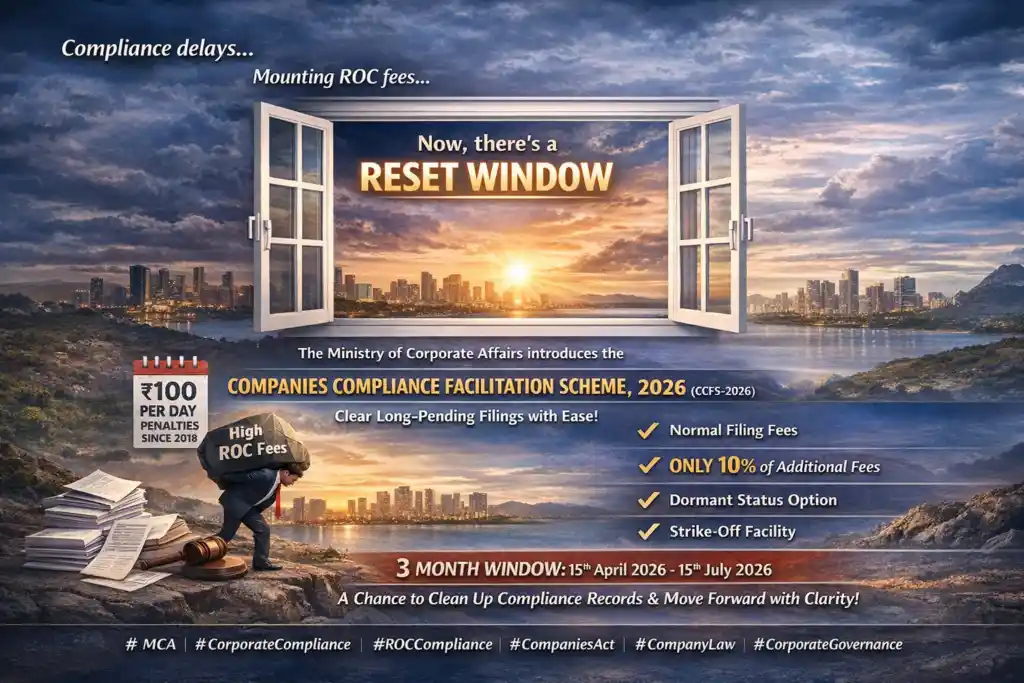
Recognizing this challenge, the Ministry of Corporate Affairs (MCA) has introduced the Companies Compliance Facilitation Scheme 2026 (CCFS-2026).

This scheme provides companies with a limited-period opportunity to regularize long-pending filings relating to Annual Returns and Financial Statements under the Companies Act 2013.

For many organizations, CCFS-2026 represents not just a fee reduction initiative, but a strategic opportunity to reset their compliance position with the Registrar of Companies (ROC).

Why ROC Filing Delays Become Expensive

Since July 2018, delayed ROC filings have attracted ₹100 per day in additional fees without any upper cap.

This means that companies with multiple years of pending filings may face extremely high compliance costs.

Typical filings affected include:

  • Annual Return (Form MGT-7 / MGT-7A)
  • Financial Statements (Form AOC-4)
  • Other statutory filings required under the Companies Act

For companies that have missed filings for several financial years, the additional fee component alone can become financially burdensome.

What CCFS-2026 Changes

The Companies Compliance Facilitation Scheme 2026 significantly reduces the cost of clearing pending filings.

Under this scheme:

  • Companies pay normal filing fees
  • Only 10% of the additional fees otherwise payable
  • The remaining additional fees are effectively waived

This structure makes it far easier for companies to clear historical compliance defaults without facing the full financial impact of accumulated penalties.

Scheme Timeline

The CCFS-2026 scheme will be available for a limited period of three months.

📅 Start Date: 15 April 2026
📅 End Date: 15 July 2026

During this window, eligible companies can file pending statutory documents with reduced additional fees.

Because the scheme is time-bound, companies should evaluate their ROC filing backlog well in advance of the closing date.

Filings Covered Under the Scheme

The scheme primarily focuses on delayed filings relating to:

Annual Returns

Filed using Form MGT-7 or MGT-7A, these filings provide a summary of a company’s:

  • Shareholding structure
  • Directors and key managerial personnel
  • Corporate governance details

Financial Statements

Filed through Form AOC-4, these include:

  • Balance sheet
  • Profit and loss account
  • Auditor’s report
  • Board report

Ensuring these filings are up-to-date is critical for maintaining a clean corporate compliance record.

Additional Options Under CCFS-2026

Apart from facilitating delayed filings, the scheme also provides compliance pathways for companies that are no longer operational.

Dormant Company Status

Companies that intend to retain their corporate structure but temporarily suspend operations can apply for Dormant Company status under the Companies Act.

This allows entities to maintain existence while reducing ongoing compliance requirements.

Strike-Off of Inactive Companies

Companies that are no longer conducting business operations may choose to apply for strike-off from the Register of Companies.

This option allows promoters to formally close inactive entities and avoid future compliance obligations.

Potential Relief from Penalty Proceedings

Another important benefit of the scheme is that companies completing their filings within the prescribed timelines may be able to avoid certain penalty proceedings related to delayed filings.

This provides an opportunity to:

  • Resolve historical compliance defaults
  • Reduce regulatory risk
  • Strengthen corporate governance records

Why Companies Should Evaluate the Scheme Early

For many businesses, compliance delays accumulate gradually over time.

However, unresolved ROC filings can create complications such as:

  • Director disqualification risks
  • Difficulty in raising investment or bank funding
  • Issues during due diligence or corporate restructuring
  • Increased regulatory scrutiny

By using the CCFS-2026 window, companies can clean up their compliance records and restore regulatory clarity.

Final Thoughts

The Companies Compliance Facilitation Scheme 2026 provides a rare opportunity for companies to reset their ROC compliance status at significantly reduced cost.

Rather than allowing penalties to continue accumulating, businesses can use this three-month window to clear pending filings, regularize statutory records, and move forward with a stronger compliance foundation.

For many organisations, CCFS-2026 is not just a financial relief mechanism.It is a practical chance to rebuild corporate compliance credibility and eliminate long-standing regulatory exposure.

RoDTEP Annual Return (ARR): Important Compliance for Exporters Before 31 March 2026

Many exporters believe that once RoDTEP benefits are credited, the compliance cycle is complete.

However, there is one additional requirement that often goes unnoticed — the RoDTEP Annual Return (ARR).

For exporters who claimed ₹1 crore or more under the Remission of Duties and Taxes on Exported Products (RoDTEP) during FY 2024–25, filing the ARR is mandatory.

The due date for submitting the ARR is 31 March 2026.

Understanding this requirement early can help exporters avoid compliance risks, delays in future incentives, or scrutiny from authorities.

What is the RoDTEP Annual Return (ARR)?

The RoDTEP Annual Return (ARR) is a compliance requirement designed to verify the accuracy and legitimacy of export incentive claims.

The return is submitted through the Directorate General of Foreign Trade (DGFT) portal and serves as a post-benefit validation mechanism.

In simple terms, ARR helps authorities confirm that:

  • RoDTEP benefits claimed by exporters were accurately calculated
  • The export transactions and documentation match the incentive claimed
  • The remission granted aligns with the applicable scheme rules

This makes ARR a crucial step linking export incentives with final regulatory verification.

Who Needs to File the RoDTEP ARR?

Exporters must file the ARR if they meet the following condition:

Total RoDTEP benefits claimed during FY 2024–25 are ₹1 crore or more.

This threshold applies to exporters across sectors, including:

  • Manufacturing exporters
  • Merchant exporters
  • Large export houses
  • Sector-specific exporters such as textiles, marine products, engineering goods, and pharmaceuticals

If the threshold is crossed, ARR filing becomes mandatory compliance.

Due Date for RoDTEP ARR Filing

For exporters covered under the requirement:

Due Date:
📅 31 March 2026

Missing the deadline may lead to regulatory scrutiny and operational complications in future RoDTEP claims.

Exporters are therefore advised to review their RoDTEP credits well in advance and determine whether the ARR filing requirement applies.

Why ARR Filing is Important for Exporters

Many exporters become aware of ARR only when the deadline is approaching.

However, this return plays a critical role in maintaining export incentive eligibility and compliance integrity.

Key reasons ARR filing matters

1. Validation of RoDTEP benefits
ARR helps DGFT validate whether the incentives claimed were legitimate and properly calculated.

2. Protection of future RoDTEP credits
Failure to file ARR may affect eligibility for future export incentive claims.

3. Risk mitigation for past benefits
Non-compliance could lead to questions on previously claimed RoDTEP credits.

4. Strengthening compliance transparency
ARR filing ensures exporters maintain accurate documentation and reporting alignment with export records.

Common Mistake Many Exporters Make

A frequent issue is that exporters assume RoDTEP compliance ends once the credit is received in the electronic ledger.

In reality, the process includes post-benefit compliance verification through ARR filing.

Because awareness about ARR remains limited, many exporters discover this requirement close to the due date, leaving very little time for preparation.

Steps Exporters Should Take Now

If your business claimed RoDTEP benefits in FY 2024–25, consider the following steps early:

Review total RoDTEP benefits claimed

Check whether the ₹1 crore threshold has been crossed.

Verify export documentation

Ensure that shipping bills, export invoices, and RoDTEP claims align accurately.

Prepare ARR data early

Advance preparation reduces last-minute compliance pressure.

Seek professional guidance if required

Export incentive regulations can be complex, especially when dealing with large benefit amounts and multiple shipments.

Final Thoughts

Export incentives such as RoDTEP play an important role in improving global competitiveness for Indian exporters.

However, these benefits also come with compliance responsibilities.

The RoDTEP Annual Return (ARR) acts as the final checkpoint between incentive claims and regulatory validation.Exporters who stay informed and prepare early can ensure smooth compliance, uninterrupted incentives, and reduced regulatory risk.