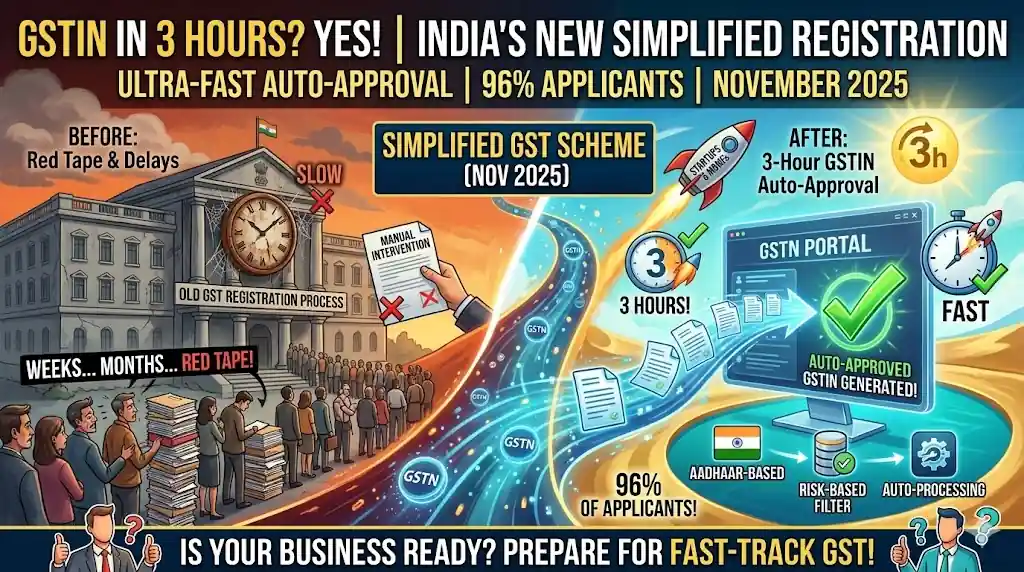
GST Registration in 3 Hours? India’s New Simplified Scheme Revolutionizes Business Onboarding

Imagine getting your GST registration in India completed in just 3 hours.

Not 30 days.
Not even 3 days.

With the introduction of the Simplified GST Registration Scheme effective from 1st November 2025, this is now becoming a reality for eligible applicants.

This reform marks a major leap toward improving the ease of doing business in India, especially for startups, MSMEs, and small businesses.
A Game-Changing Shift in GST Registration

The new system, powered by the Goods and Services Tax Network (GSTN), introduces a fully automated, Aadhaar-based GST registration process.

In several cases, businesses have already experienced:

  • GSTIN issued within just a few hours
  • No manual intervention
  • Seamless, end-to-end digital processing

This is a significant improvement over the earlier system, which often involved delays, document queries, and procedural bottlenecks.

What is the Simplified GST Registration Scheme?

The Simplified GST Registration Scheme is designed to:

  • Enable auto-approval of GST registration
  • Reduce human intervention
  • Eliminate unnecessary delays
  • Promote faster business onboarding

At its core, the scheme relies on:

  • Aadhaar authentication
  • Risk-based verification systems
  • Automated processing workflows

Eligibility Criteria for Fast-Track GST Registration

To qualify for this auto-approved GST registration, applicants must meet certain conditions:

✔️ Turnover Threshold

  • B2B supplies up to ₹2.5 lakh GST per month (CGST + SGST + IGST)

✔️ No Restriction on B2C Supplies

  • Businesses can have unlimited B2C transactions

✔️ Aadhaar-Based Authentication

  • Mandatory for faster approval and system validation

Flexibility to Exit the Scheme

One of the key advantages is flexibility:

  • Businesses can exit anytime once they outgrow the threshold
  • Exit is governed by Rule 14A under GST
  • The process is system-driven and seamless

Key Features of the New GST Registration System

⚡ Ultra-Fast Processing

  • GST registration possible within hours instead of days

📲 100% Online Process

  • No physical verification in most cases
  • Fully digital and transparent

🤖 Automation-Driven Approval

  • Minimal officer intervention
  • Faster decision-making

📊 Risk-Based Screening

  • High-risk cases still subject to scrutiny
  • Ensures balance between speed and compliance

Impact on Businesses and Entrepreneurs

This reform is a major boost for:

  • Startups launching new ventures
  • MSMEs and small-scale manufacturers
  • Service providers entering the GST system
  • Growing businesses expanding operations

Key Benefits:

  • Faster market entry
  • Reduced compliance delays
  • Improved business agility
  • Lower administrative burden

Important Considerations

While the system is faster, businesses must ensure:

  • Accuracy in PAN, address, and bank details
  • Correct classification using HSN/SAC codes
  • Consistency in submitted data

👉 Automation works efficiently only when the input data is clean and reliable.

A Structural Reform in GST Compliance

This is not just a procedural update — it is a structural reform in India’s GST ecosystem.

By reducing friction in the registration process, the government is:

  • Encouraging formalization of businesses
  • Enhancing digital governance
  • Strengthening the overall tax compliance framework

Role of Professional Guidance

Despite automation, professional expertise remains crucial:

  • Interpreting eligibility conditions
  • Ensuring compliance accuracy
  • Managing transitions and exit from the scheme

A well-guided approach helps businesses avoid errors, rejections, and future complications.

Conclusion

The possibility of getting a GST registration within 3 hours highlights how far India’s tax system has evolved.

The Simplified GST Registration Scheme (effective November 2025) is a bold step toward making compliance:

  • Faster
  • Smarter
  • More business-friendly

Final Thoughts 💬

From delays and red tape to speed and automation, GST registration in India is entering a new era.Are you ready to leverage this ultra-fast GST registration system for your business?
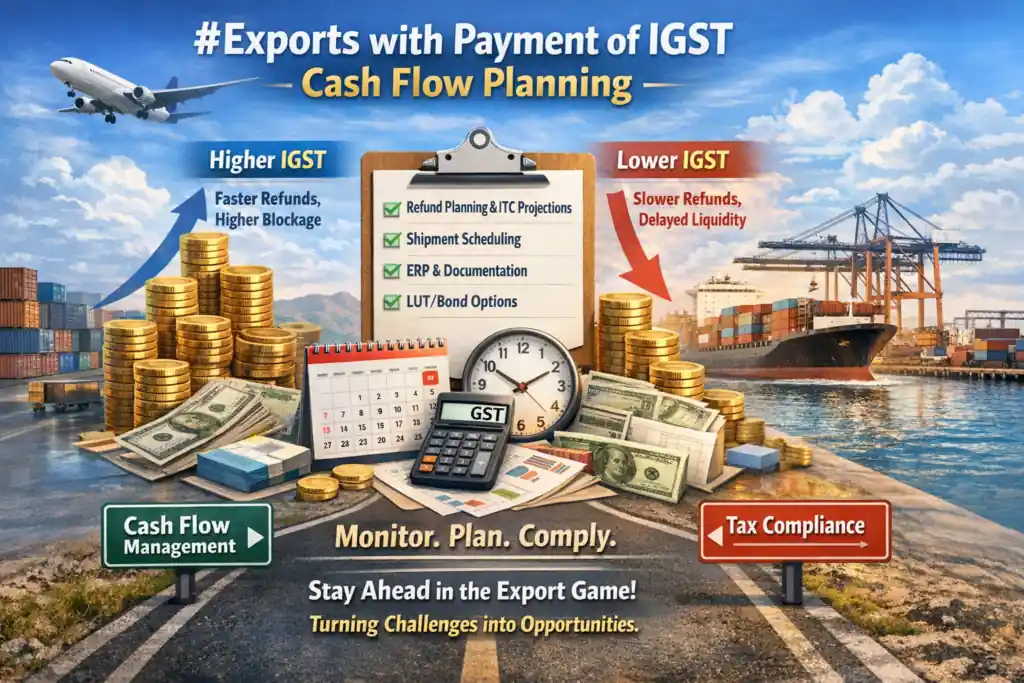
Exports with Payment of IGST: Cash Flow Planning Strategies for Exporters After the 56th GST Council Meeting

Exporters operating under the Goods and Services Tax (GST) framework must constantly evaluate how tax rate changes affect their working capital and refund cycles. One of the most important areas impacted by GST policy updates is exports with payment of Integrated GST (IGST).

Recent developments following the 56th meeting of the GST Council have significant implications for exporters who choose to export goods or services with payment of IGST and claim refunds.

Changes in IGST rates directly influence cash flow planning, Input Tax Credit (ITC) utilisation, and refund timelines, making proactive financial planning essential for export businesses.

Understanding Exports with Payment of IGST

Under the GST framework, exporters generally have two options when supplying goods or services outside India:

  1. Export with payment of IGST and claim refund
  2. Export without payment of tax under LUT/Bond and claim ITC refund

When exporters choose the IGST payment route, they pay IGST on exports and subsequently claim a refund of the tax paid once the export documentation is validated.

This method often allows for faster refund processing, but it also affects working capital management, particularly when IGST rates change.

How IGST Rate Changes Affect Exporter Cash Flow

Changes in IGST rates can significantly influence how quickly exporters can convert Input Tax Credit (ITC) into cash refunds.

Scenario 1: Higher IGST Rate

When the IGST rate increases:

  • Exporters pay higher tax at the time of export
  • Input Tax Credit gets liquidated faster
  • However, there is greater upfront working capital blockage

This may create short-term cash flow pressure, especially for exporters with large shipment volumes.

Scenario 2: Lower IGST Rate

When the IGST rate decreases:

  • Exporters pay lower tax at the time of export
  • Immediate cash outflow is reduced
  • However, ITC accumulation may increase

This can result in slower conversion of ITC into cash refunds, affecting liquidity planning for some businesses.

Key Areas Exporters Must Monitor

To manage these implications effectively, exporters must closely track several operational and compliance factors.

1. Refund Planning and ITC Projections

Exporters should regularly monitor:

  • Monthly Input Tax Credit accumulation
  • Expected IGST refunds
  • Cash flow projections linked to refund timelines

A structured refund planning strategy helps businesses avoid liquidity constraints.

2. Shipment Scheduling Around Rate Changes

When GST rate changes are notified, exporters may consider adjusting shipment schedules strategically.

This can help optimize:

  • Tax outflows
  • refund timing
  • working capital utilisation

However, such planning must always remain commercially practical and compliant with GST regulations.

3. Documentation and ERP System Updates

Changes in IGST rates require updates across several systems, including:

  • ERP tax master configurations
  • export invoicing systems
  • shipping bill documentation
  • GST reporting tools

Accurate system updates help avoid refund mismatches, compliance errors, and e-invoice inconsistencies.

4. Evaluating Export Under LUT or Bond

Exporters should also periodically evaluate the alternative option of exporting without payment of tax under LUT/Bond.

Export under LUT allows businesses to:

  • Avoid upfront IGST payment
  • claim refund of accumulated ITC instead

This approach may be beneficial for exporters seeking to reduce working capital blockage.

However, the choice between IGST payment and LUT export depends on each company’s cash flow structure, refund speed, and ITC availability.

Why Cash Flow Planning Is Critical for Export Businesses

For export-driven organizations, cash flow management is as important as revenue generation.

Delays in refunds, tax rate changes, or incorrect documentation can lead to significant working capital pressure, especially for companies with high export turnover.

By combining refund planning, ERP updates, shipment scheduling, and compliance monitoring, exporters can transform GST changes from operational challenges into strategic financial advantages.

Final Thoughts

The implications of IGST rate changes on exports highlight how tax policy directly influences working capital cycles and refund mechanisms.

Exporters must therefore integrate GST compliance, cash flow planning, and operational strategy to remain financially efficient and compliant.In today’s regulatory environment, smart planning can turn GST complexities into opportunities for better financial management.

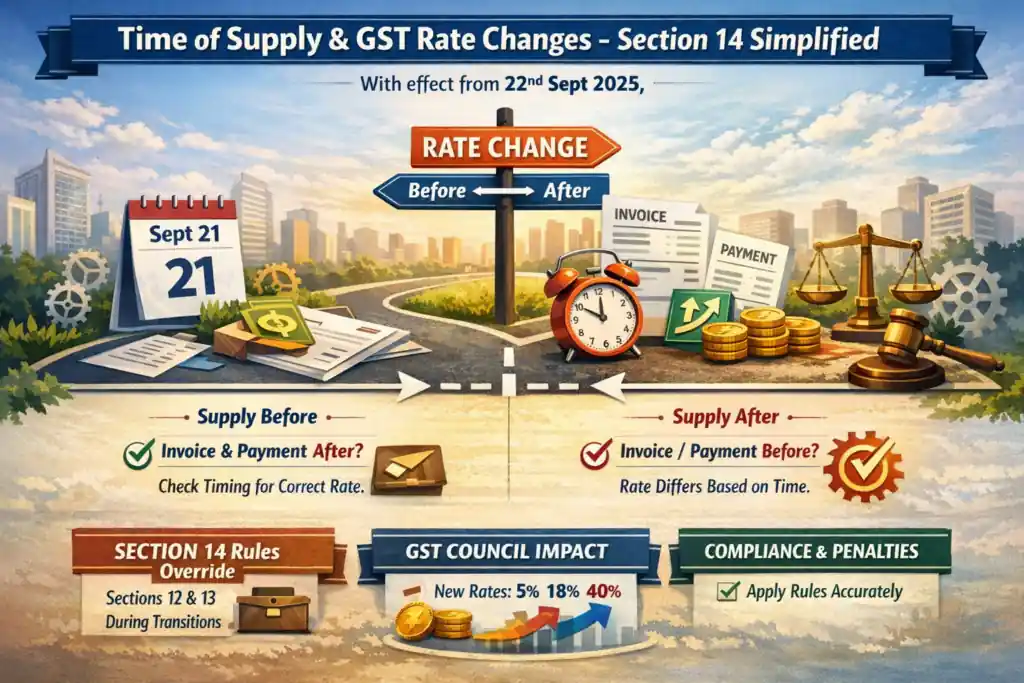
Time of Supply Under GST Rate Changes: Understanding Section 14 of the CGST Act

When GST rates change, determining the correct tax rate is not always straightforward. Businesses must carefully evaluate when the supply is deemed to occur, especially when supply, invoicing, and payment happen on different dates.

With several GST rate revisions coming into effect from 22 September 2025 following recommendations of the GST Council, businesses must now apply the provisions of Section 14 of the Central Goods and Services Tax Act, 2017 to determine the correct tax rate.

Section 14 specifically deals with taxability when there is a change in the GST rate, and it overrides the general time of supply provisions under Sections 12 and 13 during such transitions.

Understanding this rule is essential to ensure accurate GST compliance and avoid tax disputes or penalties.

What Is Time of Supply Under GST?

Under the GST framework, the time of supply determines the point at which tax becomes payable.

Normally, the time of supply is determined under:

  • Section 12 – Time of supply for goods
  • Section 13 – Time of supply for services

However, when there is a GST rate change, these provisions are temporarily overridden by Section 14, which introduces specific rules for determining the applicable rate.

Why Section 14 Becomes Important During GST Rate Changes

When GST rates change, transactions may span across different timelines.

For example:

  • Supply may occur before the rate change
  • Invoice may be issued after the rate change
  • Payment may be received either before or after the change

Without clear rules, such scenarios could lead to confusion, inconsistent tax treatment, and disputes with tax authorities.

Section 14 ensures uniform application of GST rates during transitional periods.

Key Scenarios Under Section 14 of the CGST Act

Section 14 provides rules for determining the applicable GST rate based on the timing of three key events:

  • Date of supply
  • Date of invoice
  • Date of payment

Scenario 1: Supply Before Rate Change

If the supply occurs before the GST rate change, the applicable rate depends on the timing of the invoice and payment.

Examples include:

  • Supply before rate change and invoice issued after → Payment timing determines the applicable rate
  • Supply before rate change and payment received before → Old rate may apply

This requires careful review of both invoicing records and payment dates.

Scenario 2: Supply After Rate Change

If the supply occurs after the GST rate change, the applicable rate may still depend on whether the invoice or payment was made before the change.

For example:

  • Supply after rate change but invoice issued earlier
  • Supply after rate change but payment received earlier

In such cases, Section 14 rules determine whether the old GST rate or new GST rate should apply.

GST Rate Changes Following the 56th GST Council Meeting

The 56th meeting of the GST Council introduced several changes to GST rate slabs across different sectors.

Certain goods and services have now moved to revised tax brackets, including:

  • 5% GST slab
  • 18% GST slab
  • 40% GST slab in specific cases

These rate changes make it even more critical for businesses to apply Section 14 correctly when transactions cross the rate-change date of 22 September 2025.

Compliance Risks if Time of Supply Rules Are Misapplied

Incorrect application of Section 14 provisions may lead to multiple compliance risks, such as:

  • Incorrect GST rate applied on invoices
  • Mismatches between GSTR-1 and GSTR-3B returns
  • ITC disputes with recipients
  • Possible tax demands, interest, and penalties

Therefore, finance teams must carefully evaluate transaction timelines and supporting documentation.

Best Practices for Businesses During GST Rate Transitions

To avoid compliance issues, businesses should take the following steps:

Review Pending Transactions

Identify transactions where supply, invoicing, or payment fall across the rate change date.

Update ERP and Accounting Systems

Ensure ERP systems correctly capture the applicable GST rate based on Section 14 logic.

Train Finance and Billing Teams

Accounting teams must understand how time of supply rules change during GST rate transitions.

Maintain Proper Documentation

Maintain clear records of supply dates, invoice dates, and payment receipts to support the tax treatment applied.

Final Thoughts

GST rate changes often create transitional complexities for businesses. Section 14 of the CGST Act plays a critical role in ensuring consistency and clarity during these periods.

With the new rate revisions coming into effect from 22 September 2025, businesses must carefully determine the time of supply to apply the correct GST rate.In many cases, the difference between compliance and non-compliance comes down to correctly identifying when the supply is deemed to occur.

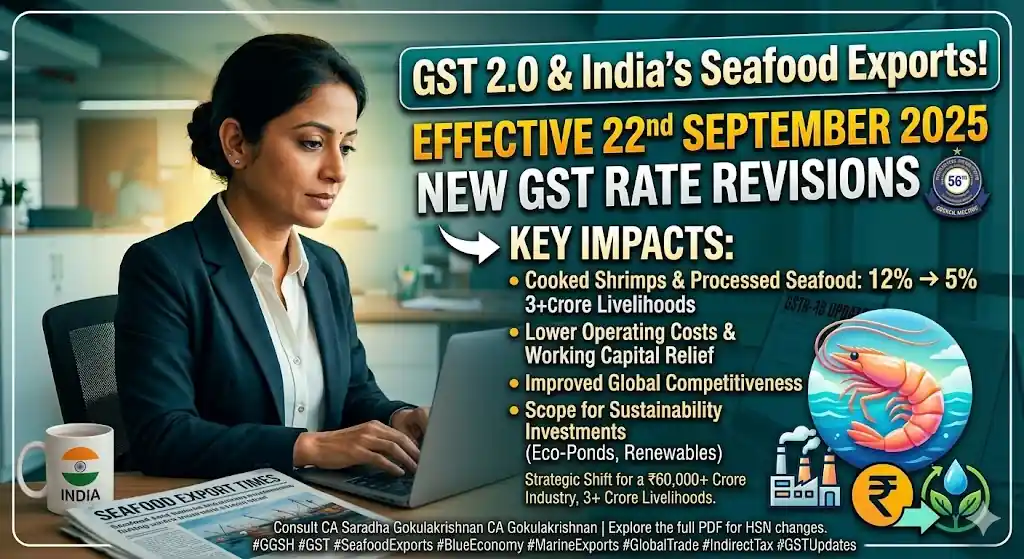
GST 2.0 and India’s Seafood Exports: How GST Rate Changes Will Impact the Marine Export Industry

India’s seafood and marine export sector is set to experience a significant shift following the GST rate rationalisation measures announced during the 56th meeting of the GST Council.

Effective 22 September 2025, revised GST rates on several processed seafood products and marine exports will reshape the cost structure for exporters, processors, and aquaculture businesses across the country.

These changes are widely viewed as part of the evolving GST 2.0 reform framework, aimed at improving industry competitiveness, reducing tax inefficiencies, and supporting strategic sectors in the Indian economy.

For the seafood sector — a major contributor to India’s export revenue and coastal livelihoods — this policy shift may create new opportunities for growth and sustainability.

Key GST Rate Changes for the Seafood and Marine Sector

One of the most notable announcements under the GST reforms is the reduction in GST rates on certain processed seafood products.

GST Rate Reduction

  • Cooked shrimp and processed seafood products:
    GST reduced from 12% to 5%

This tax rationalisation significantly lowers the indirect tax burden on seafood processing units and exporters, enabling better pricing competitiveness in global markets.

The change also reduces the working capital blockage associated with higher GST rates.

Why These GST Changes Matter for the Seafood Industry

India’s seafood sector plays a critical role in the national economy, supporting millions of livelihoods and contributing substantially to export earnings.

According to industry estimates:

  • The sector supports over 3 crore livelihoods, including fishermen, aquaculture farmers, processors, and logistics providers.
  • India’s seafood exports contribute more than ₹60,000 crore annually to the economy.

By lowering GST rates on processed seafood, policymakers aim to strengthen the global competitiveness of Indian marine products.

Benefits for Seafood Exporters and Processors

The GST rate reduction may generate several operational and financial advantages for businesses in the marine export value chain.

1. Reduced Operating Costs

Lower GST rates reduce the tax component embedded in processed seafood products, allowing processors to optimize production costs and improve profit margins.

2. Improved Working Capital Efficiency

High GST rates often result in greater working capital blockage until refunds or adjustments are processed.

The rate reduction helps ease cash flow pressure for seafood processors and exporters.

3. Greater Global Competitiveness

India competes with major seafood exporting nations such as Vietnam, Thailand, and Ecuador.

A lower GST burden enables Indian exporters to price products more competitively in international markets.

4. Encouragement for Sustainable Investments

The improved financial environment may also encourage investments in sustainable aquaculture practices, including:

  • eco-friendly shrimp farming systems
  • renewable energy solutions for aquaculture farms
  • improved cold chain infrastructure
  • environmentally responsible marine processing facilities

These developments align with India’s broader Blue Economy strategy, which focuses on sustainable use of ocean resources for economic growth.

Operational Changes Businesses Must Implement

Although the GST rate reduction provides benefits, businesses must also take several operational steps to ensure proper implementation.

Key areas requiring attention include:

HSN Code Re-Mapping

Businesses must verify the correct HSN classification for seafood products to ensure the revised GST rate is applied correctly.

SKU Repricing

Companies must update:

  • product pricing structures
  • invoices and billing systems
  • export contracts

This ensures that GST changes are accurately reflected in commercial transactions.

ERP and Accounting System Updates

GST rate changes require updates across ERP systems, accounting software, and billing platforms to prevent tax calculation errors.

Cash Flow and Export Planning

Exporters should review working capital cycles, refund planning, and shipment schedules to align with the new GST structure.

GST Policy and the Future of India’s Blue Economy

The GST rate reduction for seafood products signals a broader shift in how tax policy is being used to support strategic sectors of the Indian economy.

Rather than focusing solely on revenue collection, tax reforms are increasingly aimed at improving:

  • export competitiveness
  • industry sustainability
  • supply chain resilience

For the seafood industry, this represents an important step toward building a stronger and more sustainable Blue Economy.

Final Thoughts

The GST rate rationalisation measures effective 22 September 2025 represent a significant opportunity for India’s seafood and marine export sector.

By reducing GST rates on processed seafood products, the government has taken a step toward enhancing global competitiveness while supporting millions of livelihoods dependent on the marine economy.

However, successful implementation will require businesses to adapt quickly through HSN reclassification, system updates, and operational planning.Ultimately, the takeaway is clear: modern tax policy is not just about rates — it is about resilience, competitiveness, and sustainable growth.

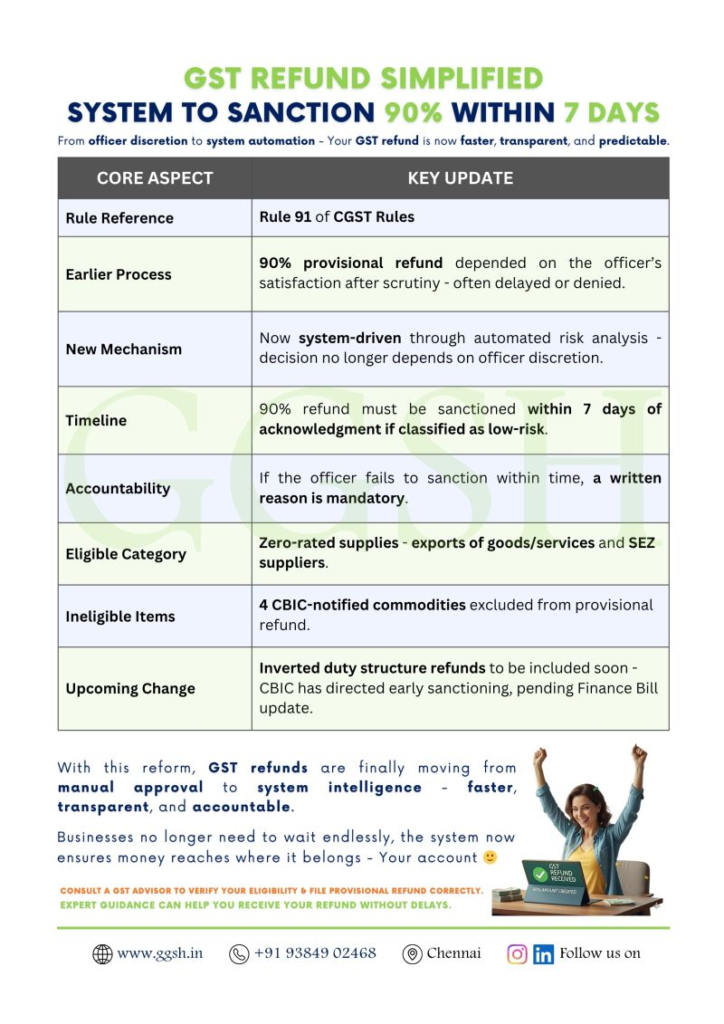
GST Refunds in India to Get Faster: 90% Refunds Likely Within 7 Days with Automation

For years, businesses have often joked that when it comes to GST refunds in India, patience doesn’t pay — it delays.

But now, that narrative is finally changing.

With increasing automation in the GST system, nearly 90% of GST refunds are expected to be processed within just 7 days, marking a significant shift toward a faster, system-driven refund mechanism.

The Problem with GST Refund Delays

Traditionally, taxpayers faced multiple challenges in claiming GST refunds:

  • Heavy reliance on manual officer verification
  • Frequent follow-ups with tax authorities
  • Delays in processing timelines
  • Lack of transparency in application status

This created cash flow issues, especially for:

  • Exporters
  • Small and medium businesses
  • Service providers

The Big Shift: Automated GST Refund Processing

The transformation is being driven by technology upgrades led by the Goods and Services Tax Network (GSTN).

Key Highlights of the New System:

  • Up to 90% of GST refunds to be processed automatically
  • Refund timelines reduced to around 7 days
  • Minimal or no officer intervention
  • End-to-end system-driven verification and approval

How the New GST Refund System Works

The automated refund system relies on:

  • Data matching across GST returns
  • Pre-validated information from filings
  • Risk-based processing for exception cases

Only cases flagged as high-risk or mismatched may require manual scrutiny.

Benefits of Faster GST Refunds

1. Improved Cash Flow

Businesses receive refunds quicker, improving working capital management.

2. Reduced Compliance Burden

  • No repeated follow-ups
  • Less dependency on officers

3. Greater Transparency

  • Clear tracking of refund status
  • Reduced uncertainty in timelines

4. Boost for Exporters

Exporters benefit significantly as input tax credit (ITC) refunds are processed faster.

Who Will Benefit the Most?

This reform is especially beneficial for:

  • Exporters claiming GST refunds
  • MSMEs and small businesses
  • Tax professionals and consultants
  • Companies with regular refund claims

Challenges to Keep in Mind

While automation brings efficiency, businesses must ensure:

  • Accurate GST return filings
  • Proper reconciliation of data
  • Timely submission of refund applications

👉 Any mismatch or error may still lead to delays or manual intervention.

A Step Toward Digital GST Ecosystem

This move reflects the government’s continued focus on:

  • Digital transformation in taxation
  • Reducing human intervention
  • Improving ease of doing business in India

The shift from an officer-driven system to a technology-driven process is a major milestone in GST reforms.

Conclusion

The move toward automated GST refunds with 7-day processing timelines is a game-changer for businesses across India.

By reducing delays and improving efficiency, the GST system is becoming more predictable, transparent, and business-friendly.

Final Thoughts 💬

From “patience delays” to “automation delivers” — GST refunds are finally evolving.Are you ready to benefit from the new fast-track GST refund system?

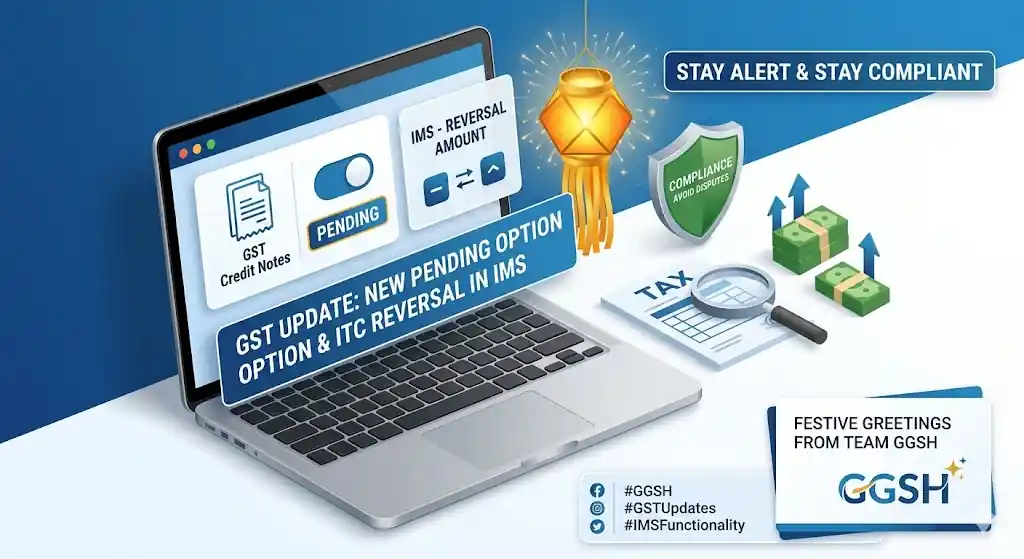
GST Invoice Management System (IMS) Update: “Pending” Option for Credit Notes Introduced by GSTN

The Goods and Services Tax Network (GSTN) has introduced a significant update in the Invoice Management System (IMS) on the GST portal, aimed at improving how businesses handle credit notes and Input Tax Credit (ITC) reversals.

Under this update, taxpayers can now mark credit notes as “Pending” for one tax period within the IMS module. This enhancement offers businesses greater flexibility in managing ITC reversals, supplier–recipient reconciliations, and GST dispute resolution.

The update is particularly relevant in the current business environment, where many companies are issuing post-sale discounts, price adjustments, and festive season credit notes, especially in light of the broader GST 2.0 changes.

What Is the Invoice Management System (IMS) in GST?

The Invoice Management System (IMS) is a functionality available on the GST portal that allows taxpayers to view, accept, reject, or keep invoices and credit notes pending before they impact Input Tax Credit (ITC) calculations.

IMS helps businesses manage:

  • Supplier invoice validation
  • Credit note acceptance
  • ITC eligibility verification
  • Reversal and adjustment of tax credits

This system plays a crucial role in GST return reconciliation and ITC accuracy.

New “Pending” Option for Credit Notes

With the latest enhancement by the Goods and Services Tax Network, taxpayers now have the ability to keep credit notes in a “Pending” status for one tax period instead of immediately accepting or rejecting them.

Why This Matters

Earlier, businesses were often required to immediately accept or reject credit notes, which sometimes created challenges when:

  • Commercial disputes were still under discussion
  • Price adjustments were not finalized
  • Supporting documentation was pending

The “Pending” option now gives businesses additional time to review transactions before confirming ITC reversals.

Flexibility in ITC Reversal Through IMS

Another key improvement in the IMS functionality is the flexibility provided to taxpayers regarding ITC reversals.

Once a credit note is accepted in IMS, taxpayers can now modify the corresponding ITC reversal amount, allowing adjustments that reflect the actual commercial agreement between supplier and recipient.

This enhancement helps reduce:

  • Supplier-recipient disputes
  • Incorrect ITC reversals
  • Compliance errors in GST returns

It also improves transparency and reconciliation accuracy in GST reporting.

Why This Update Is Important Now

The introduction of the Pending option for credit notes comes at a crucial time for businesses.

Several factors are increasing the volume of credit notes in the GST system:

1. Festive Season Discounts and Adjustments

During festive periods, businesses often offer promotional discounts, sales incentives, and post-sale price adjustments, leading to a higher number of credit notes.

2. GST 2.0 Changes and Pricing Revisions

Recent GST rate rationalisation and GST 2.0 reforms have led to adjustments in pricing and tax structures, resulting in additional credit note issuance across industries.

3. Time Limit for Issuing Credit Notes for FY 2024-25

Businesses must also remember the statutory time limit for issuing credit notes relating to FY 2024-25 transactions.

Proper management of these credit notes within the IMS system is essential to ensure correct ITC reporting and GST compliance.

Key Compliance Tips for Businesses

To fully benefit from the updated GST IMS functionality, businesses should take the following steps:

Review Credit Notes Carefully

Ensure that all credit notes received from suppliers are reviewed before acceptance to avoid incorrect ITC reversals.

Use the “Pending” Option Strategically

If there are commercial discussions or documentation gaps, businesses can temporarily keep credit notes in Pending status for one tax period.

Reconcile ITC Adjustments

Accounting teams should regularly reconcile IMS data with purchase registers and GSTR-2B statements.

Train Finance and GST Teams

Tax professionals and finance teams should be trained on how the new IMS features impact ITC reversals and return filing.

Final Thoughts

The introduction of the “Pending” option for credit notes in the GST Invoice Management System marks a positive step toward flexible, technology-driven GST compliance.

By allowing businesses more time to evaluate credit notes and adjust ITC reversals appropriately, the update reduces disputes and enhances accuracy in GST return filings.

As businesses navigate festive season transactions, GST 2.0 changes, and credit note deadlines for FY 2024-25, staying updated with these system enhancements is essential.

Proactive compliance and proper use of the IMS features can help businesses avoid disputes, litigation, and unnecessary tax adjustments.

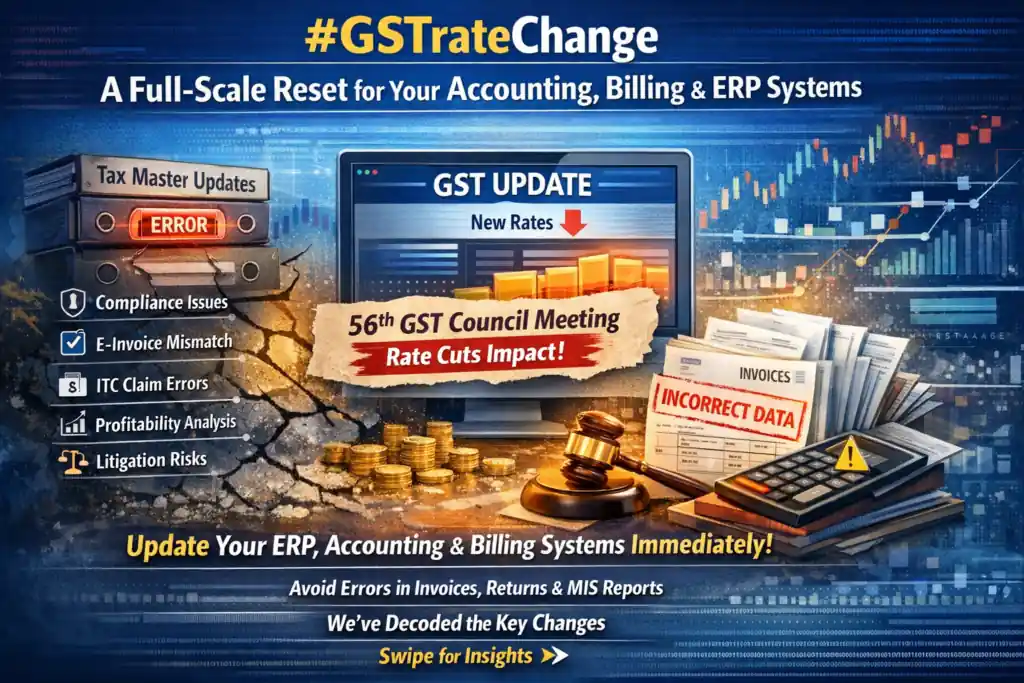
GST Rate Changes and ERP System Updates: What Businesses Must Do After the 56th GST Council Meeting

A GST rate change is far more than simply applying a new tax percentage on invoices. For businesses, it triggers a full-scale reset across accounting systems, billing software, and ERP configurations.

With the recommendations from the 56th meeting of the GST Council, several GST rate adjustments have been introduced across industries. These changes require businesses to immediately update their ERP systems and accounting workflows to prevent compliance errors.

Failure to properly implement these updates can lead to invoice mismatches, incorrect Input Tax Credit (ITC) claims, reporting discrepancies, and potential litigation risks.

Why GST Rate Changes Impact ERP and Accounting Systems

When a GST rate revision occurs, it affects multiple operational layers within an organization. The tax percentage is not only reflected on invoices but also influences tax masters, product classifications, return filings, and financial reporting systems.

A single incorrect configuration in an ERP or billing system can result in:

  • Incorrect GST calculation on invoices
  • Mismatches in e-invoice reporting
  • Errors in GST returns such as GSTR-1 or GSTR-3B
  • Incorrect Input Tax Credit (ITC) claims
  • Distorted profitability and MIS reports

Therefore, ERP and accounting systems must be updated promptly to ensure tax accuracy and compliance under the GST framework.

Key ERP and Accounting Updates Businesses Must Implement

Businesses must conduct a systematic review of their tax configuration across ERP and accounting software.

1. Update Tax Master Data

The tax master configuration in ERP systems must reflect the updated GST rates.

This includes:

  • Revised GST percentages
  • Updated HSN/SAC tax mappings
  • Correct tax applicability for different product categories

Incorrect tax master settings can cause system-wide calculation errors across invoices and returns.

2. Reconfigure Sector-Specific ERP Settings

Certain industries have special ERP configurations based on GST treatment, including:

  • manufacturing companies
  • trading businesses
  • service providers
  • export-oriented units

Each sector may require specific tax rule adjustments within the ERP environment to align with the latest GST rate changes.

3. Update Billing and Invoicing Systems

Billing systems must be aligned with the updated tax structure to ensure:

  • Correct GST calculation on invoices
  • Accurate e-invoice generation
  • Proper GST reporting in sales registers

Errors at the invoicing stage often cascade into compliance mismatches across the entire tax reporting cycle.

4. Review Input Tax Credit (ITC) Mapping

Changes in GST rates can affect Input Tax Credit eligibility and reporting structures.

Businesses must review:

  • ITC mapping rules
  • purchase tax configurations
  • reconciliation processes

This ensures accurate ITC claims and avoids disputes during GST audits or assessments.

5. Align MIS and Financial Reporting

GST rate updates can also influence profitability analysis, cost allocation, and management reporting.

Companies must ensure their MIS reports and financial dashboards reflect the updated tax treatment to maintain accurate business performance analysis.

Risks of Not Updating ERP Systems After GST Rate Changes

Businesses that delay ERP updates after GST rate changes may face multiple compliance and operational risks.

These include:

  • GST return mismatches
  • e-invoice validation failures
  • incorrect tax payments
  • ITC disputes
  • potential litigation with tax authorities

Early system updates help businesses maintain smooth compliance and avoid costly corrections later.

Why Proactive GST System Updates Are Critical

GST compliance is increasingly technology-driven, especially with the integration of:

  • e-invoicing systems
  • automated return matching
  • digital GST audits

As a result, even minor system configuration errors can create large-scale reporting discrepancies across multiple tax filings.

Proactive ERP configuration updates ensure businesses remain fully compliant with evolving GST regulations.

Final Thoughts

The GST rate revisions introduced after the 56th GST Council meeting highlight the importance of aligning technology systems with tax regulations.

Businesses should treat GST rate changes not merely as tax adjustments but as a comprehensive operational update across accounting, billing, and ERP platforms.By updating systems early and correctly, organizations can avoid compliance issues and ensure accurate financial and tax reporting.

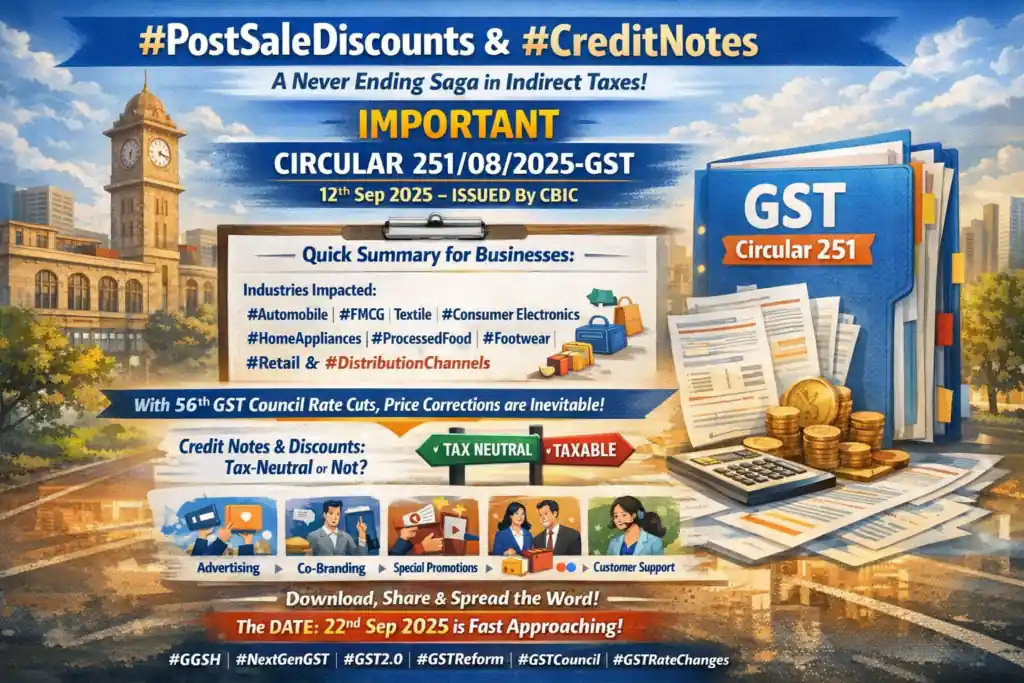
GST Circular 251/08/2025 Explained: Post-Sale Discounts and Credit Notes Under GST

The treatment of post-sale discounts and credit notes under GST has always been one of the most debated topics in the history of indirect taxation in India. From the pre-GST regime to the current GST framework, businesses have frequently faced challenges in determining whether discounts should impact the taxable value and input tax credit adjustments.

A new clarification has now been issued through GST Circular No. 251/08/2025-GST dated 12 September 2025 by the Central Board of Indirect Taxes and Customs. The circular provides important guidance on the GST treatment of post-sale discounts, incentives, and credit notes, particularly in light of the recent rate rationalisation recommended during the 56th meeting of the GST Council.

For businesses across industries, this circular represents a significant development in understanding when discount-related credit notes remain tax neutral and when they attract GST implications.

Why GST Circular 251 Is Important for Businesses

The recent GST rate changes recommended by the GST Council have led to price adjustments across many sectors. As a result, many companies are expected to issue post-sale discounts or financial adjustments to distributors, dealers, or customers.

This circular helps clarify:

  • When credit notes can be issued without affecting GST liability
  • When certain incentives or payments are treated as taxable supply of services
  • How businesses should structure their sales promotion arrangements

These clarifications are particularly important for companies that regularly provide dealer incentives, promotional discounts, or marketing support payments.

Key Focus of the Circular: Credit Notes and Tax Neutrality

One of the core objectives of the circular is to clarify whether post-sale discounts can reduce the taxable value under GST.

In certain situations, credit notes issued for discounts may remain tax-neutral, meaning they do not trigger additional GST implications.

However, if the payment relates to services provided by the recipient, such as promotional or marketing activities, the transaction may be treated as a taxable supply of services under GST.

This distinction is crucial for businesses that offer performance-based incentives or promotional reimbursements.

Industries Most Impacted by the Circular

Several industries are likely to be affected by the clarifications provided in GST Circular 251/08/2025.

Industries with complex distribution and promotional structures are particularly impacted, including:

  • Consumer goods and FMCG companies
  • Automobile sector
  • Electronics and appliances industry
  • Pharmaceutical distribution networks
  • Retail and wholesale trading businesses

These sectors often rely on dealer incentives, rebates, marketing reimbursements, and volume discounts, making the new guidance highly relevant.

Sales Promotion Activities That May Require Restructuring

The circular indicates that certain sales promotional arrangements may need restructuring to ensure proper GST compliance.

Examples of promotional activities that may require review include:

  • Advertising campaigns conducted by distributors
  • Co-branding arrangements
  • Product customization services
  • Special sales drives and promotional events
  • Exhibition or marketing arrangements
  • Customer support services provided by channel partners

If these activities are treated as services supplied by the distributor or dealer, GST may become applicable on the consideration received.

Why Businesses Should Review Their Agreements

Many companies structure their dealer incentive schemes and marketing support arrangements through credit notes.

However, if the underlying transaction actually represents consideration for a service, the tax authorities may treat it as a taxable supply rather than a discount.

Businesses should therefore carefully review:

  • Distribution agreements
  • incentive schemes
  • marketing support arrangements
  • pricing adjustment mechanisms

A proper review can help avoid future tax disputes, GST demands, or input tax credit complications.

Upcoming Compliance Timeline Businesses Should Note

Businesses should be aware that 22 September 2025 is an important date in relation to the changes discussed in the circular.

Companies must ensure that their commercial arrangements, documentation, and GST treatment of credit notes are aligned with the new clarification before the effective implementation timeline.

Early preparation will help organizations avoid compliance risks and operational disruptions.

Final Thoughts

The clarification issued through GST Circular 251/08/2025-GST marks another important milestone in the evolving interpretation of post-sale discounts and credit notes under the GST framework.

For businesses, this is the right time to:

  • Review sales promotion structures
  • reassess credit note practices
  • align dealer incentive models with GST regulations

Proactive planning will help businesses maintain tax neutrality where possible while avoiding unintended GST liabilities.

RoDTEP Annual Return Due Date Extended to 30 November 2025: Relief for Indian Exporters

Indian exporters have received a significant compliance relief with the extension of the RoDTEP Annual Return filing deadline for FY 2023–24. Businesses that were concerned about missing the earlier deadline now have additional time to complete their filings accurately.

The extension has been officially announced by the Directorate General of Foreign Trade, commonly known as DGFT, providing exporters a valuable opportunity to ensure proper documentation and compliance under the Remission of Duties and Taxes on Exported Products (RoDTEP) Scheme.

Under the revised timeline, exporters can now submit their RoDTEP Annual Return for FY 2023–24 until 30 November 2025, instead of the earlier deadline of 30 September 2025.

Importantly, the ₹10,000 composition fee requirement remains unchanged.

What Is the RoDTEP Scheme?

The Remission of Duties and Taxes on Exported Products (RoDTEP) Scheme is a flagship export incentive initiative introduced by the Government of India to refund embedded taxes and duties that are not otherwise refunded through GST or other mechanisms.

The scheme aims to:

  • Enhance global competitiveness of Indian exporters
  • Reduce hidden costs in export supply chains
  • Support Make in India manufacturing and exports

Exporters receive RoDTEP credits which can be used for duty payment or transferred as tradable scrips.

Because of its financial benefits, timely filing of the RoDTEP Annual Return is critical for exporters who wish to continue claiming benefits under the scheme.

Revised RoDTEP Annual Return Filing Deadline

The extension provides exporters with two additional months to complete their filings.

Updated Timeline

  • Financial Year Covered: FY 2023–24
  • Original Due Date: 30 September 2025
  • Extended Due Date: 30 November 2025
  • Composition Fee: ₹10,000 (unchanged)

The extension ensures exporters have adequate time to review their export documentation, reconcile claims, and avoid errors in the annual return.

Why This Extension Is Important for Exporters

The extension is more than just an additional compliance window. It offers exporters an opportunity to improve the accuracy and completeness of their RoDTEP filings.

1. Additional Time for Documentation Review

Exporters often manage multiple documents such as shipping bills, invoices, and export records. The extension allows them to reconcile these records properly before submission.

2. Better Quality Filing Instead of Rushed Compliance

Instead of filing hurried returns to meet the deadline, exporters can now review claims carefully and avoid mistakes that could delay RoDTEP benefits.

3. Protection of RoDTEP Credits

Missing the filing deadline could potentially affect eligibility for RoDTEP benefits. The extension reduces the risk of exporters losing valuable incentives.

Avoid Last-Minute Compliance Rush

Although the deadline extension provides relief, exporters should avoid treating it as an excuse to delay compliance.

The months of October and November are often packed with financial reporting, export documentation, and year-end activities for many businesses.

Completing the filing early allows exporters to:

  • Reduce compliance stress
  • Avoid technical portal issues near the deadline
  • Ensure accurate reporting

Proper planning ensures exporters can maximize their RoDTEP benefits without facing last-minute challenges.

How Exporters Can Prepare for RoDTEP Annual Return Filing

To ensure smooth filing, exporters should begin preparing the following documents:

  • Shipping bills and export documentation
  • RoDTEP claim records
  • Export turnover details
  • GST and customs reconciliations
  • Supporting financial data

A structured review of these records will help exporters file accurate RoDTEP returns and avoid compliance errors.

Final Thoughts

The extension of the RoDTEP Annual Return deadline to 30 November 2025 is a welcome move that provides exporters additional time to ensure proper compliance and secure their incentive benefits.

However, exporters should use this window wisely by focusing on accurate filing, documentation review, and timely submission.Proper compliance today helps businesses maximize export incentives and strengthen their global competitiveness.

GST Next Generation Reforms: Comprehensive Guide to the 56th GST Council Meeting Recommendations

The recommendations emerging from the 56th meeting of the GST Council have sparked significant discussions across industries, tax professionals, and businesses in India. These reforms are being widely viewed as part of the next generation of GST reforms, aimed at simplifying the tax structure and improving compliance efficiency.

However, with multiple announcements, press releases, and sector-specific updates, many professionals are finding it difficult to track the complete picture of GST rate changes and regulatory updates.

To address this challenge, the GGSH Indirect Tax Advisory Team has prepared a comprehensive GST reform guidance document, offering a structured and practical interpretation of the recommendations from the 56th GST Council meeting.

This guide is designed as a one-stop reference for businesses, accountants, finance professionals, and tax consultants navigating the upcoming GST transition.

A One-Stop Guide to the GST Next Generation Reforms

The comprehensive guide developed by the GGSH Indirect Tax Advisory Team aims to simplify complex updates and provide clear sector-wise insights into the latest GST changes.

The document is structured in a unique and practical format, allowing readers to quickly understand:

  • GST rate revisions across industries
  • Implementation steps for businesses
  • Practical impact on compliance and operations

This approach ensures that stakeholders can translate policy announcements into actionable business decisions.

Sector-Wise GST Rate Changes Explained

One of the most important sections of the guide provides a sector-wise analysis of GST rate changes recommended by the GST Council.

The document clearly identifies:

  • GST rate increases
  • GST rate reductions
  • New exemptions or relief measures

By presenting these updates industry by industry, businesses can easily understand how GST reforms affect their specific sector.

Industries covered include multiple segments across manufacturing, services, and emerging sectors impacted by the reforms.

Practical Implementation Guidance for Businesses

Understanding a tax rate change is only the first step. The real challenge lies in implementing the changes within business systems and processes.

The guide therefore includes clear action points for businesses, helping them adapt to the new tax environment.

Key implementation guidance includes:

  • Updating billing and invoicing systems
  • Revising pricing strategies
  • Adjusting ERP and accounting software configurations
  • Ensuring correct GST classification for products and services

This practical orientation makes the guide particularly valuable for finance teams, accountants, and tax departments.

Impact Analysis Beyond GST Rate Changes

While GST rate revisions attract the most attention, the 56th GST Council meeting also introduced several policy and regulatory changes beyond tax rates.

The GGSH guide provides a detailed impact analysis of these non-rate recommendations, helping stakeholders understand their broader implications.

These insights assist businesses in preparing for:

  • Regulatory adjustments
  • compliance changes
  • sector-specific policy shifts

Such analysis is critical for organizations that want to remain proactive rather than reactive in managing tax changes.

Supporting Businesses Through the GST Transition

The reforms discussed during the 56th GST Council meeting represent an important transition phase in India’s indirect tax system.

As businesses adapt to the GST Next Generation reforms, clear guidance and structured interpretation will play a vital role in ensuring smooth implementation.

By compiling all relevant changes into a single comprehensive reference, the GGSH Indirect Tax Advisory Team aims to help stakeholders:

  • Understand the reforms quickly
  • Implement them correctly
  • Reduce compliance risks

Who Should Read This GST Reform Guide?

The guide is designed to benefit a wide range of professionals and decision-makers, including:

  • Industry business heads
  • Finance heads
  • tax heads
  • accountants
  • tax consultants
  • GST practitioners
  • compliance professionals
  • entrepreneurs and business owners

Even general citizens interested in understanding the evolving GST framework in India may find the guide informative.

Download and Share the GST Reform Guide

Stakeholders are encouraged to download the comprehensive guide and share it widely with professionals across industries.

Wider awareness of GST reforms ensures smoother adoption and better compliance across the business ecosystem.

Join the Discussion on GST Next Generation Reforms

The GST Next Generation reforms mark another step in the evolution of India’s indirect tax system.

However, their success will ultimately depend on effective implementation, stakeholder understanding, and continuous policy review.

What are your thoughts on these reforms?

How do you think they will impact your industry or business sector?Share your views and join the discussion on the future of GST in India.