

Exporters operating under the Goods and Services Tax (GST) framework must constantly evaluate how tax rate changes affect their working capital and refund cycles. One of the most important areas impacted by GST policy updates is exports with payment of Integrated GST (IGST).
Recent developments following the 56th meeting of the GST Council have significant implications for exporters who choose to export goods or services with payment of IGST and claim refunds.
Changes in IGST rates directly influence cash flow planning, Input Tax Credit (ITC) utilisation, and refund timelines, making proactive financial planning essential for export businesses.
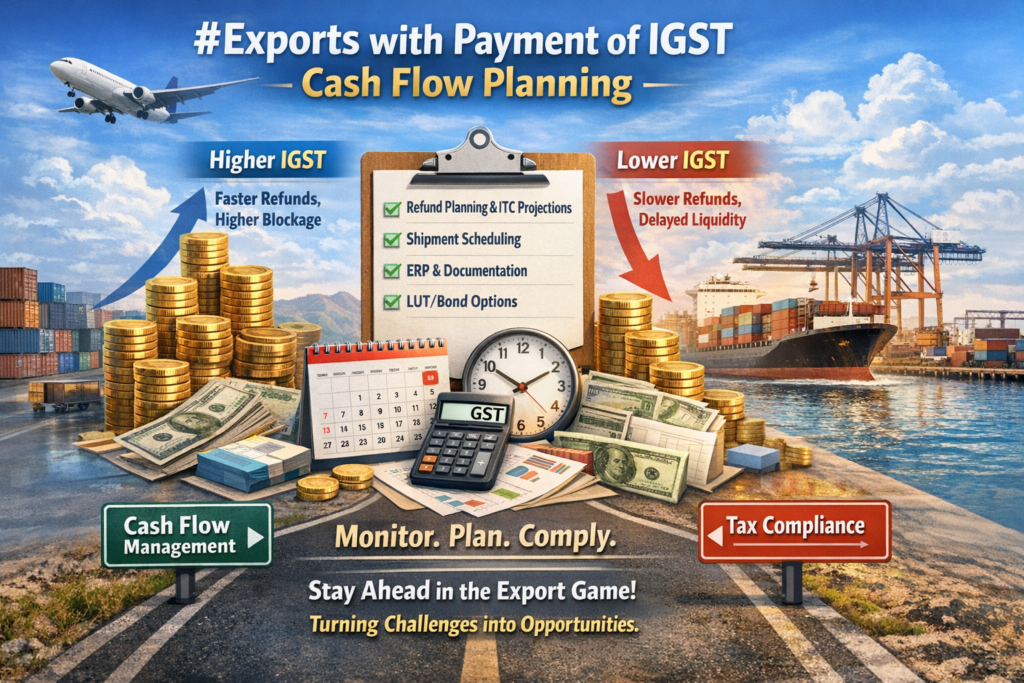
Understanding Exports with Payment of IGST
Under the GST framework, exporters generally have two options when supplying goods or services outside India:
- Export with payment of IGST and claim refund
- Export without payment of tax under LUT/Bond and claim ITC refund
When exporters choose the IGST payment route, they pay IGST on exports and subsequently claim a refund of the tax paid once the export documentation is validated.
This method often allows for faster refund processing, but it also affects working capital management, particularly when IGST rates change.
How IGST Rate Changes Affect Exporter Cash Flow
Changes in IGST rates can significantly influence how quickly exporters can convert Input Tax Credit (ITC) into cash refunds.
Scenario 1: Higher IGST Rate
When the IGST rate increases:
- Exporters pay higher tax at the time of export
- Input Tax Credit gets liquidated faster
- However, there is greater upfront working capital blockage
This may create short-term cash flow pressure, especially for exporters with large shipment volumes.
Scenario 2: Lower IGST Rate
When the IGST rate decreases:
- Exporters pay lower tax at the time of export
- Immediate cash outflow is reduced
- However, ITC accumulation may increase
This can result in slower conversion of ITC into cash refunds, affecting liquidity planning for some businesses.
Key Areas Exporters Must Monitor
To manage these implications effectively, exporters must closely track several operational and compliance factors.
1. Refund Planning and ITC Projections
Exporters should regularly monitor:
- Monthly Input Tax Credit accumulation
- Expected IGST refunds
- Cash flow projections linked to refund timelines
A structured refund planning strategy helps businesses avoid liquidity constraints.
2. Shipment Scheduling Around Rate Changes
When GST rate changes are notified, exporters may consider adjusting shipment schedules strategically.
This can help optimize:
- Tax outflows
- refund timing
- working capital utilisation
However, such planning must always remain commercially practical and compliant with GST regulations.
3. Documentation and ERP System Updates
Changes in IGST rates require updates across several systems, including:
- ERP tax master configurations
- export invoicing systems
- shipping bill documentation
- GST reporting tools
Accurate system updates help avoid refund mismatches, compliance errors, and e-invoice inconsistencies.
4. Evaluating Export Under LUT or Bond
Exporters should also periodically evaluate the alternative option of exporting without payment of tax under LUT/Bond.
Export under LUT allows businesses to:
- Avoid upfront IGST payment
- claim refund of accumulated ITC instead
This approach may be beneficial for exporters seeking to reduce working capital blockage.
However, the choice between IGST payment and LUT export depends on each company’s cash flow structure, refund speed, and ITC availability.
Why Cash Flow Planning Is Critical for Export Businesses
For export-driven organizations, cash flow management is as important as revenue generation.
Delays in refunds, tax rate changes, or incorrect documentation can lead to significant working capital pressure, especially for companies with high export turnover.
By combining refund planning, ERP updates, shipment scheduling, and compliance monitoring, exporters can transform GST changes from operational challenges into strategic financial advantages.
Final Thoughts
The implications of IGST rate changes on exports highlight how tax policy directly influences working capital cycles and refund mechanisms.
Exporters must therefore integrate GST compliance, cash flow planning, and operational strategy to remain financially efficient and compliant.In today’s regulatory environment, smart planning can turn GST complexities into opportunities for better financial management.