

India’s seafood and marine export sector is set to experience a significant shift following the GST rate rationalisation measures announced during the 56th meeting of the GST Council.
Effective 22 September 2025, revised GST rates on several processed seafood products and marine exports will reshape the cost structure for exporters, processors, and aquaculture businesses across the country.
These changes are widely viewed as part of the evolving GST 2.0 reform framework, aimed at improving industry competitiveness, reducing tax inefficiencies, and supporting strategic sectors in the Indian economy.
For the seafood sector — a major contributor to India’s export revenue and coastal livelihoods — this policy shift may create new opportunities for growth and sustainability.
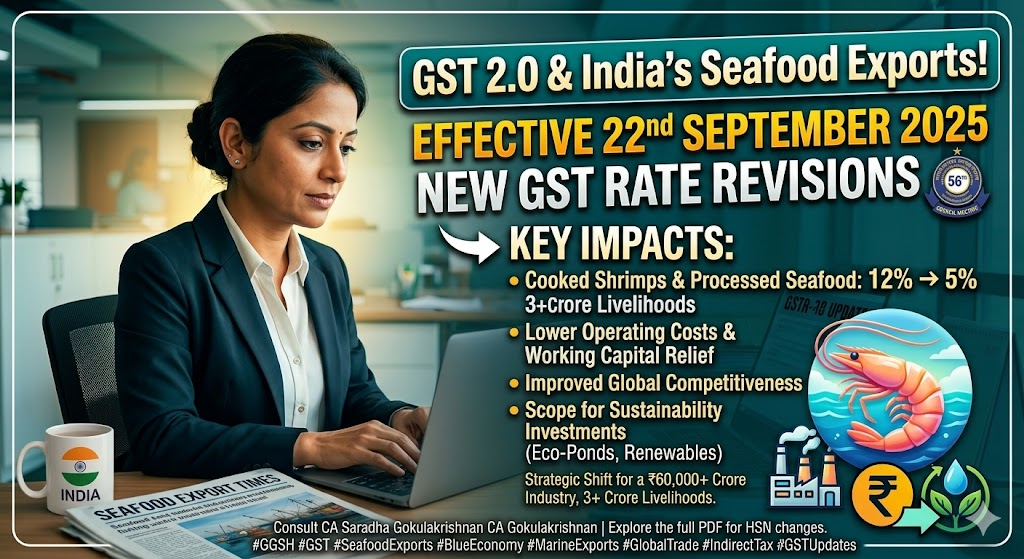
Key GST Rate Changes for the Seafood and Marine Sector
One of the most notable announcements under the GST reforms is the reduction in GST rates on certain processed seafood products.
GST Rate Reduction
- Cooked shrimp and processed seafood products:
GST reduced from 12% to 5%
This tax rationalisation significantly lowers the indirect tax burden on seafood processing units and exporters, enabling better pricing competitiveness in global markets.
The change also reduces the working capital blockage associated with higher GST rates.
Why These GST Changes Matter for the Seafood Industry
India’s seafood sector plays a critical role in the national economy, supporting millions of livelihoods and contributing substantially to export earnings.
According to industry estimates:
- The sector supports over 3 crore livelihoods, including fishermen, aquaculture farmers, processors, and logistics providers.
- India’s seafood exports contribute more than ₹60,000 crore annually to the economy.
By lowering GST rates on processed seafood, policymakers aim to strengthen the global competitiveness of Indian marine products.
Benefits for Seafood Exporters and Processors
The GST rate reduction may generate several operational and financial advantages for businesses in the marine export value chain.
1. Reduced Operating Costs
Lower GST rates reduce the tax component embedded in processed seafood products, allowing processors to optimize production costs and improve profit margins.
2. Improved Working Capital Efficiency
High GST rates often result in greater working capital blockage until refunds or adjustments are processed.
The rate reduction helps ease cash flow pressure for seafood processors and exporters.
3. Greater Global Competitiveness
India competes with major seafood exporting nations such as Vietnam, Thailand, and Ecuador.
A lower GST burden enables Indian exporters to price products more competitively in international markets.
4. Encouragement for Sustainable Investments
The improved financial environment may also encourage investments in sustainable aquaculture practices, including:
- eco-friendly shrimp farming systems
- renewable energy solutions for aquaculture farms
- improved cold chain infrastructure
- environmentally responsible marine processing facilities
These developments align with India’s broader Blue Economy strategy, which focuses on sustainable use of ocean resources for economic growth.
Operational Changes Businesses Must Implement
Although the GST rate reduction provides benefits, businesses must also take several operational steps to ensure proper implementation.
Key areas requiring attention include:
HSN Code Re-Mapping
Businesses must verify the correct HSN classification for seafood products to ensure the revised GST rate is applied correctly.
SKU Repricing
Companies must update:
- product pricing structures
- invoices and billing systems
- export contracts
This ensures that GST changes are accurately reflected in commercial transactions.
ERP and Accounting System Updates
GST rate changes require updates across ERP systems, accounting software, and billing platforms to prevent tax calculation errors.
Cash Flow and Export Planning
Exporters should review working capital cycles, refund planning, and shipment schedules to align with the new GST structure.
GST Policy and the Future of India’s Blue Economy
The GST rate reduction for seafood products signals a broader shift in how tax policy is being used to support strategic sectors of the Indian economy.
Rather than focusing solely on revenue collection, tax reforms are increasingly aimed at improving:
- export competitiveness
- industry sustainability
- supply chain resilience
For the seafood industry, this represents an important step toward building a stronger and more sustainable Blue Economy.
Final Thoughts
The GST rate rationalisation measures effective 22 September 2025 represent a significant opportunity for India’s seafood and marine export sector.
By reducing GST rates on processed seafood products, the government has taken a step toward enhancing global competitiveness while supporting millions of livelihoods dependent on the marine economy.
However, successful implementation will require businesses to adapt quickly through HSN reclassification, system updates, and operational planning.Ultimately, the takeaway is clear: modern tax policy is not just about rates — it is about resilience, competitiveness, and sustainable growth.