

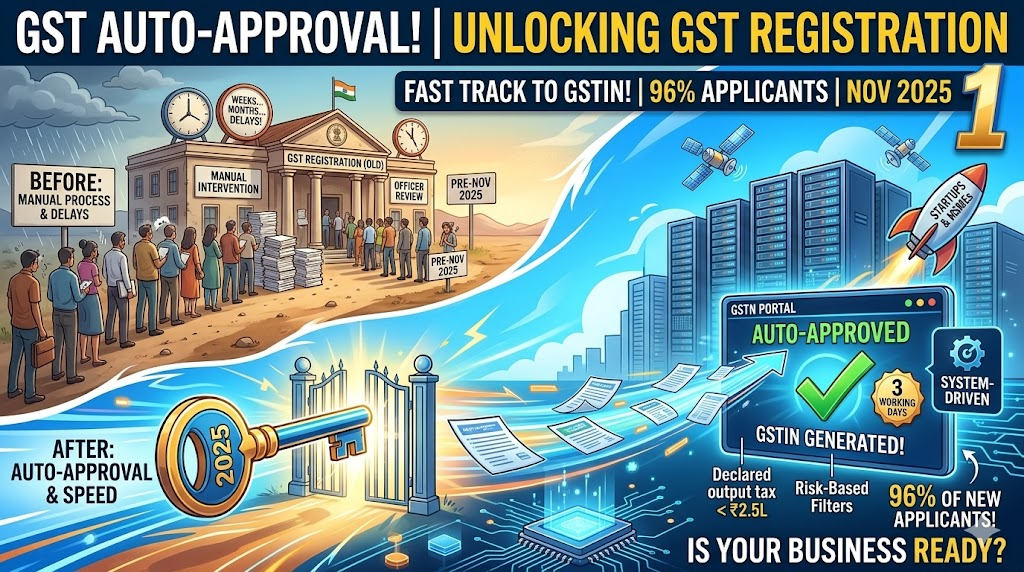
A major transformation is coming to the GST registration process in India. In a move toward automation and ease of doing business, the government is set to introduce an auto-approval mechanism for GST registration starting 1st November 2025.
This reform is expected to benefit nearly 96% of new GST applicants, especially startups, MSMEs, and small businesses, by significantly reducing approval timelines.
What is GST Registration Auto-Approval?
Under the new system, eligible applicants will receive automatic GST registration approval without manual intervention, provided they meet certain risk-based criteria.
This initiative, supported by the Goods and Services Tax Network (GSTN), aims to create a faster, technology-driven GST compliance system.
Key Highlights of the New GST Auto-Approval System
📅 Effective Date
- 1st November 2025
⚡ Faster Approval Timeline
- GST registration approval within 3 working days
🎯 Eligibility Criteria
- Declared monthly output tax liability up to ₹2.5 lakh
- Applicant qualifies under analytics-based risk filters
📊 Coverage
- Expected to benefit around 96% of applicants
How GST Registration Will Change
1. Reduced Manual Intervention
- Minimal officer interaction
- Faster processing with system-driven validation
2. Risk-Based Verification
- Applications assessed using data analytics and risk profiling
- Only high-risk cases flagged for manual scrutiny
3. Improved Ease of Doing Business
- Quicker onboarding for new businesses
- Reduced compliance burden for small taxpayers
Benefits for Startups, MSMEs & Growing Businesses
This reform is a game-changer for:
- Startups launching new ventures
- MSMEs seeking quick market entry
- Businesses expanding operations across states
Key Advantages:
- Faster business setup
- Reduced delays in GST registration
- Lower compliance friction
- Improved operational efficiency
Preparation Checklist for Businesses
To fully benefit from the auto-approval GST registration system, businesses should prepare in advance:
✅ 1. Ensure Data Accuracy
- PAN details
- Business address
- HSN/SAC codes
- Bank account information
✅ 2. Digitize Documents
- Keep all statutory documents ready in digital format
- Ensure clarity and consistency in submissions
✅ 3. Strengthen Internal Processes
- Train teams on the new GST registration workflow
- Implement validation checks before submission
✅ 4. Align with Compliance Requirements
- Maintain proper records
- Avoid discrepancies in filed data
Challenges to Watch Out For
While automation simplifies the process, businesses must be cautious about:
- Incorrect or mismatched data leading to rejection
- Risk profiling flags triggering manual verification
- Delays due to incomplete documentation
👉 Automation works best only when data is accurate and consistent
Why This Reform Matters
The move toward GST registration auto-approval reflects the government’s broader goal of:
- Enhancing digital governance in taxation
- Reducing human intervention and subjectivity
- Promoting ease of doing business in India
- Encouraging formalization of the economy
Conclusion
The introduction of auto-approved GST registration from November 2025 is a significant milestone in India’s GST journey. By combining automation with compliance, the system is set to deliver faster, more efficient, and more reliable registration processes.
However, the responsibility now shifts to businesses to ensure data accuracy and readiness.
Final Thoughts 💬
Automation is here to make GST compliance faster, not harder — but only if you’re prepared.Is your business ready for the new automated GST registration system?