

India’s GST ecosystem is moving toward greater automation and data-driven compliance. A major reform in the GST registration process will come into effect from 1 November 2025, enabling auto-approval of GST registration applications for low-risk taxpayers.
This initiative, introduced under the policy framework of the GST Council and implemented through the GST administration led by the Central Board of Indirect Taxes and Customs, aims to simplify business onboarding and reduce delays in registration approvals.
The new system is expected to benefit nearly 96% of GST registration applicants, particularly startups, MSMEs, and new businesses seeking to enter the formal tax ecosystem.
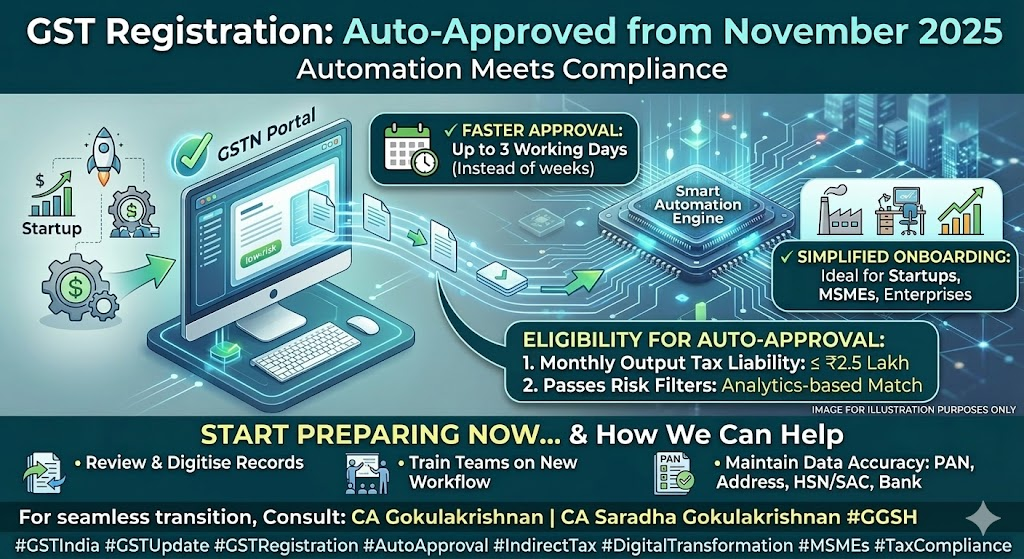
What Is the New GST Auto-Approval Mechanism?
Under the new reform, GST registration applications that meet predefined risk parameters will be automatically approved by the GST portal without manual officer intervention.
This automation is based on data analytics and risk-based verification systems that validate the information provided by applicants.
If the applicant’s profile satisfies the system’s risk criteria, the GST registration certificate can be issued within 3 working days.
This represents a major improvement compared to the current process, where registration approvals may take several days or even weeks depending on verification requirements.
Eligibility Criteria for Auto-Approved GST Registration
The auto-approval system will primarily apply to low-risk applicants.
A key eligibility parameter includes:
- Declared monthly output tax liability of ₹2.5 lakh or less
Additionally, the applicant’s details must successfully pass the GST system’s risk analysis filters, which examine the consistency and authenticity of the submitted data.
Applications flagged for potential discrepancies may still undergo manual verification by tax authorities.
Benefits of Automated GST Registration
The introduction of auto-approved GST registrations brings several advantages for businesses and entrepreneurs.
1. Faster Business Onboarding
Startups and new enterprises can begin operations more quickly, as GST registration may be granted within three working days.
This helps reduce delays in invoicing, compliance registration, and business transactions.
2. Reduced Administrative Delays
The automation process minimizes manual intervention by tax officers, which historically contributed to delays in GST registration approvals.
3. Support for Startups and MSMEs
The reform particularly benefits micro, small, and medium enterprises (MSMEs) that require quick tax registration to participate in B2B transactions, supply chains, and government tenders.
4. Increased Transparency and Efficiency
By relying on data analytics and automated verification, the GST system improves transparency while maintaining compliance checks.
Preparations Businesses Should Make Before November 2025
While the new system simplifies registration, businesses must ensure that their application data is accurate and properly documented.
Companies planning to apply for GST registration should begin preparing now.
Review and Digitise Business Records
Ensure that all statutory documents are available in digital format, including identity proofs, business registration documents, and address verification.
Maintain Accurate PAN and Address Information
Any mismatch between PAN details, address records, or bank information may trigger system alerts and delay approval.
Correct HSN and SAC Classification
Businesses must accurately classify their goods or services using correct HSN or SAC codes, as incorrect classification could affect the risk assessment process.
Train Finance and Compliance Teams
Accounting and compliance teams should understand the new automated GST registration workflow to ensure smooth application submission.
Automation and the Future of GST Compliance
The introduction of auto-approved GST registrations reflects a broader trend in India’s tax administration toward technology-driven compliance systems.
Automation within the GST framework is expanding across areas such as:
- e-invoicing systems
- automated return reconciliation
- risk-based audit selection
- digital registration approvals
These developments aim to create a more efficient, transparent, and business-friendly tax environment.
Final Thoughts
The auto-approval of GST registrations from 1 November 2025 represents a significant step toward simplifying tax compliance for businesses.
By enabling faster registration for low-risk applicants, the government is encouraging entrepreneurship, startup growth, and formalisation of the economy.
However, automation works best when businesses maintain accurate data, proper documentation, and compliance readiness.Preparing early will help organizations take full advantage of the new automated GST registration framework.