

Many taxpayers assume that GSTR-9 and GSTR-9C are simply routine annual compliance forms under GST. However, the Financial Year 2024–25 annual return cycle introduces several structural reporting changes, additional disclosures, and tighter reconciliation requirements.
While these updates may not appear dramatic at first glance, the underlying reporting framework for annual GST compliance has become more detailed, requiring businesses and tax professionals to pay closer attention during filing.
Understanding these changes early can help avoid last-minute confusion, reconciliation mismatches, and compliance risks.
Why FY 2024–25 Annual Returns Require Extra Attention
The GST annual return process has gradually evolved with improvements in technology, analytics, and data reconciliation.
The returns are processed through the GST portal managed by the Goods and Services Tax Network, where auto-population, cross-form matching, and analytics-based validations are increasingly used to detect discrepancies.
As a result, GSTR-9 and GSTR-9C filings now require deeper reconciliation between GST returns and financial records.
Key Areas That Need Extra Care in FY 2024–25
1. Reporting of ITC Reversals and Reclaims
One of the most sensitive areas in GST annual return filing is the reporting of Input Tax Credit (ITC) reversals and subsequent reclaims.
Businesses must carefully ensure that:
- ITC reversals reported in GSTR-3B are correctly reflected in GSTR-9 tables
- Any reclaimed ITC is disclosed accurately
- Differences between books of accounts and GST returns are properly explained in GSTR-9C reconciliation tables
Improper reporting of ITC adjustments can lead to scrutiny or demand notices.
2. Behaviour of Auto-Populated Data
In recent years, the GST portal has introduced auto-population of certain tables in GSTR-9 based on previously filed returns.
However, taxpayers must remember that:
- Auto-populated values are system-generated references
- They may not always reflect adjustments made during the year
- Businesses remain responsible for verifying and reconciling the data before submission
Blindly relying on system values without reconciliation can lead to incorrect disclosures in annual returns.
3. Importance of Reconciliation Explanations
In GSTR-9C, reconciliation tables compare data reported in GST returns with figures in the audited financial statements.
For FY 2024–25, the importance of clear explanations for differences has increased.
Businesses must ensure that any mismatch is supported by:
- Proper documentation
- Reconciliation workings
- Logical explanations in the reconciliation statement
This helps ensure that differences are understood as reporting adjustments rather than compliance issues.
4. Separate Late Fee Mechanism for GSTR-9C
Another development taxpayers should note is that late fees related to GSTR-9C may now operate independently from GSTR-9 compliance.
This means delays or errors in the reconciliation statement filing could result in separate compliance consequences, reinforcing the need for timely and accurate submission.
Why Early Preparation Is Important
Given the additional reporting depth in FY 2024–25, businesses should start preparing their annual return data well in advance.
Early preparation helps in:
- Reconciling GSTR-1, GSTR-3B, and financial statements
- Identifying ITC mismatches
- Validating auto-populated data
- Preparing explanations for reconciliation differences
This proactive approach reduces the risk of last-minute errors and filing pressure.
Practical Support for GSTR-9 & GSTR-9C Filing
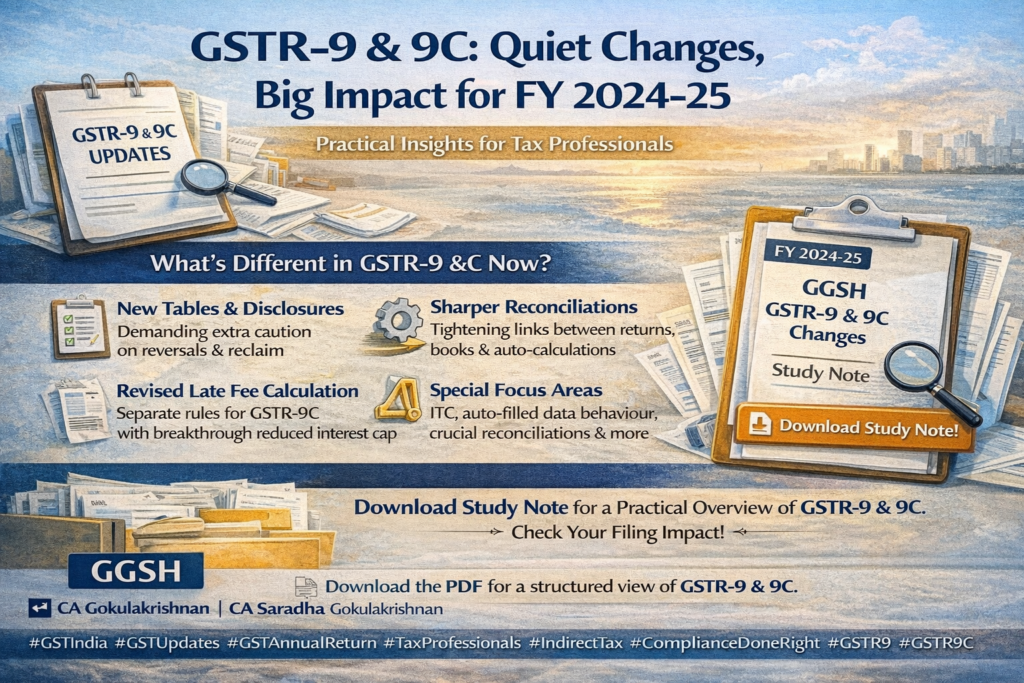
To simplify the process, the Indirect Tax team at GGSH has analysed the latest developments table-by-table, FAQ-by-FAQ, and notification-by-notification.
The analysis highlights practical aspects such as:
- ITC reporting and adjustments
- Behaviour of system-generated values
- Reconciliation documentation requirements
- Compliance considerations during annual filing
The findings have been compiled into a structured and easy-to-reference study note designed for practical use during the actual filing process.
Final Thoughts
Although GSTR-9 and GSTR-9C remain annual compliance requirements, the reporting framework for FY 2024–25 has become more detailed and reconciliation-focused.
Businesses and tax professionals should approach these filings with careful review, proper documentation, and accurate data mapping across GST returns and financial statements.Preparing early and understanding the latest reporting expectations will help ensure smooth, compliant, and error-free annual GST filings.