

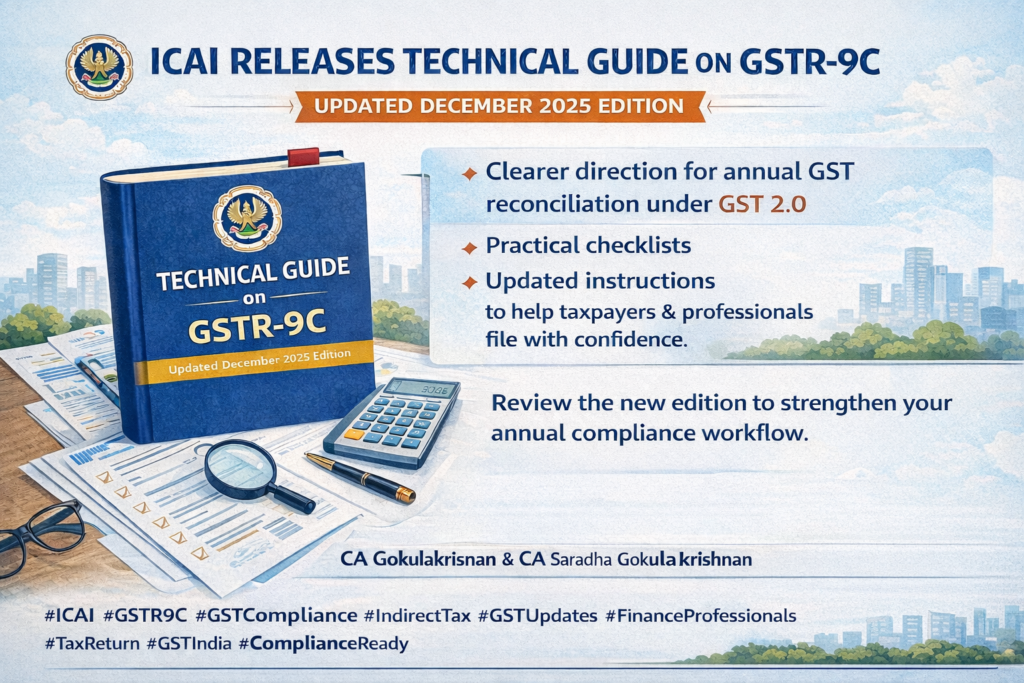
The Institute of Chartered Accountants of India (ICAI) has released the updated December 2025 edition of the Technical Guide on GSTR-9C, providing comprehensive guidance for businesses and professionals preparing the GST reconciliation statement.
With the evolving GST framework and the broader transition toward GST 2.0 compliance practices, the updated guide offers clearer direction on reconciliation methodology, reporting requirements, and practical compliance procedures.
For taxpayers and professionals handling annual GST reconciliations, this guide serves as a valuable technical reference to ensure accurate reporting and regulatory compliance.
What Is GSTR-9C Under GST?
GSTR-9C is the GST reconciliation statement that compares the data reported in GST returns with the figures appearing in the taxpayer’s audited financial statements.
It is an important compliance document that helps ensure alignment between:
- Turnover reported in financial statements
- Taxable supplies declared in GST returns
- Input Tax Credit (ITC) claimed during the year
- Tax liability and tax payments reported
The reconciliation statement helps identify differences, adjustments, and additional disclosures, strengthening transparency in GST reporting.
Key Highlights of the Updated ICAI Technical Guide
The updated guide issued by the Institute of Chartered Accountants of India incorporates amendments and practical clarifications up to December 2025.
It provides professionals with a structured framework for handling GSTR-9C reconciliation under evolving GST rules.
1. Practical Reconciliation Framework
The guide explains how to reconcile turnover, tax liability, and Input Tax Credit between GST returns and audited books of accounts, helping taxpayers maintain consistency across financial records.
2. Updated Reporting Guidance
Clear instructions are provided on reporting requirements for various tables in GSTR-9C, enabling professionals to prepare the reconciliation statement with greater accuracy.
3. Compliance Checklists
One of the most valuable additions in the updated guide is the inclusion of practical compliance checklists, which help businesses and consultants verify:
- Data accuracy
- Reconciliation completeness
- Correct disclosure of adjustments
4. Error Prevention and Best Practices
The guide highlights common errors in annual GST reconciliation and suggests best practices to avoid mismatches between GST returns and financial statements.
Importance for Businesses and GST Professionals
The updated GSTR-9C technical guide is particularly useful for:
- Chartered accountants and tax consultants
- Corporate finance and compliance teams
- Businesses with complex GST reporting structures
- Professionals responsible for annual GST reconciliation
Using the guide helps improve accuracy in GST annual filings and reduces the risk of scrutiny or notices from tax authorities.
Strengthening GST Compliance Under GST 2.0
As India’s GST system evolves with technology-driven compliance tools and deeper data analytics, annual reconciliation has become more important than ever.
Resources like the ICAI Technical Guide on GSTR-9C help businesses align their financial reporting, GST returns, and compliance documentation, creating a stronger compliance framework.
Final Thoughts
The December 2025 edition of the GSTR-9C Technical Guide released by the Institute of Chartered Accountants of India is a valuable resource for navigating the complexities of annual GST reconciliation.
With practical checklists, updated instructions, and structured reconciliation guidance, the guide helps taxpayers and professionals approach GSTR-9C filing with greater clarity and confidence.Reviewing the updated edition can significantly strengthen your annual GST compliance workflow and reporting accuracy.