

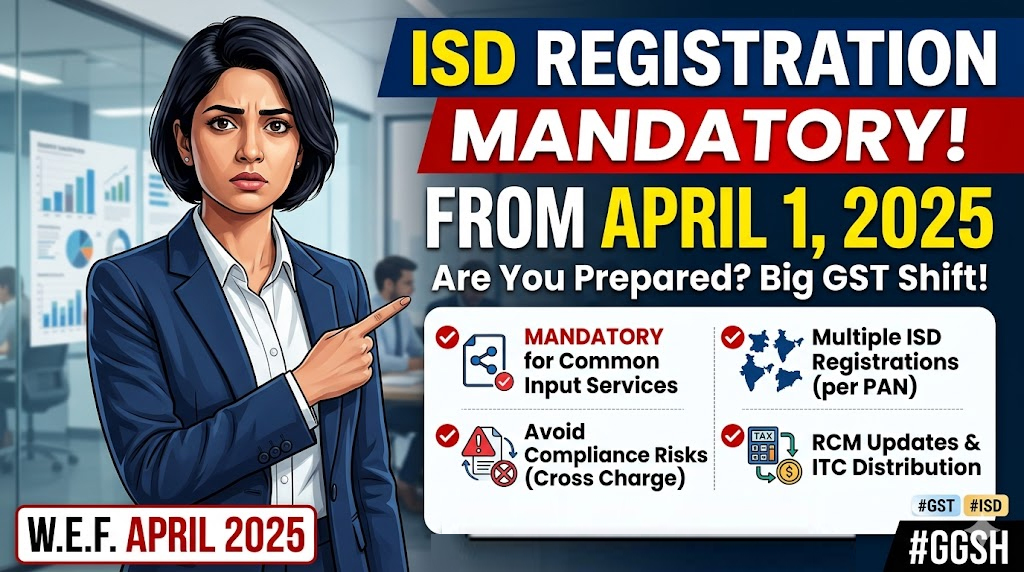
From April 1, 2025, the GST framework is witnessing an important compliance shift that businesses with multiple GST registrations under the same PAN cannot afford to overlook.
The Input Service Distributor (ISD) mechanism, which earlier remained optional in many cases, is now becoming a mandatory compliance requirement for distributing common input service credits. This change requires businesses to carefully reassess their vendor invoicing structure, input service procurement, and internal credit distribution processes.
For organizations operating across multiple states, this development is more than just a procedural update—it requires a structural realignment of GST practices.
Understanding the Shift
Many businesses operate with a centralized procurement system where common services such as software subscriptions, professional services, consulting fees, marketing expenses, or corporate support services are billed to one GST registration.
However, these services are often used by multiple units or branches located in different states.
Earlier, companies sometimes used a mix of cross-charge mechanisms or informal allocation methods to distribute the Input Tax Credit (ITC). With the upcoming changes, the law expects such credits to be distributed strictly through the ISD mechanism wherever applicable.
This essentially means that businesses must evaluate whether their existing credit distribution approach aligns with the revised compliance expectations.
Why ISD Registration Matters Now
The mandatory nature of ISD registration introduces a more structured approach to credit distribution. Businesses that avail common input services across multiple GST registrations will now need to ensure proper routing of credits through an ISD registration.
Failing to adopt the correct mechanism may create ITC mismatches, audit queries, and potential compliance risks in the future.
The change is intended to bring greater transparency and traceability in the flow of input tax credits across related registrations.
Multiple ISD Registrations Under One PAN
Another important aspect businesses should note is that a single PAN can hold multiple ISD registrations across different states.
This flexibility allows organizations to design their credit distribution structure based on operational convenience, especially when multiple head offices or administrative centers are involved in procuring shared services.
Businesses should therefore evaluate:
- Where the common services are typically invoiced
- Which location should function as the ISD registration
- Whether multiple ISDs may be required across states
Cross Charge vs ISD – A Common Area of Confusion
One of the most misunderstood areas in GST compliance is the distinction between Cross Charge and ISD distribution.
Both mechanisms deal with transactions between related registrations under the same PAN, but they apply in different circumstances.
- ISD is specifically used for distribution of input tax credit on common input services.
- Cross charge, on the other hand, applies when actual services are provided by one branch to another branch.
Using the wrong mechanism may lead to incorrect tax treatment or denial of credits, making it essential for businesses to clearly identify which method applies to each scenario.
Reverse Charge Mechanism (RCM) – Awaiting Procedural Clarity
Recent updates have also brought discussions around how Reverse Charge Mechanism (RCM) payments interact with ISD credit distribution.
While the broad framework has been clarified, certain procedural aspects still require further guidance from the CBIC. Businesses should therefore stay alert for upcoming notifications or circulars that may define the exact process for handling RCM credits within the ISD framework.
What Businesses Should Do Now
With the deadline approaching, businesses should begin evaluating their current GST structures and internal processes.
Some practical steps include:
- Reviewing vendor invoicing patterns for common services
- Identifying services used by multiple GST registrations
- Evaluating whether ISD registration is required
- Designing a clear internal credit distribution policy
- Training finance and compliance teams on the ISD vs cross charge distinction
Early preparation can help avoid compliance disruptions once the changes take effect.
The Bottom Line
The upcoming ISD mandate represents a significant shift in GST compliance for multi-location businesses. Organizations that proactively review their input service procurement and credit distribution structures will be better positioned to stay compliant and avoid future disputes.
April 2025 may seem distant, but restructuring internal processes and vendor invoicing practices takes time.Starting the preparation now can ensure a smooth transition into the revised compliance framework.