

In a significant development in GST litigation in India, the Madras High Court has once again reaffirmed its stance against the bunching of Show Cause Notices (SCN) across multiple financial years.
Following the landmark ruling in the Titan Company Ltd case, the High Court has reiterated that issuing combined SCNs for multiple financial years is legally unsustainable.
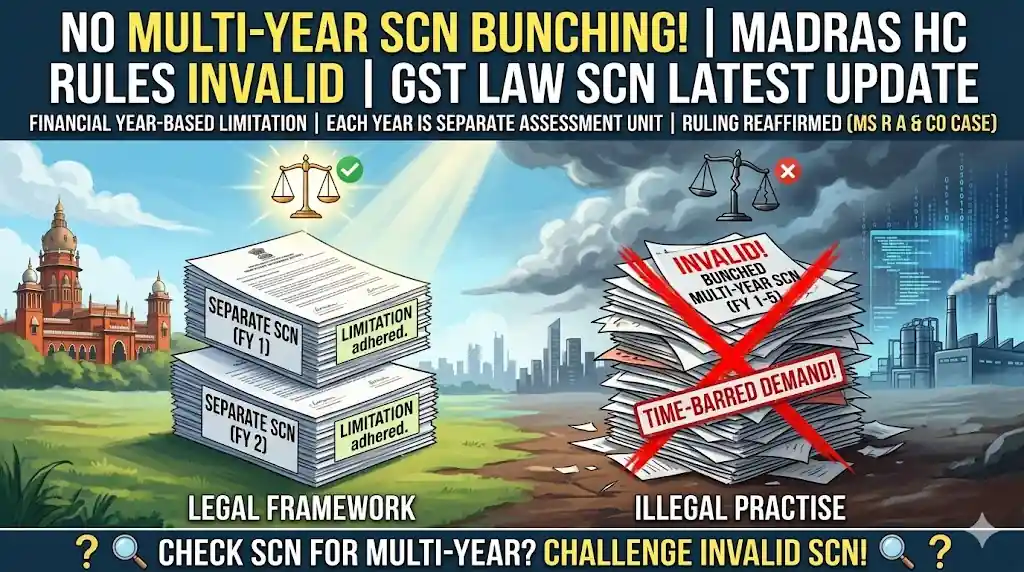
Background: What is Bunching of SCN in GST?
“Bunching of SCN” refers to the practice where tax authorities:
- Issue a single Show Cause Notice covering multiple financial years (FYs)
- Pass a single adjudication order for multiple FYs
This approach is often used to:
- Include time-barred periods
- Consolidate multiple issues into one proceeding
However, this practice has been under judicial scrutiny.
Key Case: Ms R A And Co vs AC of Central Taxes
Case Details:
- Case Name: Ms R A And Co vs Assistant Commissioner of Central Taxes
- Citation: W.P. No. 17239 of 2025
- Judgment Date: 21.07.2025
The Madras High Court examined the legality of issuing SCNs and orders covering multiple financial years under GST law.
Key Issue Before the Court
Whether:
A single Show Cause Notice and order covering more than one financial year is valid under Sections 73 and 74 of the CGST Act?
Court’s Ruling: Multi-Year SCNs Are Invalid
The High Court held that:
- Issuing SCNs covering multiple financial years is bad in law
- Passing a common order for multiple FYs is invalid
- Such notices violate the statutory framework of GST law
Accordingly, the court quashed the impugned order.
Legal Reasoning: Financial Year-Based Limitation
The judgment emphasized that:
- Sections 73 and 74 of the CGST Act prescribe time limits based on “financial year”
- Each financial year is treated as a separate assessment unit
👉 Therefore, combining multiple financial years into a single SCN:
- Defeats the intent of limitation provisions
- Allows inclusion of time-barred demands
- Violates procedural fairness
Reference to Titan Company Case
The court also relied on its earlier decision in the Titan Company Ltd case, where a similar view was taken.
Despite this clear precedent, the department:
- Attempted to repeat the same approach
- Issued combined notices across financial years
The court observed that such repeated errors reflect an unfair approach by tax authorities.
Impact on GST Litigation and Taxpayers
This ruling has significant implications for:
- Businesses facing GST Show Cause Notices
- Tax professionals handling litigation
- Authorities issuing SCNs under GST
Key Takeaways:
- Each financial year must be assessed separately
- SCNs cannot club multiple years into one notice
- Taxpayers can challenge invalid SCNs on limitation grounds
- Orders based on such notices are liable to be quashed
Practical Guidance for Taxpayers
If you receive a GST SCN:
- Check whether it covers multiple financial years
- Verify compliance with Section 73/74 time limits
- Evaluate if the notice includes time-barred demands
👉 If yes, you may have strong grounds to:
- Challenge the SCN before authorities or courts
- Seek relief through writ petitions
Conclusion
The ruling in Ms R A And Co vs AC of Central Taxes strengthens the legal position that bunching of SCNs across financial years is not permissible under GST law.
By reinforcing financial year-based limitation, the Madras High Court has once again protected taxpayers from procedural overreach.
Final Thoughts 💬
Will this ruling put an end to the practice of issuing multi-year GST notices, or will litigation continue on this issue?