

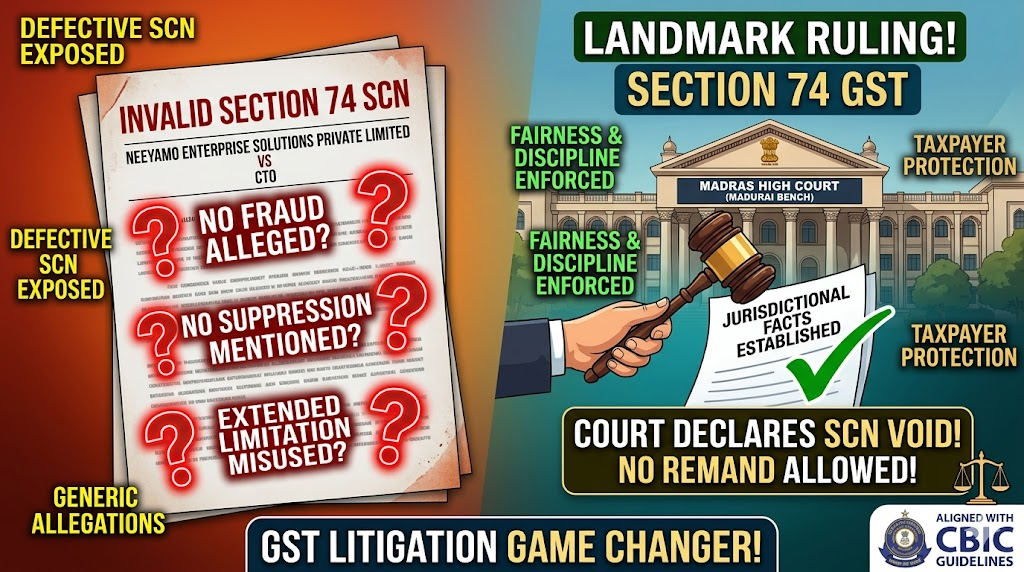
In a landmark ruling from the Madurai Bench of the Madras High Court, the Court has delivered a strong message on jurisdictional discipline under Section 74 of the CGST Act.
The judgment in Neeyamo Enterprise Solutions Private Limited vs Commercial Tax Officer (W.P(MD) Nos. 30453 to 30458 of 2024, dated 11.11.2025) reinforces a fundamental principle in GST litigation in India:
Section 74 cannot be invoked unless the Show Cause Notice (SCN) itself clearly establishes jurisdictional facts such as fraud, wilful misstatement, or suppression of facts.
Background: Misuse of Section 74 in GST Proceedings
In recent years, tax authorities have increasingly invoked Section 74 (fraud cases) even in situations where:
- No clear allegation of fraud exists
- Extended limitation is not justified
- Section 73 (non-fraud cases) would have been more appropriate
This often occurs when:
- Time limits under Section 73 expire
- Authorities attempt to extend limitation by invoking Section 74
Case Overview: Neeyamo Enterprise Solutions Pvt Ltd
Key Facts:
- A Show Cause Notice was issued following a Section 67 inspection
- The SCN pointed out discrepancies but:
- ❌ Did NOT allege fraud
- ❌ Did NOT mention suppression of facts
- ❌ Did NOT establish intent to evade tax
- ❌ Did NOT allege fraud
Despite this, proceedings were initiated under Section 74, resulting in:
- Tax demand
- Interest
- Equal penalty
Key Issue Before the Court
Whether:
Section 74 proceedings are valid when the SCN does not explicitly contain jurisdictional facts required to invoke extended limitation?
Court’s Ruling: Section 74 Invocation Invalid
The Madras High Court held that:
- Section 74 cannot be invoked without explicit allegations in the SCN
- Jurisdictional facts must be:
- Clearly stated
- Properly supported
- Form part of the foundation of the notice
- Clearly stated
👉 In the absence of these elements, the entire proceedings are:
⚠️ Void ab initio (invalid from the beginning)
Key Legal Principles from the Judgment
1. Tax Shortfall ≠ Suppression
The Court clarified:
- A mere discrepancy or tax shortfall does not automatically mean suppression of facts
- There must be a clear intent to evade tax
2. SCN Must “Specify” Demand, Not Pre-Decide It
- A valid SCN should:
- Propose allegations
- Allow the taxpayer to respond
- Propose allegations
❌ It should NOT:
- Read like a pre-determined order
- Conclude guilt at the notice stage
3. Jurisdiction Cannot Be Assumed or Implied
- Fraud, suppression, or wilful misstatement must be:
- Explicitly stated
- Clearly linked to the demand
- Explicitly stated
👉 These cannot be inferred later during adjudication.
4. No Remand When Jurisdiction is Missing
- If Section 74 is wrongly invoked:
- Proceedings cannot be remanded for reconsideration under the same provision
- The defect is fatal and irreversible
- Proceedings cannot be remanded for reconsideration under the same provision
Alignment with CBIC Guidelines
The judgment also aligns with the position of the Central Board of Indirect Taxes and Customs (CBIC), which has emphasized that:
- Section 74 should not be invoked mechanically
- Proper application of mind is required before issuing SCNs
Impact on GST Litigation and Taxpayers
This ruling has wide implications for:
- Businesses receiving GST notices
- Tax professionals handling litigation
- Authorities issuing SCNs
Key Takeaways:
- Section 74 is an exception, not the rule
- SCNs must be legally robust and well-founded
- Taxpayers can challenge notices lacking jurisdictional facts
- Proceedings based on defective SCNs are liable to be quashed
Practical Guidance for Businesses & Professionals
If you receive a GST SCN under Section 74:
✔️ Check for:
- Allegation of fraud or suppression
- Clear reasoning for extended limitation
- Proper linkage between facts and demand
❌ Red Flags:
- Generic or vague allegations
- Absence of intent to evade
- SCN resembling a final order
👉 Such cases may be challenged as jurisdictionally invalid.
Conclusion
The ruling in Neeyamo Enterprise Solutions Pvt Ltd vs CTO is a landmark step toward ensuring fairness and discipline in GST adjudication.
By reinforcing the importance of jurisdictional facts in SCNs, the Madras High Court has protected taxpayers from arbitrary invocation of extended limitation under Section 74.
Final Thoughts 💬
In GST litigation, the validity of the Show Cause Notice is everything.Do you think this judgment will curb the routine misuse of Section 74 in GST cases?