

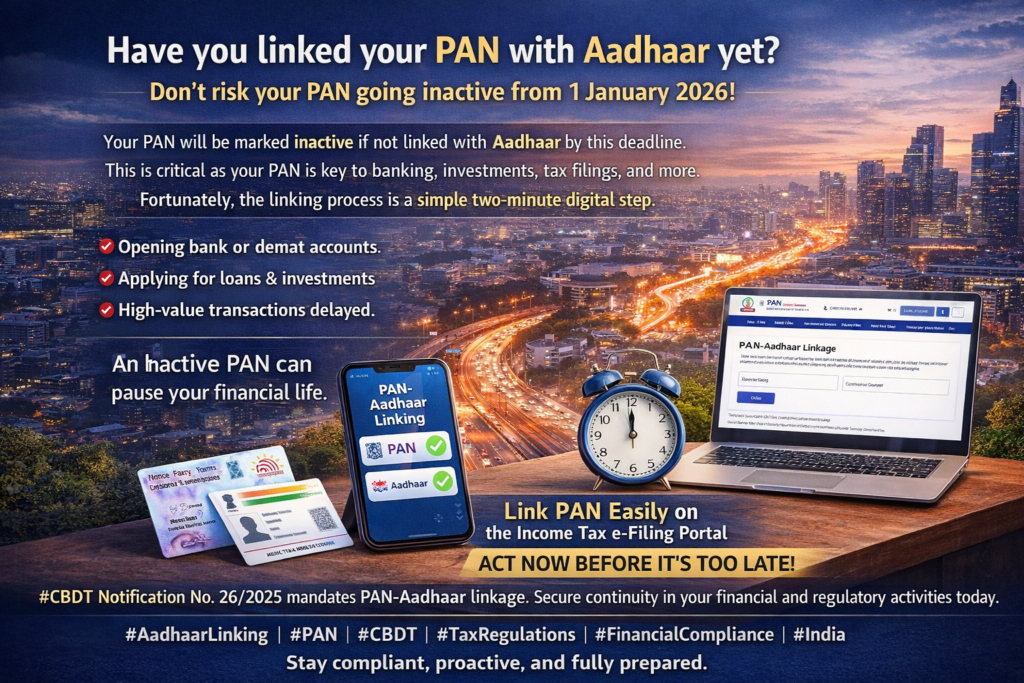
A critical compliance deadline is approaching for taxpayers across India. If your Permanent Account Number (PAN) is not linked with Aadhaar, it may soon become inactive, potentially disrupting several financial and regulatory activities.
According to Notification No. 26/2025 issued by the Central Board of Direct Taxes, taxpayers must ensure their PAN is linked with Aadhaar before the upcoming deadline to avoid operational restrictions.
📅 Effective Date: 1 January 2026
Failure to complete this linking process could result in PAN becoming inoperative, affecting a wide range of financial transactions.
Why PAN–Aadhaar Linking Is Important
The PAN issued by the Income Tax Department of India is one of the most critical identification numbers used in India’s financial ecosystem.
It is required for:
- Banking transactions
- Filing income tax returns
- Opening bank and demat accounts
- High-value financial transactions
- Property purchases and investments
- Loan applications
- Regulatory and compliance filings
When PAN becomes inactive, many of these processes can slow down or become temporarily unavailable.
Consequences of an Inactive PAN
If PAN is not linked with Aadhaar before the notified deadline, it may be marked “inoperative” under the Income-tax framework.
An inactive PAN can lead to several practical difficulties:
Banking and Financial Transactions
Opening new bank accounts, demat accounts, or investment accounts may become difficult without an active PAN.
Investment and Market Activities
Many financial platforms require PAN verification for equity investments, mutual funds, and securities transactions.
Loan and Credit Applications
Financial institutions often require PAN validation while processing loan or credit applications.
High-Value Transactions
Depositing large amounts of money, purchasing property, or executing other high-value financial transactions may require an active PAN.
Compliance and Tax Filings
PAN plays a central role in income tax return filing, tax reporting, and regulatory documentation.
An inoperative PAN may therefore affect multiple compliance activities.
Legal Basis for PAN–Aadhaar Linking
The requirement to link PAN with Aadhaar has been mandated through notifications issued by the Central Board of Direct Taxes under the provisions of the Income-tax Act, 1961.
The objective of this initiative is to:
- Eliminate duplicate PAN records
- Strengthen taxpayer identification systems
- Improve tax compliance and transparency
How to Link PAN with Aadhaar
The process for linking PAN with Aadhaar is simple and completely digital.
Taxpayers can complete the linking process through the e-filing portal of the Income Tax Department of India.
Basic Steps
- Visit the official Income Tax e-Filing portal.
- Navigate to the PAN–Aadhaar linking section.
- Enter your PAN number, Aadhaar number, and required details.
- Verify the information and submit the request.
In most cases, the entire process can be completed within a few minutes online.
Why You Should Act Early
Although the deadline is still some time away, waiting until the final weeks may create unnecessary pressure.
Completing the PAN–Aadhaar linking early helps taxpayers:
- Avoid last-minute portal congestion
- Prevent disruptions in financial activities
- Maintain uninterrupted compliance status
Proactive action ensures that all banking, investment, and regulatory transactions continue smoothly.
Final Thoughts
The upcoming PAN–Aadhaar linking deadline of 1 January 2026 is an important compliance requirement for taxpayers across India.
Since PAN acts as the central identifier for financial transactions and tax reporting, ensuring its active status is essential for both individuals and businesses.
By completing the linking process early through the Income Tax e-Filing portal, taxpayers can avoid compliance issues and maintain uninterrupted access to the country’s financial ecosystem.Staying proactive and compliant today helps prevent unnecessary disruptions tomorrow.