

The Union Budget 2026 signals a clear and consistent direction for India’s indirect tax ecosystem—moving towards simplification, digitisation, and trust-based governance.
Rather than introducing disruptive changes, the focus is on strengthening systems, improving compliance experience, and reducing friction for businesses.
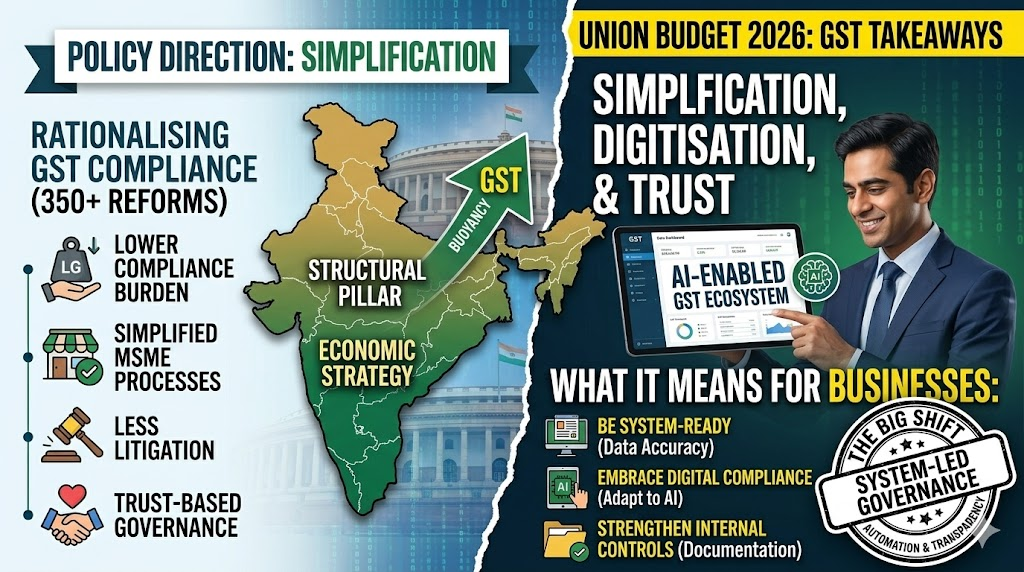
Policy Direction: Simplification with Trust
At its core, the Budget emphasizes:
- Simplifying GST processes
- Digitising tax administration
- Building a trust-based compliance framework
This reflects a shift from control-driven regulation to facilitation-driven governance.
Core Focus: Rationalising GST Compliance
The government aims to:
- Reduce compliance burden
- Eliminate redundant procedures
- Improve ease of doing business
With 350+ reforms already implemented, the direction is clear:
👉 Continuous process clean-up rather than one-time overhaul.
Technology as the Backbone of GST
A major highlight is the increasing role of technology.
🔍 AI-Enabled GST Ecosystem
- Use of Artificial Intelligence for:
- Risk assessment
- Fraud detection
- Data analytics
- Risk assessment
👉 This enables smarter scrutiny with fewer manual interventions.
⚙️ System-Driven Compliance
- Faster processing of returns and refunds
- Reduced dependency on officers
- More predictable outcomes
👉 The system is evolving into a self-regulating framework.
Economic Perspective: GST as a Structural Pillar
GST continues to play a crucial role in:
- Enhancing tax buoyancy
- Driving formalisation of the economy
- Supporting fiscal discipline
👉 It remains a key component of India’s long-term economic strategy.
MSME Impact: Reduced Friction, Greater Trust
For MSMEs, the changes are particularly significant:
✔️ Lower Compliance Burden
- Simplified processes
- Reduced procedural hurdles
✔️ Trust-Based Governance
- Less intrusive scrutiny
- Focus on voluntary compliance
✔️ Reduced Litigation
- Clearer systems
- Fewer interpretational disputes
👉 This creates a more business-friendly tax environment.
Execution Signal: Continuous Reform Mindset
The mention of 350+ reforms indicates:
- Ongoing refinement of GST systems
- Incremental improvements across processes
- Focus on long-term stability over short-term changes
The Big Shift: Enforcement → System-Led Governance
Perhaps the most important takeaway:
👉 GST is transitioning from:
- Enforcement-led model
(manual checks, officer dependency)
👉 To:
- System-led model
(automation, AI-driven validation, transparency)
What This Means for Businesses
🔹 Be System-Ready
- Ensure accurate and consistent data reporting
🔹 Strengthen Internal Controls
- Align accounting, GST returns, and documentation
🔹 Embrace Digital Compliance
- Adapt to automation and AI-based scrutiny
🔹 Focus on Accuracy Over Adjustments
- System-driven checks reduce scope for post-facto corrections
Conclusion
The Union Budget 2026 does not introduce radical GST changes—but it reinforces a clear, long-term vision:
- Simpler processes
- Stronger systems
- Predictable compliance
Bottom Line
👉 GST in India is steadily evolving into a technology-driven, trust-based tax regime
👉 The future lies in clean data, timely compliance, and system alignment
Final Thought 💬
The question for businesses is no longer:
“What are the rules?”
But:
“Are our systems aligned with how GST now works?”