

It often begins with a tempting promise.
“Claim this deduction and get a bigger tax refund.”
For many taxpayers, what seems like a harmless adjustment in their Income Tax Return (ITR) can sometimes turn into a serious compliance issue. Recently, the Income Tax Department of India launched a large-scale verification drive that uncovered how misuse of tax deductions and exemptions has become increasingly systematic.
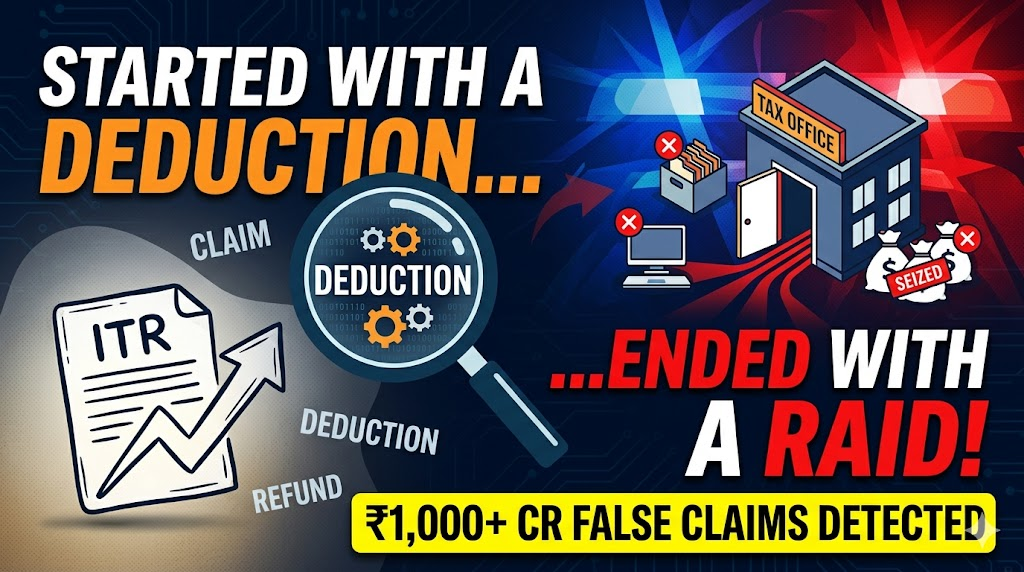
What initially appears to be a small deduction can, in some cases, escalate into tax notices, investigations, and even search operations when fraudulent claims are detected.
A Nationwide Verification Drive
The verification initiative focuses on identifying bogus deductions and fake refund claims filed in Income Tax Returns.
According to reports from the tax authorities, several taxpayers were found to have filed incorrect or fabricated claims through intermediaries promising unusually high refunds.
The investigation revealed a worrying trend where professional middlemen or agents filed returns using false deductions, fabricated TDS entries, and manipulated refund claims.
In just four months, more than 40,000 taxpayers voluntarily withdrew false claims amounting to over ₹1,045 crore after the department began verification proceedings.
Commonly Misused Tax Deductions and Exemptions
The verification drive has particularly focused on suspicious claims under several provisions of the Income-tax Act, 1961.
Some of the commonly misused sections include:
- Section 10(13A) of the Income-tax Act, 1961 – House Rent Allowance (HRA) exemption
- Section 80GGC of the Income-tax Act, 1961 – Donations to political parties
- Section 80E of the Income-tax Act, 1961 – Deduction on education loan interest
- Section 80D of the Income-tax Act, 1961 – Medical insurance premium deduction
- Section 80EE of the Income-tax Act, 1961 – Interest deduction on home loans for first-time buyers
- Section 80EEB of the Income-tax Act, 1961 – Interest deduction on electric vehicle loans
- Section 80G of the Income-tax Act, 1961 – Donations to charitable institutions
- Section 80GGA of the Income-tax Act, 1961 – Donations for scientific research and rural development
- Section 80DDB of the Income-tax Act, 1961 – Deduction for specified medical treatment
In many cases, taxpayers were encouraged to claim deductions without supporting documents or actual eligibility, leading to incorrect filings.
Fake TDS Entries and Inflated Refund Claims
Another major concern uncovered during the verification drive is the use of fictitious TDS entries to artificially inflate refund amounts.
Some intermediaries reportedly created or manipulated tax return data to show TDS that was never actually deducted or deposited, allowing taxpayers to claim refunds that were not legitimately due.
When the tax department cross-verifies such information with Form 26AS, AIS, and TIS data, discrepancies quickly become visible.
Technology is Changing the Compliance Landscape
The tax administration today relies heavily on data analytics and artificial intelligence tools to detect irregularities in tax filings.
The verification drive uses:
- AI-driven risk analysis
- Financial data triangulation
- Cross-verification with banking and reporting systems
- Ground-level intelligence gathering
These systems help the department identify unusual patterns such as large refunds relative to reported income, repeated deduction claims, or inconsistencies in financial reporting.
As technology becomes more sophisticated, fraudulent filings are increasingly difficult to conceal.
Why Taxpayers Should Be Careful
Many taxpayers involved in such cases were not necessarily acting with deliberate intent. Instead, they were misled by agents or intermediaries promising unusually high tax refunds in exchange for a commission.
This practice has affected a wide range of individuals, including:
- Salaried employees
- Small business owners
- Entrepreneurs
- Students filing their first tax returns
Unfortunately, even when the incorrect claim is suggested by a third party, the responsibility for the accuracy of the return ultimately lies with the taxpayer.
Key Takeaways for Taxpayers
To avoid complications with the tax authorities, taxpayers should keep a few important principles in mind:
File accurate returns
Ensure that every deduction or exemption claimed is supported by valid documentation.
Avoid intermediaries promising “easy refunds”
If a tax agent guarantees a large refund without proper explanation, it should raise a red flag.
Respond promptly to tax department notices
If you receive communication from the tax department, addressing it quickly can help resolve the issue before it escalates.
Building a Culture of Responsible Tax Filing
The Income Tax Department continues to emphasize its “Trust Taxpayers First” approach, encouraging voluntary compliance and transparent tax practices.
At the same time, authorities have made it clear that fraudulent filings and misuse of tax provisions will face strict enforcement.
For taxpayers, the safest approach is always to work with trusted tax professionals, maintain proper documentation, and file returns with complete accuracy.Shortcuts may look appealing in the moment, but responsible compliance today can prevent serious complications tomorrow.