

A practical guide across Books of Accounts, GST, and Income Tax
As the financial year draws to a close, businesses enter a critical phase of validation, reconciliation, and compliance readiness. Year-end is not just about closing numbers—it’s about ensuring accuracy, completeness, and alignment across financial, GST, and income tax records.
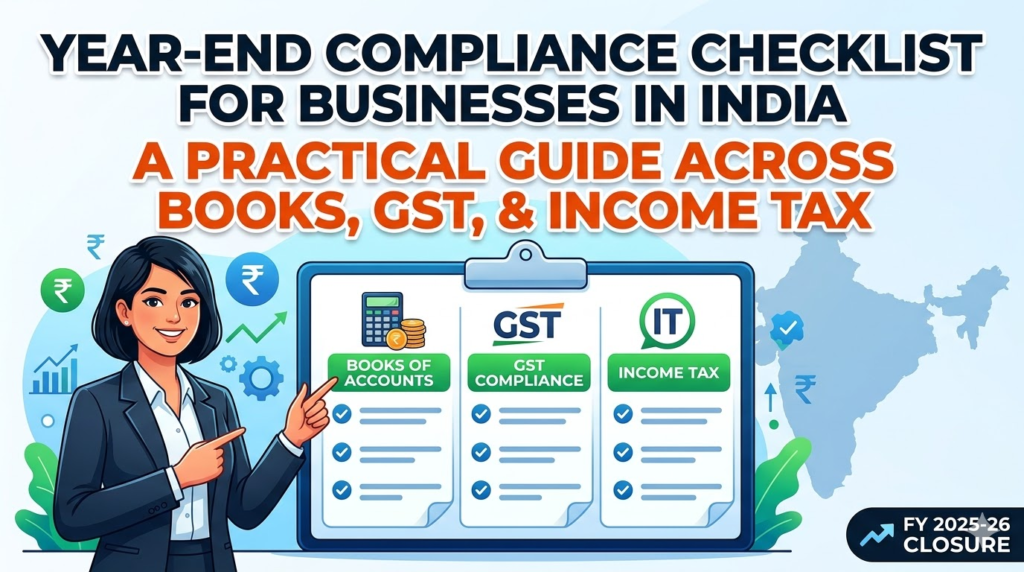
To simplify this process, we’ve broken down the year-end compliance into three key areas:
- Books of Accounts
- GST Compliance (“Dasavathaaram” approach)
- Income Tax Compliance
This checklist is designed to help businesses stay structured, reduce last-minute risks, and approach closure with confidence.
1. Books of Accounts Checklist
The foundation of all compliance begins with accurate books. A well-reviewed set of accounts ensures smoother audits, filings, and decision-making.
Key areas to focus on:
1. Cash & Bank Validation
- Perform bank and cash balance verification
- Ensure proper reconciliation with bank statements
2. Investments & Loans
- Obtain updated statements
- Ensure correct accounting treatment in books
3. Inventory & Stock
- Conduct physical stock count as on 31st March
- Perform closing stock valuation
4. Fixed Assets
- Review additions, deletions, and disposals
- Ensure correct valuation and depreciation
5. Revenue Integrity
- Identify, match, and link all income streams
- Ensure proper disclosure in books
6. Expense Completeness
- Verify expenses with:
- Bank reconciliation
- IMS vs Books
- Vendor balances
7. Expense Apportionment
- Allocate expenses across financial years appropriately
- Validate ledger classifications
8. Receivables Review
- Identify doubtful or non-recoverable balances
- Write off where necessary
Outcome:
A clean, reconciled, and audit-ready set of financial statements.
2. GST Compliance Checklist – “Dasavathaaram”
GST year-end is multi-dimensional. Think of it as covering ten critical compliance “avatars” that ensure readiness for the upcoming financial year.
A. Strategic & Reconciliation Checks
- Review aggregate turnover for FY 2025–26
- Determine applicability for:
- Registration thresholds
- Composition scheme
- QRMP
- E-invoicing
- Determine applicability for:
- Ensure HSN/SAC code compliance
- File LUT (Form GST RFD-11) before 31st March 2026
- Applicable for zero-rated supplies in FY 2026–27
- Perform 7-way reconciliation for outward supplies
- Review ITC reversals as per:
- Rule 37, 37A, 42, 43
- Blocked credits
B. Compliance & Transition Readiness
- Ensure all GST-related job/work compliances are completed
- Verify invoice series reset for new financial year
- Align with changes effective from 1st April 2026
- GTA Compliance
- File Annexure V or VI based on RCM/FCM option
- Specified Premises
- File Annexure VII where applicable
- Update GST registration details:
- Bank account
- Aadhaar authentication
- Authorized signatory
Outcome:
A GST-compliant business that is both backward reconciled and forward-ready.
3. Income Tax Compliance Checklist
Income tax closure is not just about computation—it’s about aligning financial data, tax positions, and regulatory expectations.
A. Reconciliation & Financial Integrity
- Reconcile turnover across:
- GST returns
- Books of accounts
- Income tax filings
- Maintain proper books of accounts and documentation
- Perform GST vs Income Tax turnover reconciliation
B. Compliance & Evaluation Areas
- Evaluate cash transaction limits and compliance
- Review applicability of presumptive taxation
- Perform TDS/TCS reconciliation and verification
- Validate related party transactions and documentation
C. Asset, Liability & Reporting Checks
- Verify depreciation and fixed asset register
- Ensure loan and deposit compliance
- Review statutory due dates and audit readiness
D. Advanced Tax & Risk Areas
- Assess advance tax liability and payment accuracy
- Review penalty exposure and structure
- Ensure compliance with MSME payments
- Especially Section 43B(h) timelines
Outcome:
An income tax position that is accurate, defensible, and audit-ready.
Closing Note
Year-end compliance doesn’t have to be chaotic. With a structured approach across Books, GST, and Income Tax, businesses can move from reactive corrections to proactive control.
The key is simple:
- Reconcile early
- Review thoroughly
- Document properly
- Prepare ahead
A well-executed year-end not only ensures compliance—it sets the tone for a stronger, more efficient financial year ahead