

The Government has pushed the GST Appellate Tribunal filing deadline to 31 July 2026. Here is what the notification really means and why July must still be your filing month.
I) A reprieve at the eleventh hour
For weeks, a single date hung over every GST litigator’s desk: 30 June 2026 — the outer deadline for filing backlog appeals before the Goods and Services Tax Appellate Tribunal (GSTAT). With the Tribunal only recently operational and a mountain of pending second appeals still waiting to be filed, the pressure on taxpayers and professionals alike was immense.
An unknown notification xxx?? “S.O. __(E).” dated 30th June 2026 issued by the Ministry of Finance in supersession of Notification S.O. 4220(E) dated 17 September 2025, and on the recommendations of the GST Council, the Government extended the last date for filing appeals and applications before the GSTAT to 31 July 2026.
Well, None seems to be bothered about the unnamed Notification without any reference, when both sides are happy about the extension!
But before you exhale, read the fine print.
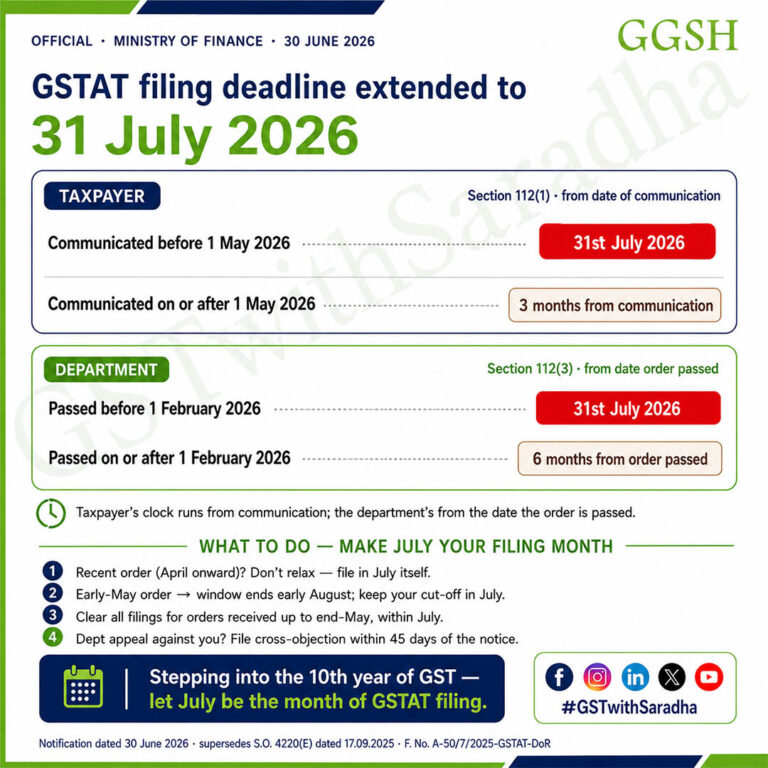
II) What the notification actually says
The extension operates along two limbs — one for the taxpayer and one for the department — and each is tied to a different reference date.
| Appellant | Reference date | Before the cut-off | On or after the cut-off |
| Taxpayer — Section 112(1) | Date the order is communicated | Communicated before 1 May 2026 → file by 31 July 2026 | Communicated on/after 1 May 2026 → 3 months from communication |
| Department — Section 112(3) | Date the order is passed | Passed before 1 Feb 2026 → file by 31 July 2026 | Passed on/after 1 Feb 2026 → 6 months from the date passed |
In plain terms: the 31 July date is a special window for older matters. Newer matters simply continue under the ordinary statutory limitation.
III) The nuance not to miss under Sec 112: “communicated,” vs “passed”
Here is the single most important point, and the one most likely to trip up the unwary. For the taxpayer, the extension is keyed to the date of communication of the order — not the date the order was signed or passed.
This distinction matters enormously. An Order-in-Appeal passed in April 2026 but communicated to you in April — that is, before 1 May – still enjoys the 31 July benefit. But if that very same order reaches you on or after 1 May 2026, you fall outside the extension and are back on the standard three-month clock.
So the rule is simple, but unforgiving: always count from the date the order was communicated to you, and verify that date before you assume you have until July.
IV) So who actually benefits?
The 31 July 2026 date is available only where the order was communicated to the taxpayer before 1 May 2026. For every order communicated on or after 1 May, there is no extra time — the normal three months runs from communication, exactly as before.
If your order is recent i.e. on or after 1st May 2026, extension has not relevance at all.
V) Why July must still be your filing month
Even where the extension does apply, treating 31 July as a comfortable finish line is a mistake. Take an order communicated in the first week of May 2026. Three months carries you only to the first week of August, yet you should still aim to file within July, never the closing days. The reason is practical, not merely cautious. A GSTAT appeal is not a one-click affair: you must compute the pre-deposit precisely (the admitted amount in full, plus ten percent of the disputed tax), arrange certified copies, draft and compile your grounds, pay the court fee through the correct channel, and navigate an e-filing portal that is still settling in. Any short payment or missing document gets the appeal returned as defective, with only a limited window to cure it. Leave it to the last week, and a small slip becomes a lost appeal.
The disciplined response is straightforward — make July your filing month:
- Identify the date of communication of every pending order; that, not the date passed, is your trigger.
- For orders communicated before 1 May 2026, file by 31 July — ideally well before.
- For orders communicated on or after 1 May, count three months from communication, and still aim to file in July wherever it falls due.
- Compute the pre-deposit, arrange certified copies, draft, compile, and pay court fees early, not on the deadline.
- Clear all filings for orders received up to the end of May within the month of July, and remove the last-minute scramble entirely.
The PIB Press Release dated 30th June 2026also highlights the importance of timely filing:
“The Government has extended the due date in view of the recent representations from various stakeholders, highlighting technical difficulties due to rush to file appeals on the GSTAT portal. It is to be noted that in the last 15 days alone, 30,000 appeals were filed, with daily volumes peaking at5,500 appeals.
Taxpayers are advised to plan their appeal filings well in advance and not wait until the deadline.”
VI) The condonation safety net and its hard limit
What if you genuinely miss the date? Section 112(6) permits the Tribunal to admit an appeal within a further three months, on sufficient cause being shown. In effect, the window can stretch a little beyond the deadline.
But do not build your plan around it. Condonation is discretionary, a relief you must earn by demonstrating sufficient cause and not a second deadline to which you are entitled. And crucially, the Tribunal, being a creature of statute, has no power to condone delay beyond that statutory window. Past the outer limit, the door is bolted. Treat the deadline as a wall, not a guideline.
VII) Don’t forget: the Department can appeal too
One final point that businesses consistently overlook. A favourable first-appeal order is not the end of the road. The department has its own right to carry the matter to the Tribunal. If it does, and you are served notice, your window to file a cross-objection is just forty-five days under Section 112(5) — far shorter than the time to file an appeal. Stay alert for any such notice, register on the GSTAT portal so that communications reach you directly, and act quickly if it lands.
Step into year 10 with your filings done
As we step into the 10th year of GST with hope, trust, and loyalty to the law, the smartest response to this extension is not relief, but resolve. Read the date of communication carefully. Don’t assume the extension covers you. And whether it does or not, let July be the month of GSTAT filing.
The deadline moved. Your discipline shouldn’t.
Author’s note: This article is based on the notification dated 30 June 2026, issued in supersession of Notification S.O. 4220(E) dated 17 September 2025, on the recommendations of the GST Council. Readers are advised to seek professional advice on the facts of their own case before acting.
Author
CA Saradha Hariharan
Co-Founder Partner | Head of Indirect Tax Advisory GGSH & Co. LLP
