

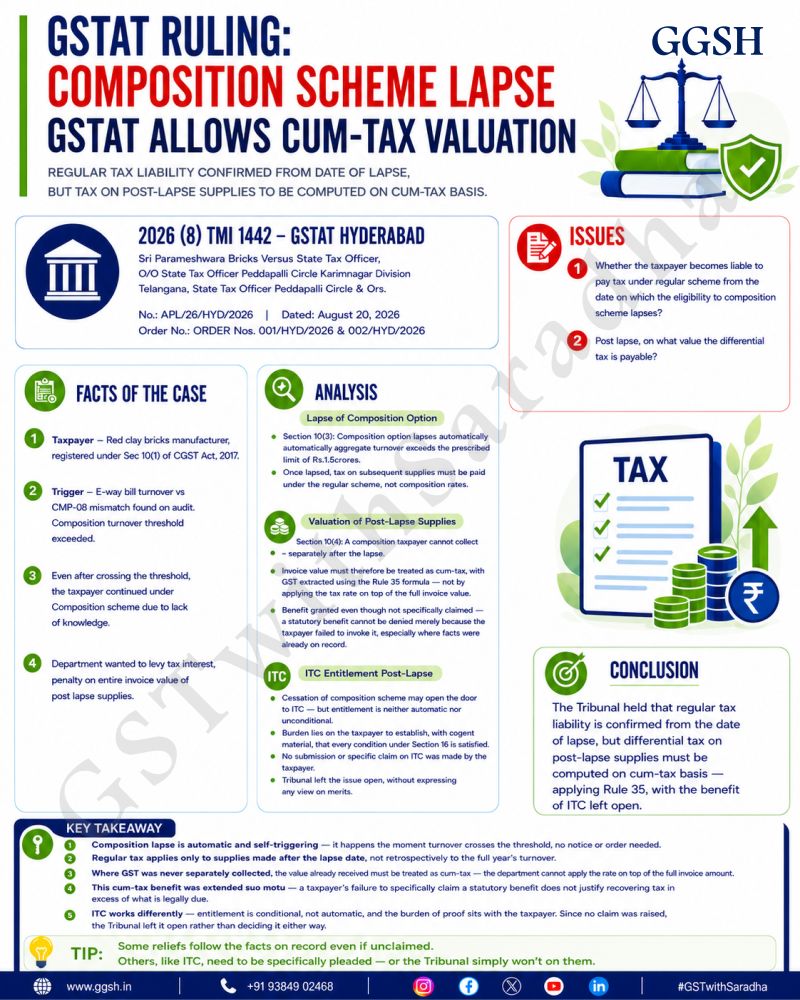
For businesses registered under the Composition Scheme, crossing the prescribed turnover threshold can significantly change the applicable GST treatment. Once the threshold is breached, the benefit of the Composition Scheme ceases and subsequent supplies become taxable under the regular GST framework.
But an important practical question arises:
If supplies have already been made after crossing the threshold, without separately collecting GST from customers, should GST be calculated by applying the tax rate over and above the invoice value?
The GSTAT Hyderabad recently examined this issue in Sri Parameshwara Bricks v. State Tax Officer & Ors.
The Issue
The appellant was operating under the Composition Scheme. After crossing the prescribed turnover threshold, the composition benefit ceased to apply and the subsequent supplies became liable to GST under the regular scheme.
However, the taxpayer had already received the invoice amounts from customers without separately collecting GST.
The question before the Tribunal was therefore not merely whether GST was payable, but how the GST liability had to be computed.
Cum-Tax Treatment of the Invoice Value
Under Section 10(4), a person paying tax under the Composition Scheme cannot collect tax from the recipient of supplies.
Considering this restriction and the fact that the amounts had already been received from customers without separately collecting GST, the GSTAT Hyderabad held that the invoice value had to be treated as cum-tax value.
Accordingly, GST was required to be determined by applying the prescribed Rule 35 cum-tax formula, rather than simply calculating GST on top of the entire invoice value.
This distinction is significant.
A tax demand cannot be mechanically increased by treating the amount already received from the customer as an amount exclusive of GST when, in substance, no separate GST had been collected.
Can a Statutory Benefit Be Granted Even If the Taxpayer Did Not Specifically Claim It?
Interestingly, the Tribunal extended the benefit of the cum-tax methodology even though the appellant had not specifically claimed it.
The reasoning was that a taxpayer’s failure to specifically request a statutory benefit cannot justify recovery of an amount higher than the tax legally payable.
In other words, the assessment must ultimately determine the correct statutory liability—not create an excess demand merely because the taxpayer failed to raise a particular argument.
What About Input Tax Credit?
The position regarding ITC was treated differently.
The Tribunal acknowledged that once the Composition Scheme ceases to apply, a taxpayer may potentially become eligible for Input Tax Credit under the regular scheme.
However, such entitlement is not automatic.
The taxpayer must satisfy the applicable conditions under Section 16 and establish its eligibility through proper evidence and compliance.
In this case, the appellants had not made any specific submission or claim seeking ITC.
Consequently, the Tribunal declined to examine the ITC issue and left the question of entitlement open, without expressing any opinion on the merits.
This distinction is particularly important:
Cum-tax relief was considered because the relevant facts were already available before the Tribunal. ITC, however, was not examined because it had neither been specifically claimed nor properly established.
The Key Takeaway
Crossing the turnover threshold changes the taxpayer’s GST treatment, but it does not mean that the tax liability can be calculated without following the prescribed statutory methodology.
At the same time, statutory benefits do not operate identically in every situation.
The case demonstrates two important principles:
1. Tax must be computed according to law.
Where the facts establish that the consideration received was inclusive of tax, the prescribed cum-tax mechanism must be considered.
2. Benefits such as ITC must be specifically claimed and established.
A potential entitlement does not automatically translate into an allowable credit. The taxpayer must satisfy the statutory conditions and discharge the necessary burden of proof.
Ultimately, the case serves as a practical reminder for businesses:
What you don’t claim, establish and argue before the authority may not be examined on your behalf.
Proper documentation, timely compliance and clearly raising every available statutory claim remain essential when a business transitions from the Composition Scheme to the regular GST regime.
Case Citation
Sri Parameshwara Bricks v. State Tax Officer & Ors.
APL/26/HYD/2026
Date: 20 August 2026
2026 (8) TMI 1442 – GSTAT Hyderabad