

Corporate compliance delays are more common than many companies publicly acknowledge.
Over time, missed ROC filings, accumulating additional fees, and unresolved compliance obligations can create a significant regulatory burden.
Recognizing this challenge, the Ministry of Corporate Affairs (MCA) has introduced the Companies Compliance Facilitation Scheme 2026 (CCFS-2026).
This scheme provides companies with a limited-period opportunity to regularize long-pending filings relating to Annual Returns and Financial Statements under the Companies Act 2013.
For many organizations, CCFS-2026 represents not just a fee reduction initiative, but a strategic opportunity to reset their compliance position with the Registrar of Companies (ROC).
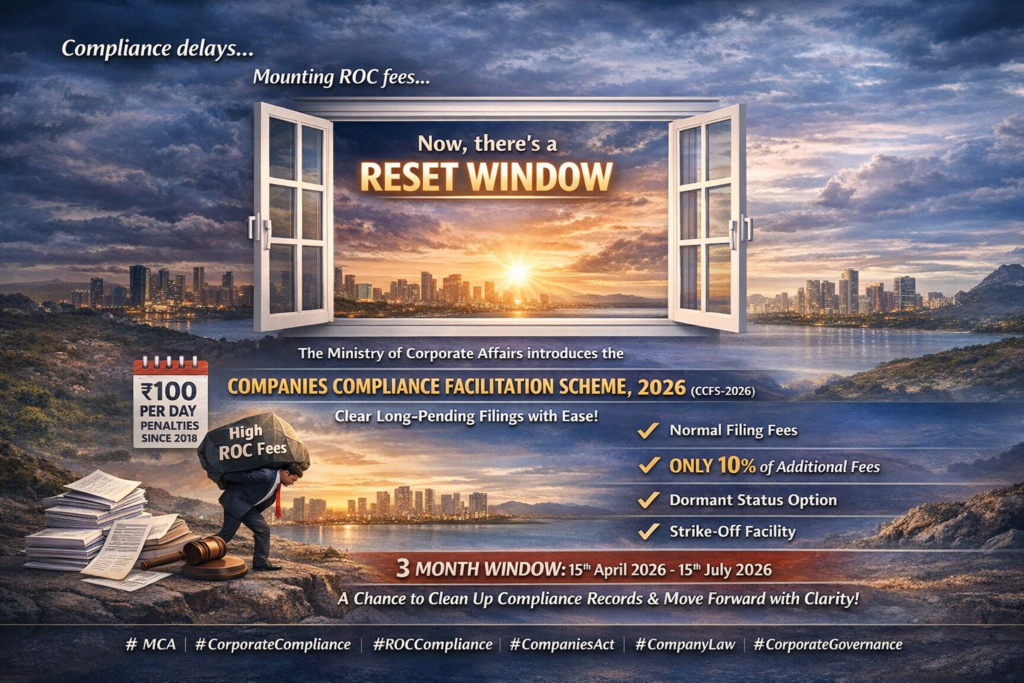
Why ROC Filing Delays Become Expensive
Since July 2018, delayed ROC filings have attracted ₹100 per day in additional fees without any upper cap.
This means that companies with multiple years of pending filings may face extremely high compliance costs.
Typical filings affected include:
- Annual Return (Form MGT-7 / MGT-7A)
- Financial Statements (Form AOC-4)
- Other statutory filings required under the Companies Act
For companies that have missed filings for several financial years, the additional fee component alone can become financially burdensome.
What CCFS-2026 Changes
The Companies Compliance Facilitation Scheme 2026 significantly reduces the cost of clearing pending filings.
Under this scheme:
- Companies pay normal filing fees
- Only 10% of the additional fees otherwise payable
- The remaining additional fees are effectively waived
This structure makes it far easier for companies to clear historical compliance defaults without facing the full financial impact of accumulated penalties.
Scheme Timeline
The CCFS-2026 scheme will be available for a limited period of three months.
📅 Start Date: 15 April 2026
📅 End Date: 15 July 2026
During this window, eligible companies can file pending statutory documents with reduced additional fees.
Because the scheme is time-bound, companies should evaluate their ROC filing backlog well in advance of the closing date.
Filings Covered Under the Scheme
The scheme primarily focuses on delayed filings relating to:
Annual Returns
Filed using Form MGT-7 or MGT-7A, these filings provide a summary of a company’s:
- Shareholding structure
- Directors and key managerial personnel
- Corporate governance details
Financial Statements
Filed through Form AOC-4, these include:
- Balance sheet
- Profit and loss account
- Auditor’s report
- Board report
Ensuring these filings are up-to-date is critical for maintaining a clean corporate compliance record.
Additional Options Under CCFS-2026
Apart from facilitating delayed filings, the scheme also provides compliance pathways for companies that are no longer operational.
Dormant Company Status
Companies that intend to retain their corporate structure but temporarily suspend operations can apply for Dormant Company status under the Companies Act.
This allows entities to maintain existence while reducing ongoing compliance requirements.
Strike-Off of Inactive Companies
Companies that are no longer conducting business operations may choose to apply for strike-off from the Register of Companies.
This option allows promoters to formally close inactive entities and avoid future compliance obligations.
Potential Relief from Penalty Proceedings
Another important benefit of the scheme is that companies completing their filings within the prescribed timelines may be able to avoid certain penalty proceedings related to delayed filings.
This provides an opportunity to:
- Resolve historical compliance defaults
- Reduce regulatory risk
- Strengthen corporate governance records
Why Companies Should Evaluate the Scheme Early
For many businesses, compliance delays accumulate gradually over time.
However, unresolved ROC filings can create complications such as:
- Director disqualification risks
- Difficulty in raising investment or bank funding
- Issues during due diligence or corporate restructuring
- Increased regulatory scrutiny
By using the CCFS-2026 window, companies can clean up their compliance records and restore regulatory clarity.
Final Thoughts
The Companies Compliance Facilitation Scheme 2026 provides a rare opportunity for companies to reset their ROC compliance status at significantly reduced cost.
Rather than allowing penalties to continue accumulating, businesses can use this three-month window to clear pending filings, regularize statutory records, and move forward with a stronger compliance foundation.
For many organisations, CCFS-2026 is not just a financial relief mechanism.It is a practical chance to rebuild corporate compliance credibility and eliminate long-standing regulatory exposure.