

The Union Budget 2026 does not attempt a dramatic overhaul of India’s tax and compliance ecosystem.
Instead, it continues a clear policy direction that has been developing over the last few years — a gradual shift toward simplified taxation, trust-based compliance, and predictable regulatory frameworks.
For businesses, finance professionals, and tax practitioners, this Budget signals something important: policy stability with structural refinement.
Rather than disruptive reforms, Union Budget 2026 focuses on reducing friction in compliance while maintaining accountability in tax administration.
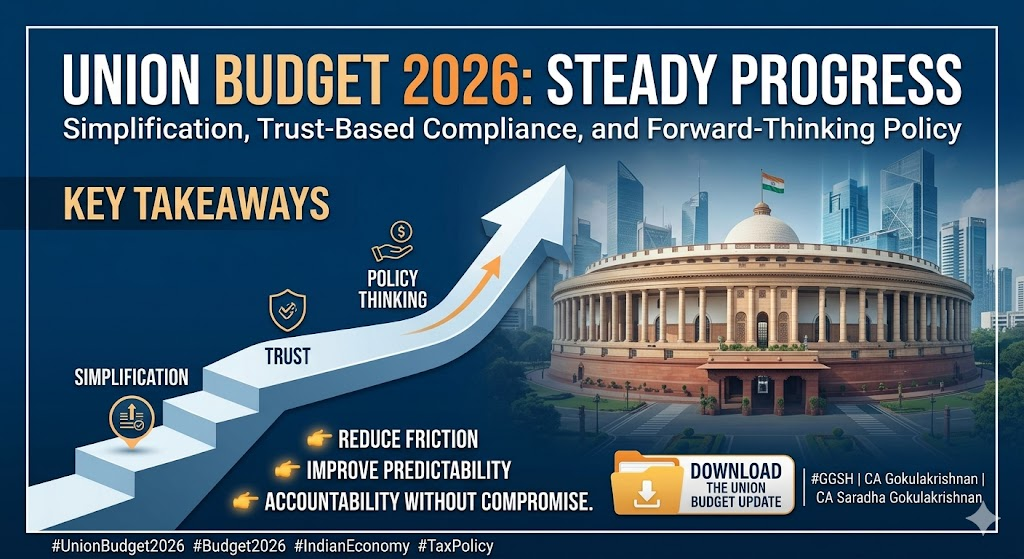
The Core Policy Direction Behind Union Budget 2026
Across direct taxes, GST, customs, and export policies, the government’s approach appears consistent and strategic.
The Budget framework is built around three central objectives:
- Reduce compliance friction for businesses and taxpayers
- Improve predictability in tax administration
- Strengthen accountability without increasing regulatory burden
This reflects the government’s broader move toward a modern tax ecosystem where transparency, digital monitoring, and simplified processes coexist.
For businesses operating in India’s evolving regulatory environment, this means greater clarity in compliance expectations and fewer interpretational disputes.
TDS and TCS Rationalisation: Simplifying the Direct Tax Landscape
One of the significant focus areas in Union Budget 2026 is the rationalisation of TDS (Tax Deducted at Source) and TCS (Tax Collected at Source) provisions.
These changes aim to address a long-standing concern among businesses and professionals — the complexity of multiple rates, thresholds, and overlapping provisions.
Key objectives behind TDS/TCS reforms
- Reduce administrative burden for taxpayers
- Improve ease of compliance for businesses
- Minimise disputes related to interpretation
- Streamline tax collection mechanisms
For finance teams, accountants, and tax consultants, these rationalisation measures could significantly improve year-end tax planning and compliance efficiency.
Litigation Relief Measures: Reducing the Compliance Backlog
Another notable policy direction in the Budget is reducing tax litigation pressure.
Over the years, India’s tax ecosystem has faced challenges related to pending disputes and prolonged litigation cycles. The Budget’s approach appears to prioritise:
- Faster dispute resolution mechanisms
- Reduction of unnecessary litigation
- Encouraging voluntary compliance
For businesses, this shift signals a move toward a more collaborative tax administration environment rather than a purely enforcement-driven approach.
GST Policy Adjustments: Incremental but Impactful
The Goods and Services Tax framework continues to evolve through measured policy adjustments rather than sweeping changes.
In Union Budget 2026, the focus appears to be on:
- Improving GST compliance frameworks
- Reducing procedural complexities
- Enhancing clarity in tax administration
For small businesses, startups, and growing enterprises, this incremental refinement could result in more predictable GST compliance processes and fewer operational uncertainties.
Customs and Export Framework: Strengthening Global Trade
The Budget also introduces targeted improvements in customs duty structures and export-oriented policies.
These measures aim to support:
- Domestic manufacturing growth
- Export competitiveness
- Integration of Indian businesses into global supply chains
By rationalising customs frameworks and improving export policies, the government is signalling its continued commitment to making India a stronger participant in global trade.
What Union Budget 2026 Means for Businesses and Finance Professionals
For business owners, CFOs, tax professionals, and compliance teams, the real takeaway from Union Budget 2026 is not about headline announcements.
It is about preparing early and responding strategically.
Businesses should consider:
1. Reviewing tax compliance frameworks
Evaluate whether internal processes align with new simplification initiatives and policy adjustments.
2. Strengthening year-end tax planning
With TDS/TCS rationalisation and litigation relief measures, organisations may need to update their tax risk management strategies.
3. Improving compliance automation
The direction toward predictable and digital compliance systems suggests that businesses should continue investing in technology-driven tax management solutions.
The Bigger Policy Signal
The Union Budget 2026 reinforces a broader shift in India’s tax policy architecture.
Rather than chasing short-term disruption, the government appears focused on building:
- A predictable tax environment
- A simplified compliance structure
- A trust-based regulatory relationship between taxpayers and authorities
For professionals working in taxation, finance, accounting, and compliance, this means less uncertainty and more emphasis on proactive compliance strategy.
Final Thoughts
The Union Budget 2026 may not introduce dramatic policy shifts, but its significance lies in continuity and structural refinement.
By prioritising simplification, predictability, and accountability, the government continues to move India toward a more stable and business-friendly tax ecosystem.For businesses and professionals alike, the key is not just understanding what changed — but interpreting what these policy signals mean for future compliance strategy and operational planning.