

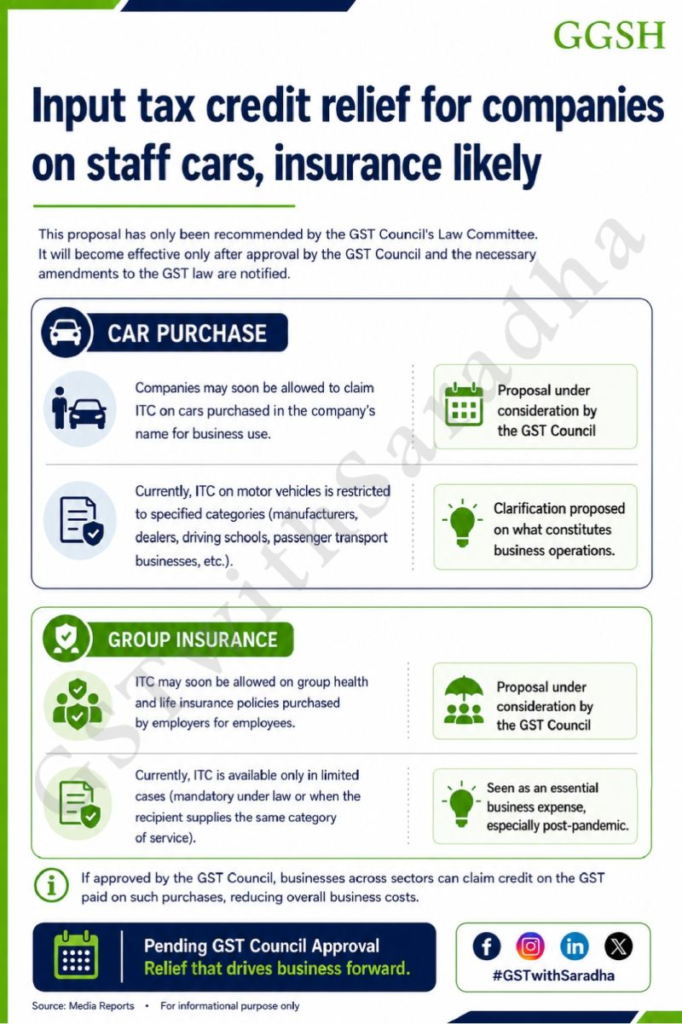
A company purchases a vehicle for business purposes.
It also takes a group health insurance policy for its employees.
From a commercial perspective, both may be genuine business expenses incurred as part of operating the organisation and supporting its workforce.
But under the present GST framework, Input Tax Credit on such expenses is subject to specific restrictions and conditions.
Could this position change?
A Reported Proposal Under Consideration
The GST Law Committee has reportedly recommended allowing Input Tax Credit in respect of certain staff vehicles purchased by companies and group health and life insurance policies taken for employees, subject to the approval of the GST Council and the necessary legal changes.
If implemented, the proposal could have a meaningful impact on businesses.
For companies that incur significant expenditure on employee welfare, transportation and related operational requirements, the availability of ITC could potentially reduce the overall GST cost associated with these expenses.
More importantly, it could bring greater clarity to an issue that businesses have had to navigate carefully under the existing framework.
Why Is This Significant?
GST was designed around the principle of taxing value addition while allowing eligible businesses to claim credit for taxes paid on inputs and input services.
However, the law also contains specific restrictions on certain categories of expenditure.
This creates an important distinction:
An expense can be commercially necessary for a business, while the GST law may still restrict the corresponding ITC.
Employee-related expenditure is a good example.
A company may provide health insurance, life insurance or transportation facilities as part of its employee-welfare and operational policies. Yet, the availability of ITC depends not merely on whether the expenditure is incurred for business purposes, but also on the specific provisions governing such credits.
A change in the law could therefore have implications beyond just the individual expense.
Potential Impact on Businesses
If the proposal is eventually approved and implemented, businesses may see benefits in areas such as:
Employee Welfare
Group health and life insurance policies are increasingly becoming an important component of employee compensation and retention strategies.
Operational Mobility
Vehicles used for business and employee-related transportation can represent a significant expenditure for certain organisations.
Tax Cost
Availability of eligible ITC could reduce the embedded GST cost associated with these expenditures.
Greater Certainty
Clearer provisions could reduce ambiguity around the treatment of commonly incurred business expenses.
However, the actual benefit would depend on the final wording of the amendments and the conditions prescribed.
But There Is an Important Caveat
This development should be viewed carefully.
The reported recommendation is only a proposal at this stage.
A recommendation of the Law Committee does not, by itself, alter the GST law.
The proposal would need to be considered and approved through the appropriate process, followed by the necessary statutory amendments, rules, notifications or other legal measures, as applicable.
Until that happens, businesses must continue to follow the existing GST provisions governing ITC.
Therefore, companies should not begin claiming additional ITC merely on the basis of the reported proposal.
What Should Businesses Do Now?
Businesses that incur significant expenditure on employee insurance, vehicles or similar categories should continue to:
- Review the existing ITC provisions applicable to each expense.
- Maintain proper invoices and supporting documentation.
- Ensure that employee-related expenses are appropriately documented.
- Monitor developments from the GST Council and the Government.
- Reassess their ITC position if and when the proposed changes are formally notified.
The key is to distinguish between what may be proposed and what is legally applicable today.
A Potential Shift in GST’s Business-Friendliness
If implemented, the proposed changes could signal a broader attempt to align GST treatment with the practical realities of modern businesses.
Employee welfare is no longer viewed simply as an incidental cost. For many organisations, insurance, transportation and other employee-related benefits form an integral part of their operating model.
Allowing eligible ITC, subject to appropriate safeguards, could therefore reduce tax costs while providing businesses with greater certainty.
But until the GST Council takes a final decision, the proposal remains just that — a proposal.
For now, businesses should continue to follow the existing law and closely track the developments.
The real impact will be known only when the proposal moves from recommendation to law.
