

“I have paid my supplier. I have paid the GST. Why should my Input Tax Credit depend on what happens after that?”
This question goes to the heart of one of the most debated issues under the GST regime: the extent to which a genuine purchaser should be affected by the supplier’s subsequent non-compliance.
For a business that has purchased goods or services in the ordinary course, paid the supplier along with GST, maintained proper documentation and complied with the applicable conditions, the possibility of losing Input Tax Credit because of a supplier’s default can create significant commercial and compliance concerns.
At the same time, the Government has a legitimate responsibility to protect revenue and prevent fraudulent or wrongful ITC claims.
The challenge, therefore, has always been about finding the right balance between revenue protection and taxpayer certainty.
The Supplier–Recipient Dilemma
Under GST, Input Tax Credit is not merely an accounting entry. It is an important component of the tax chain.
A genuine purchaser may:
- Receive the goods or services;
- Obtain a valid tax invoice;
- Pay the supplier, including GST;
- Make the payment through identifiable channels;
- Record the transaction in its books; and
- Comply with the applicable GST requirements.
Yet, the supplier may subsequently fail to discharge the corresponding tax liability correctly.
This creates a difficult question:
Should the recipient automatically lose the benefit of ITC because of a default committed by the supplier?
The answer has significant implications for businesses, particularly where the recipient has limited practical control over the supplier’s subsequent tax compliance.
The Need for a Balanced Approach
The Government’s concern is understandable.
A system that allows ITC without adequate safeguards could potentially be misused through:
- Fake invoices
- Bogus transactions
- Non-existent suppliers
- Circular trading
- Fraudulent ITC claims
Therefore, safeguards are necessary.
However, there is also a distinction between a fraudulent or collusive transaction and a genuine commercial transaction where the recipient has acted with due diligence.
This distinction becomes particularly important when determining how liability should be enforced.
A Reported Proposal That Could Change the Approach
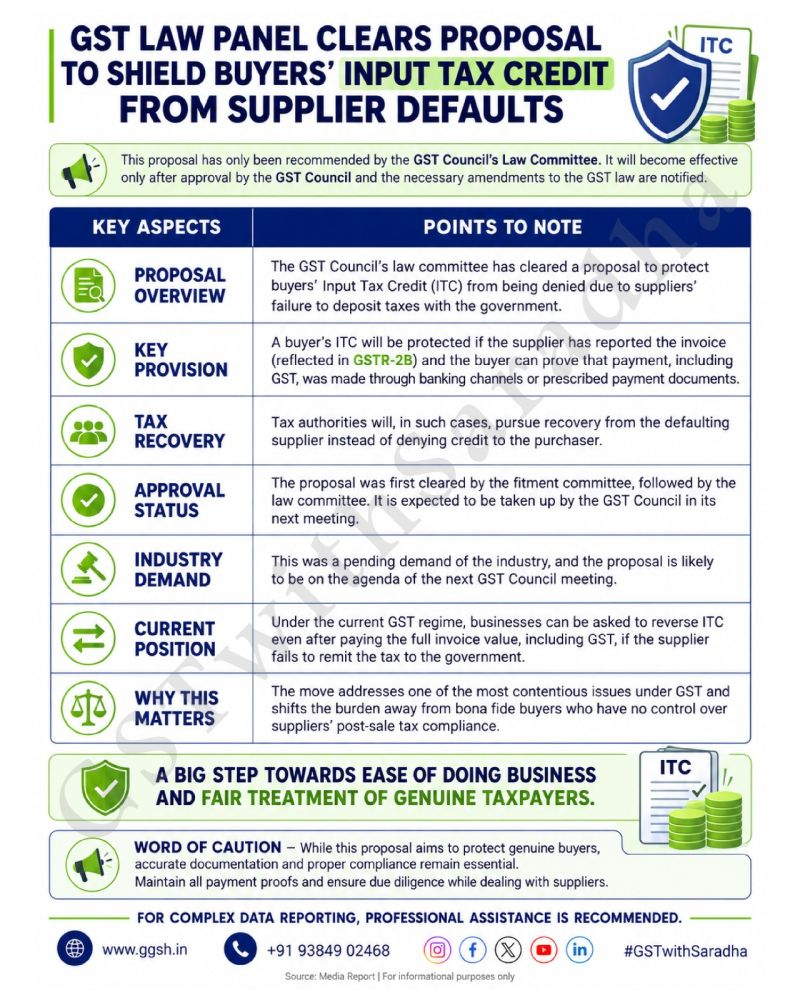
A reported recommendation of the GST Council’s Law Committee seeks to address this concern by proposing protection for a buyer’s ITC where prescribed conditions are satisfied, while allowing the tax authorities to pursue recovery from the defaulting supplier.
If ultimately approved and implemented through the necessary legal amendments, such an approach could represent an important shift in how supplier-side defaults are dealt with.
The underlying principle is relatively simple:
Where the default occurs, enforcement should, as far as possible, follow the default.
For a genuine purchaser who has fulfilled the prescribed conditions and acted in good faith, this could provide greater certainty in claiming ITC.
But Buyer-Side Due Diligence Still Matters
Such a proposal should not be interpreted as eliminating the recipient’s responsibility.
Businesses should continue to exercise reasonable commercial and tax diligence while selecting and dealing with vendors.
Important controls may include:
Vendor due diligence
Assessing the credibility and GST registration status of suppliers.
Banking-channel payments
Maintaining clear and traceable payment records.
Proper documentation
Preserving invoices, purchase records, delivery documents and other supporting evidence.
Reconciliation
Regularly reconciling purchase records, books and GST data.
Compliance monitoring
Identifying unusual vendor behaviour or inconsistencies at an early stage.
These measures are not merely defensive steps. They form part of a robust GST compliance framework.
A Word of Caution
There is an important distinction between a proposal and the law currently in force.
The reported recommendation of the Law Committee does not, by itself, change the existing legal position.
The proposal would need to go through the appropriate approval process, including consideration by the GST Council and any necessary statutory or regulatory amendments and notifications.
Therefore, taxpayers should not assume that the proposed approach is already applicable.
The existing legal framework continues to govern ITC eligibility until any change is formally approved and notified.
Moving Towards Greater Certainty
GST has evolved considerably since its introduction.
As the system matures, the focus is increasingly not only on preventing revenue leakage but also on creating a framework that provides certainty, fairness and predictability for compliant taxpayers.
The debate surrounding supplier defaults and recipient ITC reflects exactly this challenge.
The objective should be neither to compromise revenue protection nor to place an unreasonable burden on genuine taxpayers.
Instead, the focus should be on creating a system where:
Fraud is effectively addressed.
Defaulting suppliers are held accountable.
Genuine purchasers receive appropriate protection.
And compliant businesses can operate with greater certainty.
The reported proposal, if eventually approved and implemented, could be another step in that direction.
For now, however, the industry will have to wait for the GST Council’s decision and the corresponding legal changes before drawing conclusions on its practical impact.
In GST, certainty is not merely about knowing what tax to pay.
It is also about knowing when a compliant taxpayer can confidently claim the credit to which it is entitled.
