

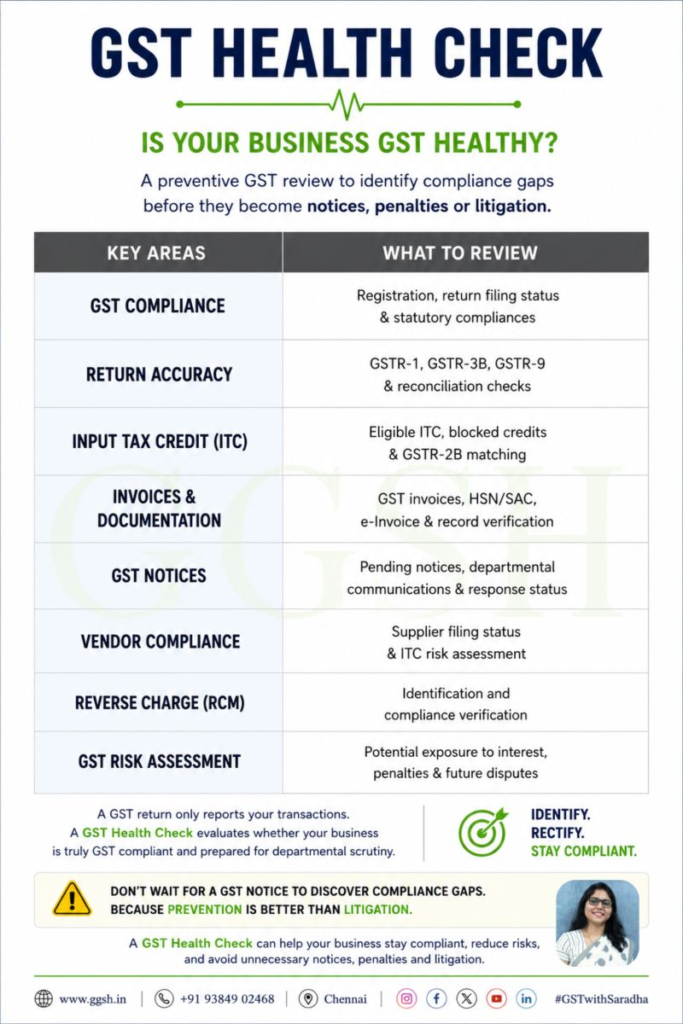
For many businesses, GST compliance is often measured by a simple checklist:
Returns filed.
Taxes paid.
Books maintained.
Reconciliations completed.
But is that enough to say that a business is truly GST compliant?
Not always.
GST compliance goes beyond meeting filing deadlines. It also involves ensuring that the transactions reported, Input Tax Credit claimed, classifications adopted, and supporting documents maintained can withstand scrutiny when examined by the authorities.
Where Do GST Risks Usually Begin?
In many cases, GST disputes do not arise because a business completely failed to comply with its filing obligations.
They arise from small gaps that remain unnoticed.
For example:
- A reconciliation that was not completed properly
- Input Tax Credit claimed without sufficient eligibility checks
- Vendor compliance issues affecting the recipient
- Incorrect HSN or tax classification
- Differences between books and GST returns
- Documentation gaps supporting a transaction
- A transaction interpreted differently by the taxpayer and the department
Individually, these may appear to be minor issues.
However, during scrutiny, audit, investigation or assessment, even a small compliance gap can become the starting point for a larger tax dispute.
Compliance Should Be Preventive, Not Reactive
One of the biggest mistakes businesses can make is reviewing their GST compliance only after receiving a notice.
By that stage, the focus often shifts from prevention to defence.
A GST Health Check takes a different approach.
Instead of waiting for a notice, businesses can periodically review their GST position to identify potential areas of exposure before they become disputes.
This may include reviewing:
ITC eligibility.
Return and book reconciliations.
Vendor-related risks.
HSN and tax classification.
Documentation and transaction trails.
Potential compliance inconsistencies.
The objective is not simply to find mistakes.
The objective is to understand where the business may be exposed and what can be corrected proactively.
Why a Timely GST Health Check Matters
A business may be growing rapidly, transactions may be increasing, and GST returns may continue to be filed regularly.
Yet, compliance risks can quietly accumulate in the background.
A timely review can help identify those risks before they result in:
- GST notices
- Interest exposure
- Penalties
- ITC disputes
- Prolonged departmental proceedings
- Litigation
In taxation, prevention can often be far more valuable than correction after a dispute has already begun.
As the saying goes:
“An ounce of prevention is worth a pound of cure.”
The same principle can apply to GST compliance.
The Real Question Is Not “Did We File?”
The better question is:
“If our GST compliance is examined tomorrow, are we confident that our transactions, ITC claims, classifications and supporting records can stand scrutiny?”
That is where a GST Health Check can add value.
Because in taxation, the best dispute is often the one that never begins.
If you would like to understand how a GST Health Check can help identify potential compliance risks in your business, feel free to connect with us.
